Long COVID: The Post-Infectious Syndrome That Persists
Long COVID (also called post-COVID condition or PASC — Post-Acute Sequelae of SARS-CoV-2) is defined as the persistence of symptoms beyond 12 weeks after acute SARS-CoV-2 infection, with no alternative explanation. The WHO estimates that 10–20 % of those infected develop long COVID — representing millions of affected individuals worldwide.
Among the most prevalent symptoms of long COVID, diffuse musculoskeletal pain and chronic muscle fatigue rank among the five most frequently reported. Persistent myalgia is reported in a relevant share of long COVID patients, with estimates varying across studies, and a significant proportion develop generalized myofascial trigger points — a picture that overlaps with myofascial pain syndrome and, in some cases, with post-viral fibromyalgia.
From Systemic Inflammation to Diffuse Myofascial Sensitization
Long COVID produces diffuse musculoskeletal pain through multiple interrelated processes. SARS-CoV-2 infection triggers an inflammatory storm that, in many patients, does not fully resolve after the acute phase — persisting at subclinical levels that sensitize the entire nociceptive system.
From viral infection to chronic myofascial pain
Acute infection and cytokine storm
SARS-CoV-2 infection triggers massive release of pro-inflammatory cytokines (IL-6, TNF-alpha, IL-1beta) that affect multiple tissues, including skeletal muscle and the nervous system.
Persistent low-grade inflammation
In long COVID patients, elevated inflammatory cytokines persist for months. This chronic low-grade inflammation sensitizes muscle nociceptors throughout the body.
Muscular mitochondrial dysfunction
SARS-CoV-2 can cause direct mitochondrial damage in muscle cells, impairing ATP production. Fatigued muscle is more susceptible to trigger point formation.
Diffuse central sensitization
Persistent nociceptive input from multiple trigger points, combined with CNS neuroinflammation (microglial activation), produces generalized central sensitization — amplifying the entire pain experience.
Autonomic dysregulation
Post-COVID dysautonomia (POTS, orthostatic hypotension) impairs vascular regulation in muscle, worsening local ischemia and perpetuating trigger points.
Three neurobiological levels of medical acupuncture: from muscle to central modulation
Mechanical stimulation of myelinated peripheral afferents engages local tissue perfusion, spinal dorsal horn gating, and descending brainstem analgesia across sessions.
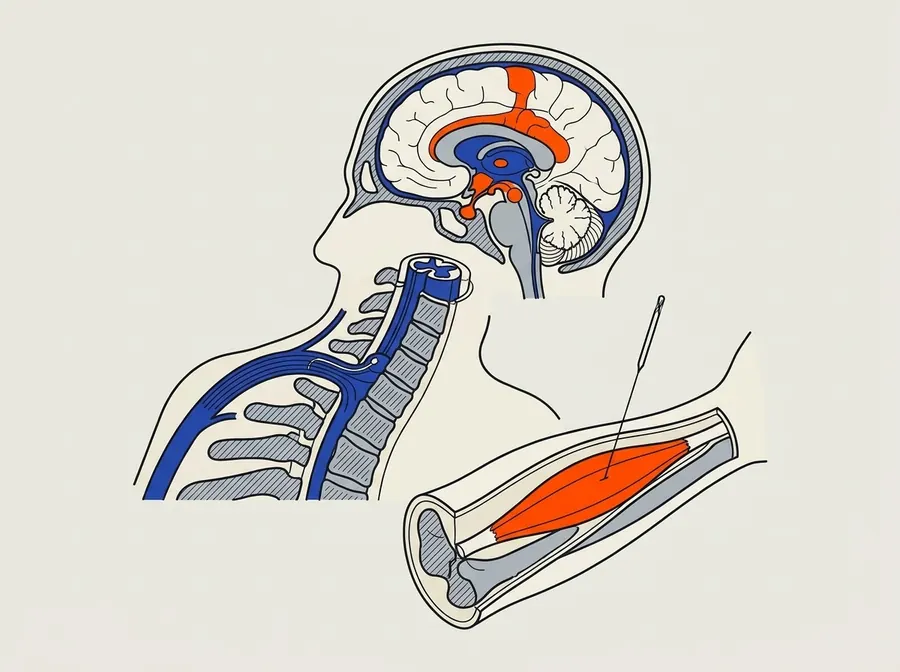
1. Local & myofascial coupling
Recruits Aβ/Aδ mechanoreceptors, releases local adenosine, and restores micro-perfusion in taut muscle bands.
2. Spinal dorsal horn gating
Segmental inhibitory interneurons dampen ascending nociceptive signaling and calm viscerosomatic reflexes.
3. Descending central control
Engages periaqueductal gray and brainstem relays, recruiting endogenous opioids and monoamines.
Clinical Presentation: Overlap with Myofascial Pain Syndrome and Fibromyalgia
Musculoskeletal pain in long COVID shares features with two well-characterized conditions: myofascial pain syndrome (localized trigger points with referred pain) and fibromyalgia (diffuse central sensitization with generalized pain). Many post-COVID patients present a hybrid picture.
Overlap: long COVID, myofascial pain, and fibromyalgia
| Characteristic | Post-COVID myofascial pain | Post-COVID fibromyalgia | Mixed presentation (most common) |
|---|---|---|---|
| Pain distribution | Regional (cervical, lumbar, shoulders) | Diffuse and generalized | Diffuse with more intense focal points |
| Palpable trigger points | Present and well defined | May be present | Multiple and in various regions |
| Muscle fatigue | Localized | Generalized and deep | Generalized with regional worsening |
| Brain fog | Absent or mild | Frequent | Frequent |
| Response to needling | Excellent (local twitch) | Variable | Good to excellent at focal points |
| Central sensitization | Segmental | Diffuse | Diffuse with segmental foci |
Medical Acupuncture in Long COVID: Multiple Therapeutic Targets
Medical acupuncture can act on multiple targets at once — myofascial pain, inflammation, autonomic dysregulation, and central sensitization — each corresponding to a pathophysiological component of the condition. Proposed mechanisms include:
Deactivation of diffuse trigger points
Systematic needling of myofascial trigger points across sequential sessions — prioritizing the most painful regions — progressively reduces total nociceptive load and breaks the central sensitization cycle.
Anti-inflammatory effect
In experimental models, acupuncture may activate the cholinergic anti-inflammatory pathway via the vagus nerve, lowering pro-inflammatory cytokines (IL6, TNF-alpha). This effect has not been confirmed in long COVID.
Modulation of central neuroinflammation
Electroacupuncture modulates microglial activation in the central nervous system — one of the proposed mechanisms underlying brain fog and central sensitization in long COVID.
Autonomic regulation
Acupuncture normalizes sympathovagal balance, with potential benefit for post-COVID dysautonomia (postural tachycardia, orthostatic intolerance, altered heart rate variability).
Scientific Evidence: What We Know Só Far
Transparency about the evidence matters here: research on acupuncture specifically for long COVID is still in its early stages. Pilot studies, case series, and a handful of small clinical trials exist — but no completed meta-analyses or systematic reviews have been published.
The indirect evidence base, however, is substantial: acupuncture has reasonable evidence for each individual component of long COVID pain — chronic myofascial pain, chronic fatigue (moderate evidence), fibromyalgia, headache, and dysautonomia (emerging evidence). Whether those findings translate directly to long COVID still needs confirmation in dedicated trials.
Treatment Protocol for Long COVID
Gradual approach for long COVID
Stabilization and titration
Short sessions (20-25 min) with minimal stimulation. Focus on the most painful trigger points (2-3 regions per session). Careful monitoring for post-session PEM. Auricular acupuncture for vagal modulation and anxiety.
Progressive deactivation and neuromodulation
Gradually increase the number of points and session duration as tolerance allows. Low-frequency electroacupuncture for endorphin release and anti-inflammatory modulation. Systematic approach to every region harboring trigger points.
Consolidation and integration
Integrate with a graded exercise program (pacing — respecting the PEM threshold). Acupuncture focused on residual regions. Manage dysautonomia when present.
Maintenance and monitoring
Maintenance sessions with periodic reassessment. Adjust the protocol as symptoms evolve. Multidisciplinary follow-up coordinated by the physician.
- Medical acupuncture can act on multiple targets at once: myofascial pain, inflammation, autonomic dysregulation, and central sensitization.
- Research on acupuncture specifically for long COVID is still in its early stages.
- Acupuncture has reasonable evidence for each individual component of long COVID pain, but whether those findings translate directly to long COVID still needs confirmation in dedicated trials.
Myths and Facts
Myth vs. Fact
Long COVID is a psychological problem — the pain is not real
Long COVID has documented pathophysiological substrates: persistent inflammation, mitochondrial dysfunction, neuroinflammation, microclots, and autonomic dysregulation. Myofascial trigger points are palpable, reproducible, and treatable — they are not imaginary.
If the acute infection was mild, there's no risk of long COVID with chronic pain
Available data indicate that up to 10–15 % of patients with mild infection develop long COVID. Acute-phase severity does not necessarily predict the severity of chronic symptoms — patients with mild infection can still develop significant diffuse myofascial pain.
Nothing can be done for long COVID pain
No single curative treatment exists, but a multimodal approach — acupuncture for myofascial pain, graded exercise, sleep management, and medical follow-up — may improve outcomes for some patients, although the evidence is still preliminary. Doing nothing is not an acceptable option.
When to Seek Medical Evaluation
Evaluation should be performed by a physician with experience in chronic pain or a medical acupuncturist, who will systematically palpate the muscles to identify trigger points and define the most appropriate treatment plan.
Important: in long COVID, acupuncture acts as a complementary approach — it does not replace follow-up by the multidisciplinary post-COVID rehabilitation team, nor the treatment of any cardiac, pulmonary, or neurologic complications that may be present. The decision to incorporate acupuncture should be coordinated with the physician responsible for the case.
Do
- Seek evaluation by a physician with experience in chronic pain or a medical acupuncturist
- Coordinate the decision to incorporate acupuncture with the physician responsible for the case
- Start with minimal stimulation, titrated gradually, to avoid triggering PEM
Avoid
- Use acupuncture in place of follow-up by the multidisciplinary post-COVID rehabilitation team
- Use acupuncture in place of treatment of any cardiac, pulmonary, or neurologic complications that may be present
- Adjust any concurrent medication on your own, since that remains at the discretion of the attending physician
Frequently Asked Questions
Frequently Asked Questions
No single curative treatment for long COVID exists. Medical acupuncture addresses the myofascial component and modulates inflammation and central sensitization — which may help relieve pain, fatigue, and headache in some patients, although direct evidence in long COVID is still preliminary. It's one part of a multimodal approach coordinated by the physician.
With an appropriate graded protocol — minimal initial stimulation, progressive titration — the risk of flare-up is low. The main concern is respecting post-exertional malaise (PEM): early sessions should be short and use few points. The physician monitors individual response throughout.
Yes. Acupuncture does not interfere with pulmonary rehabilitation and may be a useful complement — modulating the musculoskeletal pain that often limits a patient's ability to perform respiratory and functional exercises.
Response varies. Patients with a predominantly myofascial picture — well-defined trigger points — tend to respond within 4–8 sessions. Those with diffuse central sensitization may need 10–16 sessions for meaningful improvement. Treatment is individualized and continuously monitored.
Preliminary studies suggest benefit for post-viral chronic fatigue — with stronger evidence for fatigue than for brain fog specifically. Acupuncture's modulation of vagal tone and neuroinflammation has therapeutic potential for both symptoms, but direct evidence in long COVID is still being established.