Skip to content
Skip to content

BL-12 Fengmen (風門) — Wind Gate

BL-12
Fengmen
風門
Wind Gate
BL-12 Fengmen — Wind Gate
Encontro Bexiga-Du MaiCruzamento com Du MaiDangerTórax
Depth
00.5 cun3.0
Transverse insertion
Precautions
High risk of pneumothorax. Caution: pneumothorax.
Location (classical)
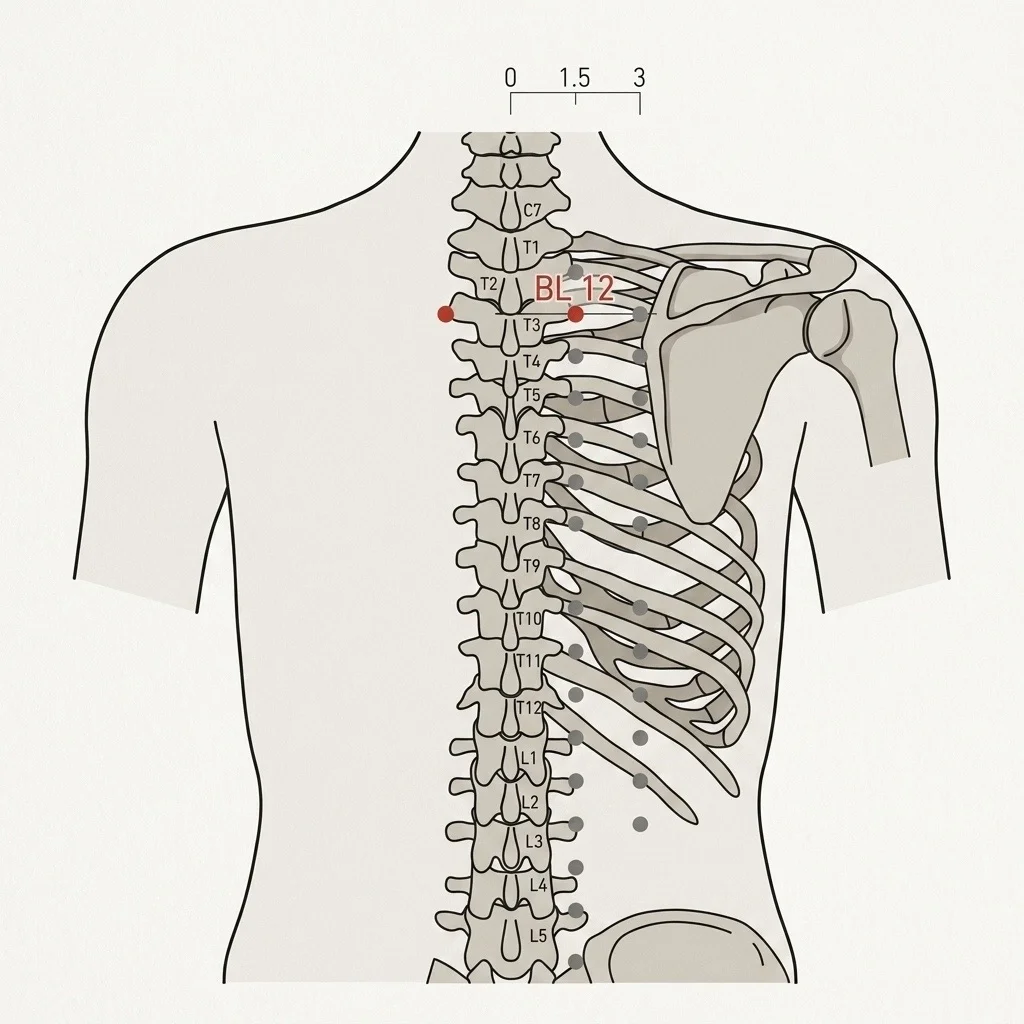
1.5 cun lateral to the inferior border of the spinous process of the second thoracic vertebra (T2), at the highest point of the paravertebral musculature.
How to find it (practical)
Seated with the neck flexed, locate the point below the spinous process of the second thoracic vertebra, 1.5 cun lateral to the posterior midline.
Anatomy
Trapezius, rhomboid minor, and erector spinae muscles.
Needling
0.5 cun obliquely toward the spine. Frequently needled transversely (subcutaneously) toward the spine to allow recumbent position during retention.
Etymology
Feng (风), pathogenic wind; Men (门), gate. The point lies in a location easily invaded by pathogenic wind. This point is considered the gate of pathogenic wind.
CLASSICAL SOURCEJia Yi Jing

Clinical Relations

Adjacent Points on the Meridian

BL 12 in research

How many Library studies cite this point, since when, and with which designs and verdicts.

Studies
3Library studies cite BL 12
By year
20042024
Verdict
  • Moderate3
Study designs
  • RCT1
  • Narrative Review1
  • Other designs1
Classical source
Jia Yi Jing
Depth
0.5 cunTransverse

Each study counts once, under the most specific design it states. The verdict is the Library’s word for the strength of each study’s evidence.

See the numbers: BL 12 in research
YearStudies
20041
20231
20241

Often appears with

Points the Library studies cite together with BL 12. It shows research practice, not a prescription.

  1. GV 143 studies in common
  2. ST 362 studies in common
  3. BL 132 studies in common
  4. LI 41 study in common
  5. LI 111 study in common
  6. GB 211 study in common
  7. CV 171 study in common

Each filled mark stands for 5 studies; an open mark, for 1 to 4.

Related Articles

6

Translation and clinical dataProf. Dr. Hong Jin Pai — Meridians: Theory and Clinical Practice, 4th edition. CEIMEC · São Paulo.

CodingWHO Standard Acupuncture Point Locations (2008) for classical and extra points.