Skip to content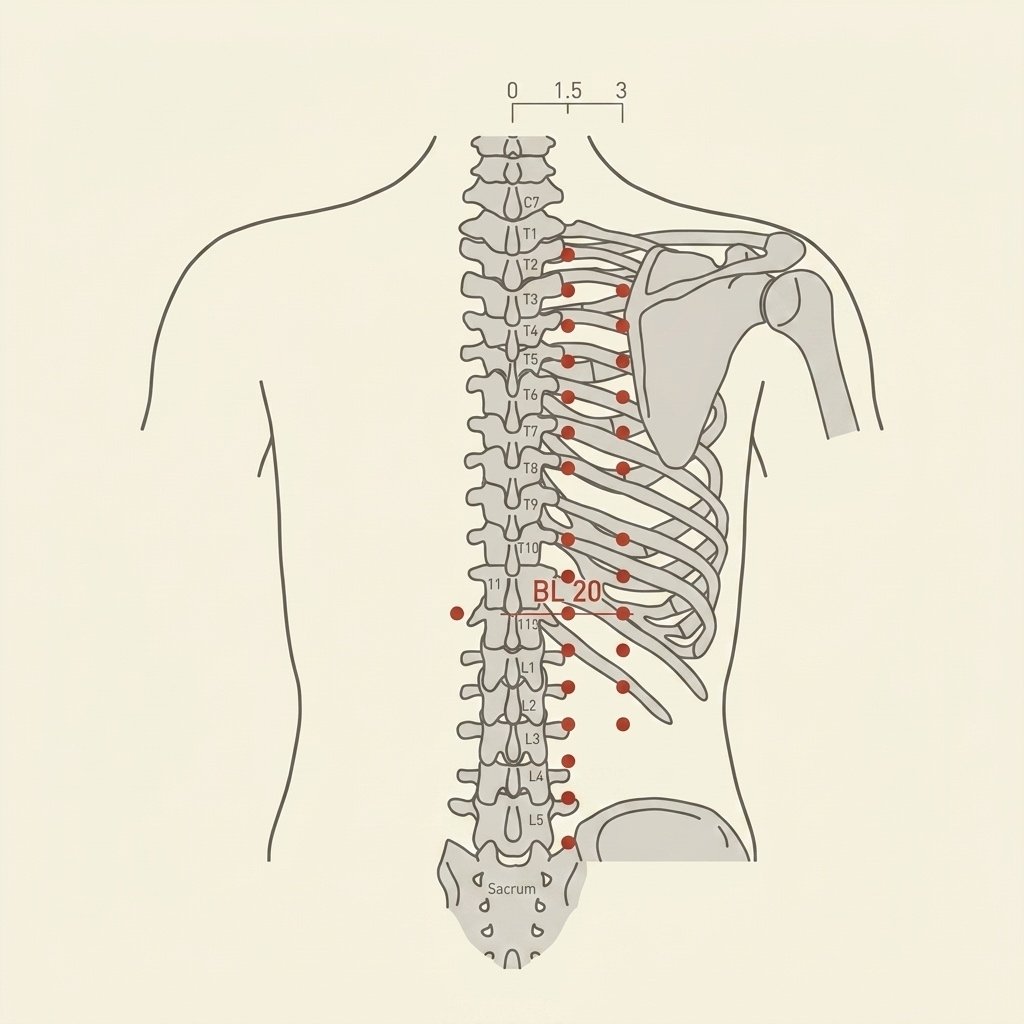
BL-20 Pishu (脾俞) — Spleen Shu
Depth
00.5–1 cun3.0
Transverse insertion
Precautions
High risk of pneumothorax. Caution: perpendicular or oblique needling away from the spine carries a substantial risk of causing pneumothorax.
Location (classical)
On the back, 1.5 cun lateral to the inferior border of the spinous process of the eleventh thoracic vertebra (T11).
How to find it (practical)
In prone or lateral decubitus, locate the point below the spinous process of the eleventh thoracic vertebra (T11), 1.5 cun lateral to Ji Zhong (GV-6).
Anatomy
Skin, subcutaneous tissue, posterior cutaneous branches of the medial branches of the dorsal rami of the thoracic nerve, dorsal branches of the posterior intercostal arteries, latissimus dorsi, erector spinae, and serratus posterior inferior muscles.
Needling
Oblique insertion toward the spine, 0.5 to 1 cun, or transverse-oblique insertion of 1 to 1.5 cun.
Etymology
Pi (脾), Spleen; Shu (俞), point. Place where the Qi of the Pi (Spleen) reaches the back.
CLASSICAL SOURCELing Shu
Clinical Relations
Point Pairs
Back-Shu/Front-MuLR-13 Zhangmen
Adjacent Points on the Meridian