Ponto Mu do PulmãoEncontro Pulmão-BaçoEncontro com canal do BaçoDangerTórax
Depth
00.5–1 cun3.0
Transverse insertion
Precautions
Deep perpendicular or medially directed insertion carries substantial risk of pneumothorax. Caution: deep perpendicular, medial, or oblique insertion poses a real risk of pneumothorax. The needle must be directed only laterodorsally or tangentially to the coracoid process.
📍 Location (classical)
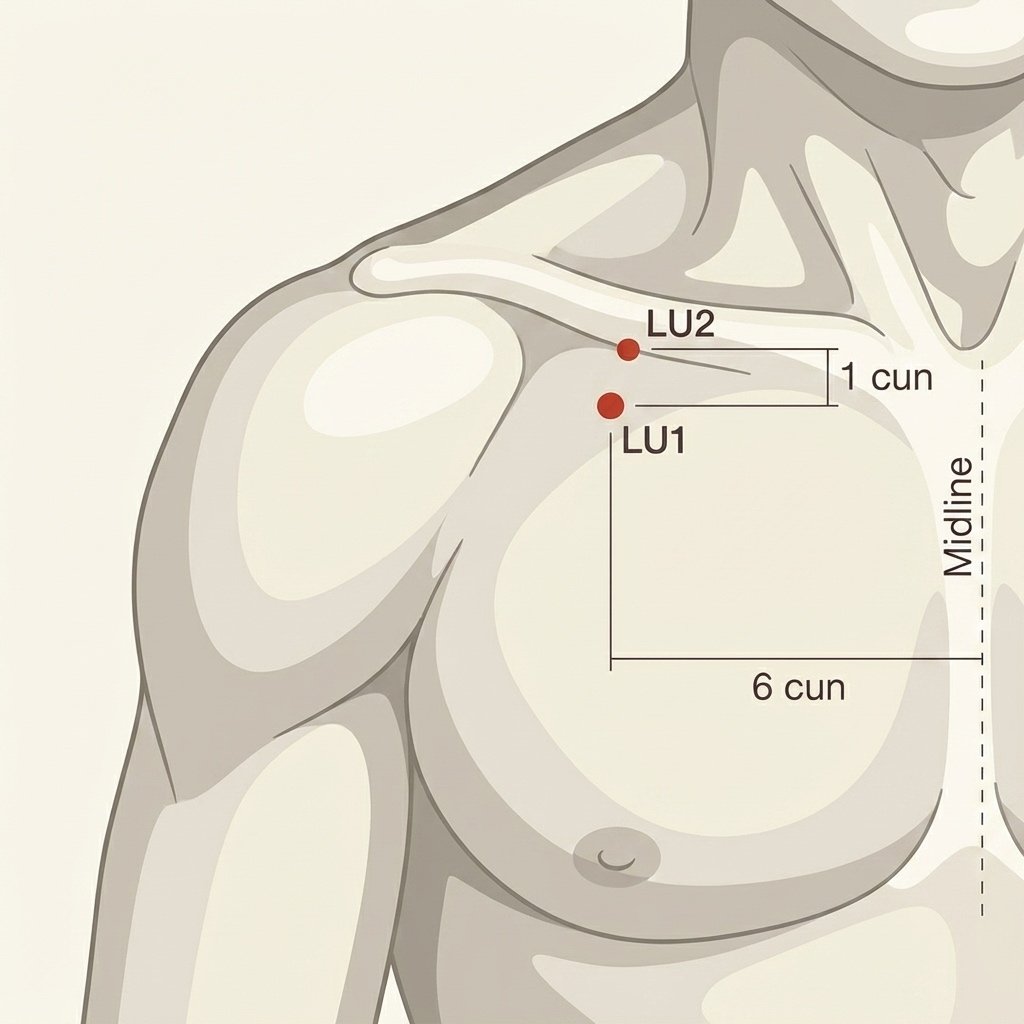
On the lateral aspect of the chest wall, at the level of the first intercostal space, 6 cun lateral to the anterior midline and 1 cun below Yunmen LU-2. Located slightly medial to the caudal border of the coracoid process.
🧭 How to find it (practical)
Seated with the hand resting on the hip, locate Yun Men (LU-2) in the depression below the lateral segment of the clavicle (at the acromioclavicular extremity). The point lies 1 cun directly below Yun Men (LU-2), at the level of the first intercostal space.
In the supine position, locate the point 2 cun lateral to the nipple (in males) at the first intercostal space.
🔬 Anatomy
Skin, subcutaneous tissue, supraclavicular nerve branch, pectoralis major muscle, thoracoacromial artery, cephalic vein, lateral pectoral nerve, and lateral intercostal muscle.
💉 Needling
Oblique insertion 0.5–1 cun directed cranially (approximately 45°) and laterally toward the coracoid process, or transverse-oblique insertion of 0.5 to 1 cun medially along the intercostal space.
📜 Etymology
Zhong (中), chest; Fu (府), site. Meeting point of the Qi of Fei (Lung).