The Pain Epidemic Among Professional Drivers
Brazil has more than 2 million truck drivers and millions of professional drivers (taxi, app-based, bus). These workers spend 8 to 14 hours a day seated in a fixed posture, exposing the lumbar spine, gluteal muscles, and piriformis to sustained compression and ischemia. It is no surprise that low back pain is very common in this population, with a prevalence higher than that of the general population in several studies.
The clinical picture in drivers extends beyond low back pain: prolonged sitting posture generates a cascade of interconnected dysfunctions — shortening of the iliopsoas, inhibition of the gluteus maximus, overload of the piriformis (which is compressed against the seat), lumbar disc compression, and trigger points throughout the entire posterior and gluteal chain.
Vehicle vibration adds an aggravating factor: whole-body vibration (WBV) at frequencies of 4 to 8 Hz — typical of trucks and buses — is transmitted directly to the lumbar spine, accelerating disc degeneration and muscular fatigue. Epidemiological studies suggest that drivers exposed to WBV have a higher risk of low back pain and disc disease than workers without vibration exposure, with magnitude varying across studies.
The Biomechanics of Prolonged Sitting Posture
Sitting raises lumbar intradiscal pressure by 40 percent compared with standing (Nachemson, 1966). In drivers, that pressure persists for hours without interruption and is amplified by vehicle vibration and the lack of adequate lumbar support in most seats.
From Chronic Sitting Posture to Driver Pain
Sustained disc compression
Lumbar flexion while seated shifts load to the anterior intervertebral disc. Intradiscal pressure at L4-L5 and L5-S1 rises 40 to 90 percent depending on posture. Hours in this position accelerate annulus fibrosus degeneration and nucleus pulposus dehydration.
Compression of the piriformis against the seat
The piriformis gets compressed between the ischial tuberosity and the vehicle seat. Sustained compression produces local ischemia, metabolite buildup, and trigger points. A hyperactivated piriformis can compress the sciatic nerve, producing radiating pain that mimics discogenic sciatica.
Gluteal inhibition and iliopsoas shortening
The seated position keeps the iliopsoas in a shortened position and the gluteus maximus in a lengthened, inactive position ("gluteal amnesia"). The shortened iliopsoas pulls the lumbar spine into excessive lordosis upon standing, and the weakened gluteus fails to stabilize the pelvis — transferring load to the lumbar spine and the piriformis.
Whole-body vibration (WBV)
Vehicle vibration (4 to 8 Hz in trucks) travels up the spine. That frequency matches the lumbar spine's resonant frequency, amplifying mechanical forces on the discs and facets. WBV also accelerates muscular fatigue in the erectors and multifidus.
The Piriformis: The Muscle That Mimics Sciatica
The piriformis deserves special attention in driver pain. This deep buttock muscle, when it develops trigger points from sustained compression against the seat, generates a pain pattern that can mimic sciatica caused by disc herniation, although clinical assessment helps tell them apart: pain in the buttock radiating to the posterior aspect of the thigh and leg.
Piriformis syndrome is frequently underdiagnosed in drivers because lumbar spine MRI (ordered to investigate "sciatica") shows degenerative changes expected for the patient's age — and the physician attributes the pain to the disc, when the piriformis may be the generator. Dry needling of the piriformis, guided by anatomy or ultrasound, may be helpful in these cases.
Discogenic Sciatica vs. Piriformis Syndrome
| Characteristic | Disc Herniation (True Sciatica) | Piriformis Syndrome |
|---|---|---|
| Pain pattern | Follows L5 or S1 dermatome to the foot | Buttock to posterior thigh (rarely below the knee) |
| Lasègue maneuver | Positive (lifts the irritated root) | Negative or weakly positive |
| FAIR test | Negative | Positive (flexion-adduction-internal rotation) |
| Piriformis palpation | No reproduction of pain | Reproduces the patient pain exactly |
| Lumbar MRI | Evident disc herniation | Normal or incidental findings |
| Response to dry needling | Partial (relieves comorbid trigger points) | Good — frequent clinical relief in few sessions |
Acupuncture for the Driver: Evidence-Based Protocol
The acupuncture protocol for drivers and truck drivers targets the specific mechanisms of seated pain: piriformis and gluteal trigger points, lumbar decompression, and correction of gluteal inhibition. The approach is pragmatic and adapted to these professionals' time constraints.
- Piriformis dry needling: deep technique (6 to 8 cm) in side-lying position, guided by palpatory anatomy or ultrasound. Target: trigger points that compress the sciatic nerve
- Gluteal trigger points: gluteus medius and minimus — refer pain to the buttock and lateral thigh, often mistaken for L5 radiculopathy
- Quadratus lumborum deactivation: bilateral needling in prone position — the QL compensates for gluteal weakness during pelvic stabilization
- L4-S1 paravertebral electroacupuncture: 2 Hz to release endorphins and segmentally modulate lumbar and radicular pain
- Distal points: BL40, BL60, GB34 — descending modulation and segmental analgesia for the lower limb
- Iliopsoas stretching: coaching on active stretches during breaks — reversing the shortening that builds up while seated
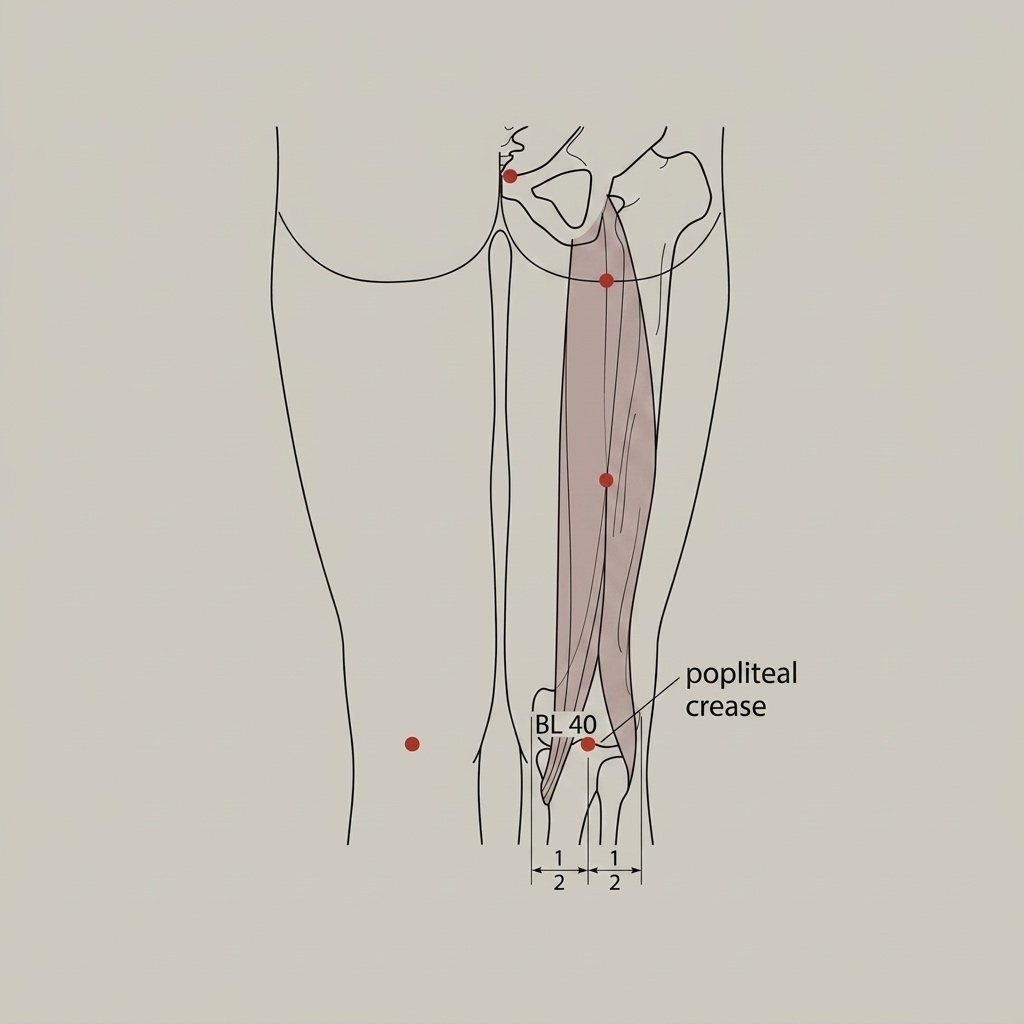
At the midpoint of the popliteal crease, between the tendons of the biceps femoris and semitendinosus.
See in the atlasProtocol Adapted to the Driver Routine
Professional drivers face unique challenges for treatment adherence: long routes, irregular schedules, and limited access to health services. The protocol must be concentrated and include self-management strategies for stretches on the road.
Protocol for Professional Drivers
Intensive Phase
Weeks 1–3Deactivation of pain generators
Sessions 2x/week when the driver is at home base. Focus on the piriformis, gluteals, QL, and paravertebrals. Electroacupuncture at 2-100 Hz. Auriculotherapy with seeds (Shenmen, lumbar, sciatic) maintains effect during travel.
Consolidation Phase
Weeks 4–8Maintenance and self-care education
Weekly sessions. Teach piriformis and iliopsoas self-stretches for mandatory breaks. Ergonomic guidance: lumbar support, seat adjustment, mirror position to avoid sustained cervical rotation. Renew auricular seeds each session.
Maintenance
OngoingSessions during stops at home base
Sessions every 2 to 4 weeks, synchronized with the driver's break schedule. Focus on preventing trigger-point reactivation. Renew auricular seeds. Advise the patient to seek immediate medical assessment for progressive leg weakness, loss of sensation in the genital area or between the legs, or changes in bladder or bowel control.
- The acupuncture protocol for drivers and truck drivers targets the specific mechanisms of seated pain: piriformis and gluteal trigger points, lumbar decompression, and correction of gluteal inhibition.
- The protocol must be concentrated and include self-management strategies for stretches on the road.
- Without ergonomic changes and regular breaks, trigger points tend to reactivate.
In-Vehicle Ergonomics: Adjustments That Prevent Pain
Small adjustments to seat and driving posture can significantly reduce load on the lumbar spine and piriformis. The medical acupuncturist coaches these changes as an integral part of treatment.
Myths and Facts
Myth vs. Fact
Buttock pain that radiates down the leg is always a herniated disc
In drivers, piriformis syndrome is a possible cause of buttock and thigh pain that can mimic discogenic sciatica, but radiculopathy remains the most common cause and needs to be assessed. Compressed for hours against the seat, the piriformis develops trigger points that irritate the sciatic nerve. The FAIR test and piriformis palpation differentiate the two conditions — and treatment is radically different.
Truck drivers don't have time for acupuncture — they're always on the road
The protocol adapts: intensive sessions during home-base periods (2 to 3x/week) plus auriculotherapy with seeds that hold their effect for 5 to 7 days on the road. Many drivers report auricular seeds are enough to maintain relief between in-person sessions.
Driver low back pain is degenerative — there is no treatment
Degenerative changes on imaging are common in drivers, but often asymptomatic. The pain a driver experiences is predominantly myofascial (trigger points) and mechanical (postural overload) — both treatable with acupuncture. Disc degeneration is the context, not necessarily the cause of the pain.
Do
- Take a break every 2 hours: stand up, walk for 5 minutes, and do 3 repetitions of piriformis and iliopsoas stretches.
- Use a seat with pneumatic suspension, which dampens vibration.
- Combine intensive acupuncture during home-base periods with auriculotherapy on the road.
Avoid
- Skip breaks under deadline pressure.
- Drive immediately after a session if you feel deep relaxation: wait 15 to 20 minutes.
- Always attribute buttock pain that radiates down the leg to a herniated disc.
Frequently Asked Questions
Frequently Asked Questions
Acupuncture can significantly relieve your pain, with response magnitude varying by individual; without ergonomic changes and regular breaks, trigger points tend to reactivate. The ideal treatment combines intensive acupuncture during home-base periods, auriculotherapy on the road, lumbar seat support, and stretching during mandatory breaks.
Piriformis syndrome is sciatic-nerve irritation by a piriformis muscle that is shortened, hypertrophied, or harboring trigger points. Suggestive signs: buttock pain that worsens with prolonged sitting, relief on standing and walking, pain radiating to the posterior thigh but usually not below the knee, and a positive FAIR test (pain with hip flexion-adduction-internal rotation). The medical acupuncturist clinically distinguishes it from discogenic sciatica.
Yes, whole-body vibration (WBV) in the 4 to 8 Hz range reaches the lumbar spine and accelerates muscular fatigue and disc degeneration. Protective measures: a seat with pneumatic suspension (dampens vibration), proper tire pressure, a lumbar support that absorbs part of the vibration, and core strengthening to stabilize the spine.
Yes, in most cases. In some people, acupuncture can cause drowsiness or dizziness. Some experience deep relaxation in the first session — in that case, wait 15 to 20 minutes before driving. After the first few sessions, the patient knows their individual response and can plan accordingly.
Generally no. Seeds sit in specific auricular regions (Shenmen, lumbar zone, sciatic) that don't interfere with most headphones. If in-ear headphones cause discomfort, the physician can select points on the helix or antihelix that don't conflict with the device.