Post-Laminectomy Syndrome: When Surgery Does Not Resolve the Pain
Post-laminectomy syndrome (also called failed back surgery syndrome — FBSS) refers to the persistence or recurrence of low back pain and/or radicular pain after an anatomically successful lumbar spine surgery. Despite technical advances, between 10% and 40% of patients undergoing spine surgery develop chronic postoperative pain that can be as disabling as, or more disabling than, the original pain.
The term is misleading because it implies surgical "failure" — but in most cases the procedure achieved its anatomical goal (decompressing the nerve root or stabilizing the segment). Pain persists through mechanisms surgery does not address: epidural fibrosis, altered biomechanics of adjacent segments, muscular deconditioning, central sensitization and, importantly, compensatory myofascial trigger points in the paraspinal and gluteal musculature.
Why Does Pain Persist After Successful Surgery?
Persistent pain after spine surgery results from multiple mechanisms that interact and reinforce one another. Understanding each component is essential to direct acupuncture treatment effectively.
Mechanisms of Post-Laminectomy Pain
Epidural fibrosis (scar tissue)
Postoperative scarring generates fibrous tissue in the epidural space that can adhere to the dura mater and nerve roots. This fibrosis does not necessarily compress the root, but it alters root mobility and produces intermittent mechanical irritation during flexion and extension.
Altered segmental biomechanics
Removal of lamina, ligamentum flavum, and/or facet joint redistributes mechanical loads to adjacent segments. This phenomenon ("adjacent segment disease") overloads discs, facets, and musculature at the levels above and below the surgery.
Compensatory trigger points
Altered biomechanics, multifidus deconditioning (atrophy from surgical denervation), and protective postural patterns generate trigger points in the quadratus lumborum, gluteus medius, piriformis, and residual multifidus — often the main source of pain in late postoperative care.
Central sensitization
Months to years of chronic pain produce maladaptive neuroplasticity in the dorsal horn and supraspinal centers. The central nervous system amplifies minimal peripheral signals and may sustain pain even after structural causes have resolved.
The Postsurgical Trigger Point Chain
The myofascial component of post-laminectomy syndrome is systematically underestimated. Spine surgery, even when minimally invasive, directly injures the multifidus (the segmental stabilizer) and alters local biomechanics. Adjacent muscles take on a compensatory role, developing chronic overload and myofascial trigger points that become the predominant source of pain.
Compensatory Trigger Points After Spine Surgery
| Muscle | Overload Mechanism | Referred Pain Pattern |
|---|---|---|
| Quadratus lumborum | Compensates for multifidus atrophy in lateral stabilization | Pain over the iliac crest, flank, and upper buttock |
| Gluteus medius | Overload from antalgic gait and core weakness | Pain in the buttock and lateral hip |
| Piriformis | Hyperactivation from sacroiliac instability after fusion | Buttock pain radiating to the posterior thigh |
| Residual multifidus | Chronic protective spasm in segments adjacent to fusion | Deep bilateral paraspinal pain |
| Iliopsoas | Shortening from protective flexion posture | Anterior lumbar and inguinal pain |
- The myofascial component of post-laminectomy syndrome is systematically underestimated.
- Spine surgery, even when minimally invasive, directly injures the multifidus (the segmental stabilizer) and alters local biomechanics.
- Myofascial trigger points become the predominant source of pain.
Acupuncture in the Management of Post-Laminectomy Syndrome: Evidence and Mechanisms
Medical acupuncture acts on multiple layers of post-laminectomy syndrome, making it particularly suited to a multifactorial condition. Unlike unimodal approaches, acupuncture can simultaneously treat the peripheral nociceptive component, central sensitization, and the myofascial component.
- Trigger point deactivation: dry needling of the quadratus lumborum, gluteus medius, piriformis, and multifidus is often among the highest-impact clinical interventions for residual postsurgical myofascial pain
- Pain modulation associated with epidural fibrosis: paraspinal electroacupuncture at 2 Hz may, according to experimental studies, stimulate release of beta-endorphin and enkephalin, contributing to analgesia by a non-invasive route
- Modulation of central sensitization: segmental and extrasegmental acupuncture protocols may activate descending inhibitory systems (serotonin, norepinephrine) which, in experimental studies, reduce central amplification of pain
- Opioid reduction: systematic reviews suggest acupuncture may help lower opioid doses in patients with chronic postsurgical pain; any dose adjustment remains the prescribing physician's decision
- Functional improvement: by relieving pain and kinesiophobia, acupuncture can facilitate core rehabilitation — important to limit progression of adjacent segment disease
Clinical Protocol: A Stratified Approach by Pain Component
Treatment of the post-laminectomy patient requires individualized assessment to identify the relative contribution of each pain component: myofascial, neuropathic, mechanical, and central. The medical acupuncturist tailors the protocol to the predominant profile.
Stratified Protocol in 4 Phases
Mapping the pain generators
Detailed physical examination: trigger point palpation, segmental provocation testing, hypersensitivity evaluation (allodynia, hyperalgesia), and analysis of analgesic use patterns. Questionnaires: DN4 (neuropathic pain), ODI (lumbar disability).
Trigger point deactivation and nociceptive modulation
Sessions twice weekly. Dry needling of identified trigger points (QL, gluteus medius, piriformis, multifidus). Paraspinal electroacupuncture at 2 Hz to release endogenous opioids. Systemic points (LI4, ST36, LR3) for central modulation.
Central modulation and analgesic reduction
Weekly sessions. Focus on modulating central sensitization: electroacupuncture at alternating frequency (2/100 Hz). Auriculotherapy with seeds for between-session control. Begin supervised opioid tapering in collaboration with the pain physician.
Relapse prevention and functional rehabilitation
Biweekly to monthly sessions. Focus on maintaining gains, reactivating emerging trigger points, and supporting core rehabilitation. Monitor pain and functional scores.
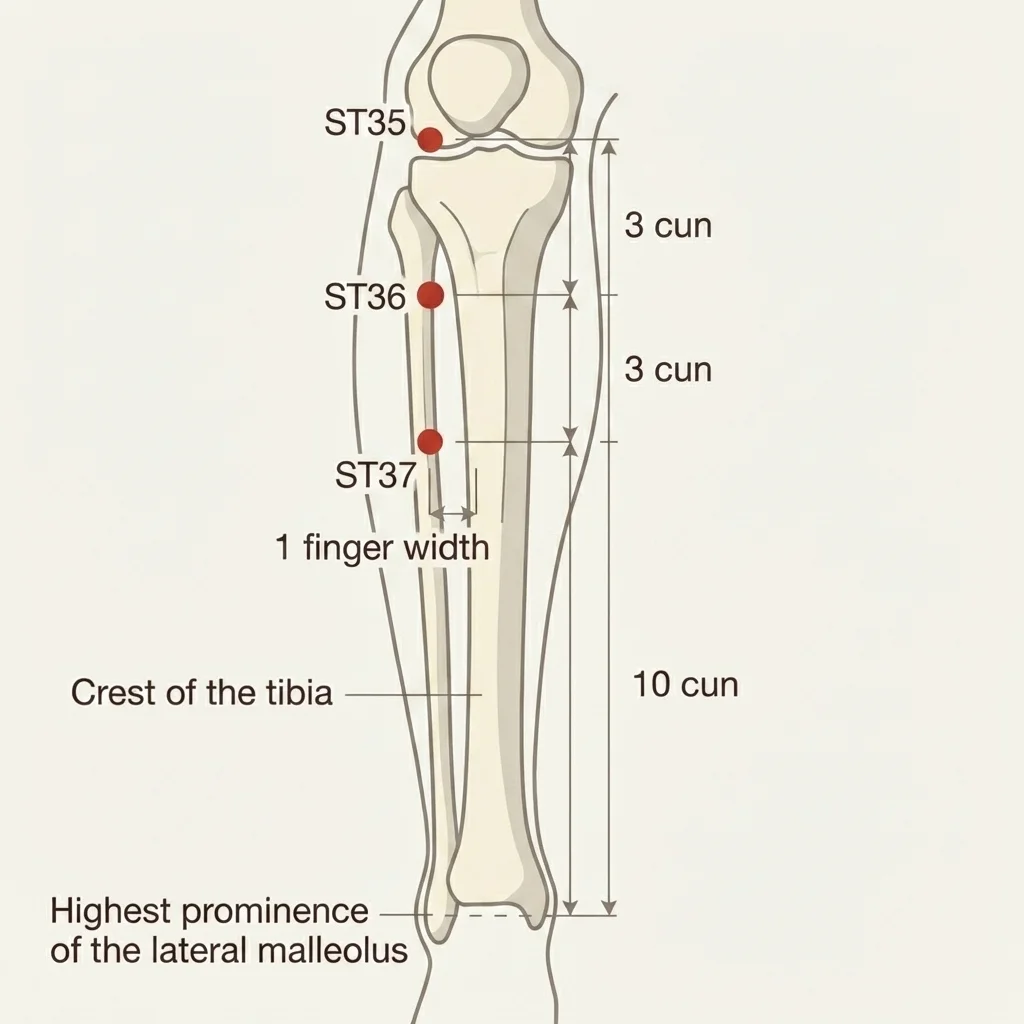
ST36, together with LI4 and LR3, is used as a systemic point in the Intensive Phase, for central modulation.
Myths and Facts
Myth vs. Fact
If spine surgery did not resolve it, nothing else will
Surgery treats structural compression, but does not address myofascial trigger points, central sensitization, or muscular deconditioning. Medical acupuncture acts on those layers and may help control pain in some patients, although the specific evidence for post-laminectomy syndrome is limited.
Needling near the operated spine is dangerous
The medical acupuncturist evaluates altered anatomy and adapts needle depth and angle. The most relevant trigger points (QL, gluteus medius, piriformis) lie distant from the spinal canal. Superficial paraspinal needling, performed by a trained physician, is generally well tolerated in patients with hardware (screws and rods) — although not risk-free: possible adverse events include bleeding, hematoma, local pain, infection, and, with inadequate depth, neural injury. Each case requires individualized assessment.
The post-laminectomy patient needs more surgery, not acupuncture
Outcomes of reoperation in FBSS are often limited. International guidelines recommend a multimodal conservative approach before considering further surgery; acupuncture may be considered as part of that management, with limited evidence.
Frequently Asked Questions
Frequently Asked Questions
Generally from 6–8 weeks postoperatively, when initial tissue healing is complete. Distal techniques (auriculotherapy, limb points) can be used earlier. The medical acupuncturist coordinates with the surgeon to define ideal timing according to the procedure performed.
It may contribute. Systematic reviews suggest acupuncture, as an adjuvant, can help reduce opioid doses in chronic pain across various contexts, with magnitudes varying among studies. No pharmacological interactions between acupuncture and opioids have been described; dose adjustments remain the prescribing physician's decision, made gradually and under monitoring. The neurobiological hypothesis involves modulation of endogenous opioids (endorphin, enkephalin), partially compensating for reduced external medication.
Generally, yes — fixation hardware is not an absolute contraindication to acupuncture. The medical acupuncturist knows the instrumentation anatomy and avoids needling directly over metallic components. The main therapeutic targets (trigger points in the QL, gluteus, piriformis) lie outside the instrumented region. As with any needle-based procedure, possible risks exist (bleeding, hematoma, local pain, infection), which the physician evaluates case by case.
MRI shows structural changes (disc, canal, root), but does not visualize myofascial trigger points, central sensitization, or functional biomechanical dysfunction — the most frequent causes of persistent pain when postsurgical anatomy is satisfactory. The myofascial examination is more informative than MRI in this setting.
The typical protocol involves 12–20 sessions over 3–4 months. Initial response is usually evident within the first 4–6 sessions. Patients with a predominantly myofascial component respond more rapidly than those with neuropathic pain. Monthly maintenance is generally needed for 6–12 months to consolidate gains.