The Challenge of Creating a Placebo for Acupuncture
In pharmacology, the ideal placebo is a pill identical to the active tablet but without any active ingredient. The patient doesn't know what they received — blinding is perfect. In acupuncture, the problem is far more complex: how do you simulate a needle insertion só that the patient can't tell the difference?
The solution developed by researchers, as described in JAMA, was sham acupuncture — a set of procedures that mimic the appearance and ritual of acupuncture without (in theory) producing the specific effects of real needling. But, as we will see, none of the available forms of sham is a perfectly inert placebo — and that has important implications for the interpretation of studies.
Types of Sham Acupuncture
The main types of sham control used in research are:
| Type of Sham | How It Works | Main Limitation |
|---|---|---|
| Streitberger needle | Retractable tip — appears to insert but does not penetrate the skin | Mechanical pressure on the skin still activates tactile nerve fibers (A-beta) |
| Park needle | Retractable tip with a plastic guide identical to the real needle's | Similar to Streitberger — does not eliminate mechanical stimulus |
| Insertion at non-acupoints | Real needle inserted at locations "outside" the canonical points | Non-canonical points still activate dermatomes and nerve fibers |
| Superficial insertion (2–3 mm) | Real needle inserted very superficially, without manipulation | Can still activate cutaneous receptors and superficial A-delta fibers |
| Adhesive-only stimulation without needle | Only the needle adhesive is applied without insertion | Noticeable difference — compromises blinding |
Three neurobiological levels of medical acupuncture: from muscle to central modulation
Mechanical stimulation of myelinated peripheral afferents engages local tissue perfusion, spinal dorsal horn gating, and descending brainstem analgesia across sessions.
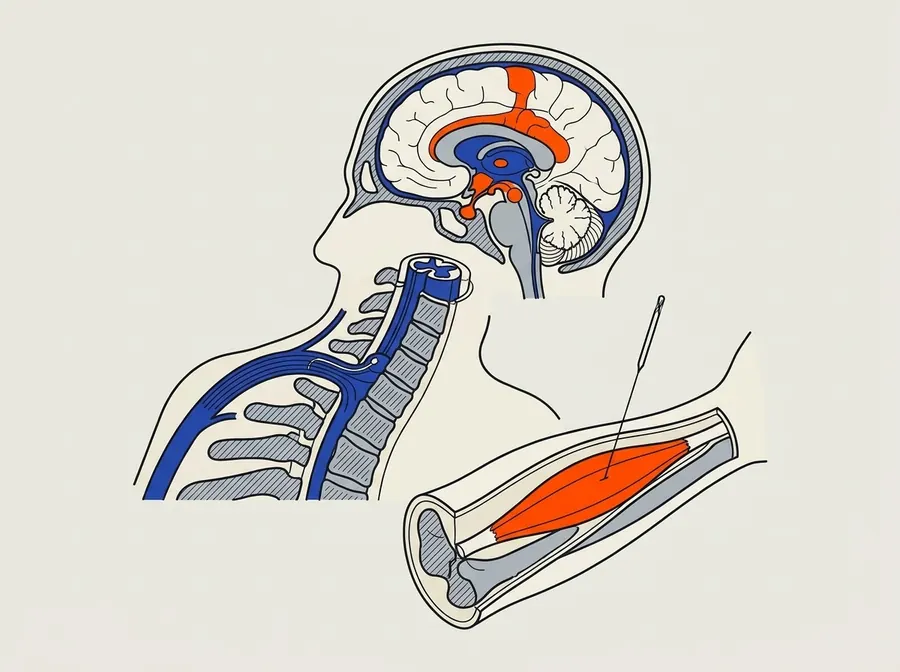
1. Local & myofascial coupling
Recruits Aβ/Aδ mechanoreceptors, releases local adenosine, and restores micro-perfusion in taut muscle bands.
2. Spinal dorsal horn gating
Segmental inhibitory interneurons dampen ascending nociceptive signaling and calm viscerosomatic reflexes.
3. Descending central control
Engages periaqueductal gray and brainstem relays, recruiting endogenous opioids and monoamines.
Why Sham Acupuncture Is Not an Inert Placebo
The central problem in acupuncture research is that any form of sham involving physical contact with the skin activates sensory nerve fibers. A retractable needle (Streitberger) that presses without penetrating the skin still stimulates mechanoreceptors and A-beta fibers — generating a real neural response, smaller than verum acupuncture but not absent.
Insertion at "non-acupoint" locations is equally problematic: no region of the body is completely devoid of innervation. Any point on the body surface belongs to some dermatome, and inserting a needle activates local nerve fibers regardless of whether the location is "correct" or "incorrect" by the acupuncture-point system.
This explains a consistent finding in the literature: the difference between verum and sham acupuncture tends to be smaller than the difference between verum acupuncture and no treatment. Sham "leaks" specific effect — it contaminates the control.
- Any form of sham involving physical contact with the skin activates sensory nerve fibers.
- Any point on the body surface belongs to some dermatome.
- The difference between verum and sham acupuncture tends to be smaller than the difference between verum acupuncture and no treatment.
Myth vs. Fact
"If verum and sham acupuncture produce similar results, it's all placebo"
Similar results between verum and sham may reflect control contamination (sham is not inert), nonspecific effects of acupuncture, or both. No-treatment comparisons show acupuncture superiority, but they measure the total effect, which includes the nonspecific component.
"The Streitberger needle eliminates acupuncture's specific effect"
No. The Streitberger needle still produces a neural response through mechanical pressure. fMRI studies show that even sham with a retractable needle produces brain activation — different from verum acupuncture, but not zero.
"Acupuncture at the wrong point doesn't work — therefore specific points don't matter"
Inserting outside acupuncture points can still produce some biological effect through local segmental activation. Dose-response and point-selectivity studies suggest that a well-chosen point can produce a greater effect, especially when segmentally relevant — though the magnitude and consistency remain debated in the literature.
Is Double-Blinding Possible in Acupuncture Studies?
In pharmacology, double-blinding means that neither the patient nor the researcher evaluating the outcome knows which treatment was administered. In acupuncture, blinding the practitioner is impossible: the physician inserting the needles always knows whether they're performing verum or sham. Only the outcome assessor can be blinded.
Patient blinding is partially achieved with Streitberger/Park needles. Blinding-verification studies (asking the patient whether they believe they received verum or sham) show that about 50% of patients identify correctly — which is consistent with chance and suggests adequate blinding in those trials, although results vary across studies.
- The maximum level achievable in acupuncture studies is "single-blind for the patient" — the practitioner can never be blinded.
- High-quality studies blind the outcome assessor — the person who measures pain, function, and quality of life doesn't know which group the patient is in.
- A blinding-verification analysis should be reported — studies that don't test whether blinding worked have reduced methodological validity.
- Perfect double-blinding isn't an absolute quality requirement — surgical, physical therapy, and psychotherapy trials also can't blind the practitioner, yet they're accepted as high-quality evidence.
Frequently Asked Questions
Frequently Asked Questions
The controversy persists for three reasons: (1) study heterogeneity — different points, frequencies, and protocols make comparison difficult; (2) the methodological problem of sham contaminates interpretation; (3) ideological bias — conventional medicine has historically evaluated Eastern-origin therapies with extra skepticism. More recent research, with greater methodological rigor, has shown benefit for some specific indications, generally with a modest specific effect.
Partly. Animal models (rats, rabbits) allow experiments with rigorous controls — including anesthesia control, sham surgery, and dose-response comparison — without the problem of expectation- and belief-driven placebo. Analgesic and anti-inflammatory effects described in animals give biological plausibility to a specific effect, but these models have their own biases and do not replace clinical trials in humans.
Partially. ATC uses individual patient data from high-quality studies, allowing adjustment for patient characteristics and subgroup analysis. Its main conclusion is that acupuncture surpasses both placebo and no-treatment for chronic pain — which is what matters most clinically. The debate over "how much it surpasses sham" is methodologically relevant but of lesser importance for clinical decision-making.
Interpreting the difference between verum and sham as "the expected clinical effect of treatment" underestimates the real benefit. The patient who undergoes treatment receives both the specific effect and the placebo effect — and both are neurologically real. The clinically relevant comparison is acupuncture vs. no treatment or acupuncture vs. pharmacological treatment — where the data favor acupuncture.