What Are Gabapentinoids?
Gabapentinoids are two structurally similar medications, collectively known as: gabapentin (Neurontin) and pregabalin (Lyrica). Although they were developed as anticonvulsants, their use exploded in the last two decades as a treatment for chronic pain — particularly neuropathic pain, fibromyalgia, and postoperative pain.
The history of these drugs is revealing. Gabapentin was originally synthesized as a GABA analog to treat epilepsy — but, ironically, it does not act significantly on GABA receptors. Its true mechanism of action remained unclear until the identification of the alpha-2-delta subunit of voltage-dependent calcium channels as the primary molecular target. Pregabalin, developed later, binds to the same target with six times greater affinity.
Understanding the actual mechanism of action of these medications is essential to grasp where they work, where they do not, and why they are being overprescribed for conditions that do not involve the molecular target they modulate.
Mechanism of Action: The Alpha-2-Delta Subunit
The central mechanism of gabapentinoids involves binding to the alpha-2-delta (α2δ) subunit of presynaptic voltage-dependent calcium channels. This subunit functions as an accessory protein that regulates calcium-channel trafficking to the synaptic membrane and modulates its activity.
In neuropathic pain states, there is overexpression of the alpha-2-delta subunit in the dorsal root ganglia and the dorsal horn of the spinal cord. This overexpression results in more functional calcium channels at the presynaptic terminals, which amplifies the release of excitatory neurotransmitters — glutamate, substance P, and norepinephrine — fueling central sensitization.
When gabapentin or pregabalin bind to the alpha-2-delta subunit, they reduce calcium-channel trafficking to the membrane, decreasing presynaptic calcium influx and, consequently, excessive neurotransmitter release. The result is reduced neuronal hyperexcitability — but only when that hyperexcitability depends on the alpha-2-delta pathway.
Cascade: From Nerve Injury to Gabapentinoid Action
Nerve injury or dysfunction
Peripheral nerve damage (compression, diabetes, herpes zoster) triggers changes in gene expression in dorsal root ganglion sensory neurons.
Overexpression of the α2δ subunit
Injured neurons dramatically increase production of the alpha-2-delta subunit — specifically subtypes α2δ-1 and α2δ-2 — which are transported to the spinal cord dorsal horn.
Increased calcium channels at the synapse
More alpha-2-delta subunits at the presynaptic membrane mean more functional calcium channels. The Ca²⁺ influx with each action potential increases pathologically.
Excessive neurotransmitter release
Excess presynaptic calcium amplifies glutamate and substance P release in the dorsal horn, driving second-order neuron hyperexcitability and central sensitization.
Gabapentinoid blocks the α2δ subunit
By binding to the alpha-2-delta subunit, the gabapentinoid reduces calcium-channel trafficking to the membrane and decreases excessive neurotransmitter release — attenuating sensitization.
Three neurobiological levels of medical acupuncture: from muscle to central modulation
Mechanical stimulation of myelinated peripheral afferents engages local tissue perfusion, spinal dorsal horn gating, and descending brainstem analgesia across sessions.
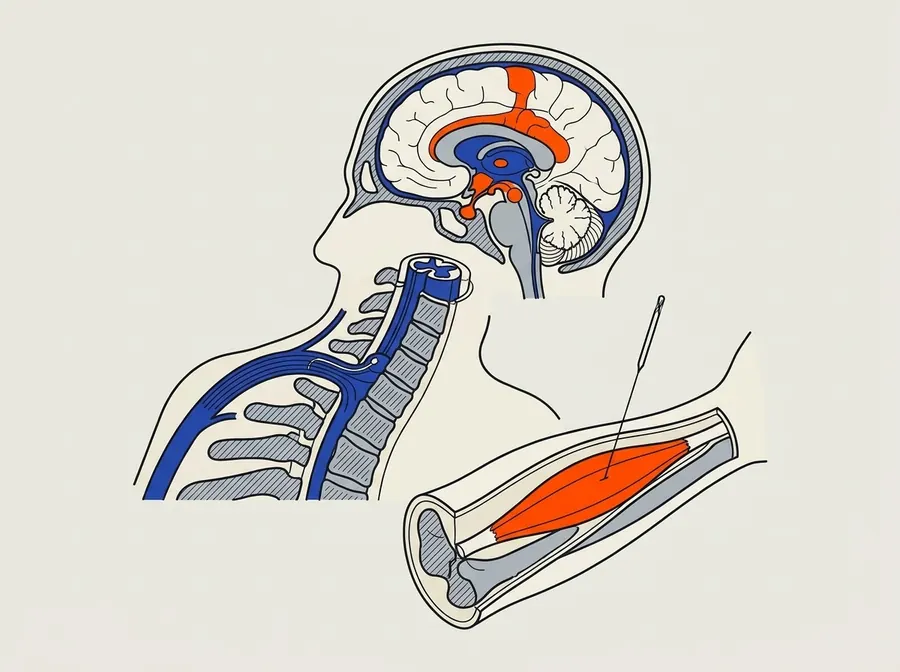
1. Local & myofascial coupling
Recruits Aβ/Aδ mechanoreceptors, releases local adenosine, and restores micro-perfusion in taut muscle bands.
2. Spinal dorsal horn gating
Segmental inhibitory interneurons dampen ascending nociceptive signaling and calm viscerosomatic reflexes.
3. Descending central control
Engages periaqueductal gray and brainstem relays, recruiting endogenous opioids and monoamines.

Real Indications vs. Overprescription
The central problem with gabapentinoids in current clinical practice is the dissociation between the mechanism of action and the indications for which they are being prescribed. If the drug acts on the alpha-2-delta subunit overexpressed in neuropathic pain, it has pharmacologic logic when the alpha-2-delta pathway is activated. When this pathway is not involved, the medication works little — or no — better than placebo.
NNT (number needed to treat) data are revealing. For postherpetic neuralgia — genuine neuropathic pain — the NNT is approximately 3.9 for pregabalin, indicating that for every 4 patients treated, 1 will have significant relief. For diabetic peripheral neuropathy, the NNT is 5.0. For fibromyalgia, the NNT is 7.2 — meaning that more than 7 patients must be treated for 1 to have a clinically significant response. And for chronic nociceptive low back pain? Randomized trials consistently show that gabapentinoids are not superior to placebo.
Despite these data, gabapentinoids are widely prescribed for low back pain, myofascial pain, osteoarthritis, and other predominantly nociceptive conditions — where the alpha-2-delta subunit is not overexpressed and the drug's mechanism has no active molecular target.
NNT of Gabapentinoids by Clinical Condition
| Condition | NNT (Pregabalin) | Clinical Implication |
|---|---|---|
| Postherpetic neuralgia | 3.9 | Good response — clear neuropathic mechanism with α2δ overexpression |
| Diabetic peripheral neuropathy | 5.0 | Moderate response — predominant neuropathic component |
| Central post-stroke pain | 5.6 | Partial response — central sensitization with variable α2δ component |
| Fibromyalgia | 7.2 | Weak response — most patients gain no significant benefit |
| Chronic low back pain (nociceptive) | ∞ (no effect) | No significant difference vs. placebo in randomized trials |
| Myofascial pain from trigger points | ∞ (no effect) | No pharmacologic logic — does not involve α2δ overexpression |
Side Effects, Dependence, and Underestimated Risks
Gabapentinoids were initially marketed with a benign safety profile. As use became widespread, however, a more complex pattern emerged. The most common adverse effects target the central nervous system — expected, given that the drug nonselectively reduces excitability in neurons that express alpha-2-delta subunits.
Dizziness and drowsiness are the most frequent effects, affecting 15-30% of patients at therapeutic doses. Cognitive blunting — frequently described by patients as "thinking in slow motion" or "brain fog" — is particularly problematic in older adults and in professionals who depend on cognitive function. Weight gain of 2 to 5 kg is common and can reach 10 kg with prolonged use, worsening conditions such as diabetes and osteoarthritis.
But the most underestimated risk is dependence and withdrawal syndrome. Although classified as having low dependence potential, growing reports document severe withdrawal syndrome on abrupt discontinuation: rebound anxiety, insomnia, diaphoresis, nausea, tachycardia and, in severe cases, seizures. Pregabalin, with its faster onset of action and perceived anxiolytic effect, has greater potential for recreational use — and is classified as a controlled substance in the United States (Schedule V) and in several European countries.
- Dizziness and drowsiness: 15-30% of patients. Increased risk of falls in older adults — observational studies associate gabapentinoids with a higher risk of falls and fractures in older adults.
- Cognitive blunting: difficulty concentrating, slowed thinking, impaired memory. Often attributed to the disease rather than the medication.
- Weight gain: 2-5 kg on average, sometimes reaching 10 kg. Mechanism: increased appetite via hypothalamic effects and peripheral fluid retention.
- Peripheral edema: 5-15% of patients. May be confused with cardiac or venous insufficiency.
- Withdrawal syndrome: rebound anxiety, insomnia, diaphoresis, tremor, rare seizures. Tapering should be gradual — usually 25-30% of the dose every 1-2 weeks, individualized by the physician.
- Respiratory depression: increased risk when combined with opioids or benzodiazepines — FDA issued an alert in 2019 about the risk of fatal respiratory depression.

Electroacupuncture vs. Gabapentinoids in Central Sensitization
Both gabapentinoids and electroacupuncture act on central mechanisms of chronic pain — but through fundamentally different pathways. Understanding this difference is essential to choose the correct approach or to combine them rationally.
Gabapentinoids act through a pharmacologic descending pathway: they reduce presynaptic excitability by blocking the alpha-2-delta subunit. It is a passive mechanism — the drug is always present in plasma and the CNS, continuously inhibiting calcium channels. When withdrawn, the effect ceases and hyperexcitability may return.
Electroacupuncture, in contrast, acts through active neuromodulation: it activates endogenous pain control mechanisms that are hypofunctional in central sensitization. At low frequency (2 Hz), it stimulates the release of beta-endorphin and enkephalins via the endogenous opioid system. At high frequency (100 Hz), it releases dynorphins and activates serotonergic and noradrenergic descending mechanisms. This activation restores inhibitory pathways and promotes positive neuroplasticity — with potential for sustained effect after the end of sessions.
fMRI studies show that electroacupuncture reduces hyperactivity of the anterior cingulate córtex and insula — key áreas in central sensitization — and strengthens connectivity of the periaqueductal gray (PAG) with the dorsal horn. These are small studies; functional changes in the insula have also been described with pregabalin, and the two approaches have not been compared directly.
Gabapentinoids vs. Electroacupuncture — Central Mechanisms
| Feature | Gabapentinoids | Electroacupuncture |
|---|---|---|
| Molecular target | α2δ subunit of presynaptic calcium channels | Opioid receptors (μ, δ, κ), serotonergic and adrenergic receptors |
| Type of modulation | Passive pharmacologic blockade | Active neuromodulation — activates endogenous circuits |
| Inhibitory pathway | Reduces release of excitatory neurotransmitters | Restores descending inhibition (PAG → NRM → dorsal horn) |
| Neuroplasticity | Does not promote circuit remodeling | fMRI studies show functional reorganization |
| Effect after cessation | Symptoms return in days to weeks | Effect may persist for weeks after a session cycle |
| Systemic side effects | Dizziness, weight gain, cognitive blunting | Minimal — transient local pain, rarely a hematoma |
| Risk of dependence | Yes — documented withdrawal syndrome | No — no dependence potential |
Electroacupuncture: Restoration of Descending Inhibition
Electrical stimulus at the needles (2-100 Hz)
The electrical current activates A-delta and C fibers in a controlled way at acupuncture points, sending afferent signals to the dorsal horn and brainstem.
Activation of the PAG and the nucleus raphe magnus
The afferent stimulus activates the periaqueductal gray (PAG) and nucleus raphe magnus (NRM) — key descending-inhibition centers that are hypofunctional in central sensitization.
Release of endogenous opioids and monoamines
At 2 Hz: beta-endorphin and enkephalin release (μ and δ receptors). At 100 Hz: dynorphin release (κ receptor) and activation of serotonergic and noradrenergic pathways.
Dorsal-horn inhibition and reduced sensitization
Activated descending pathways inhibit second-order neurons in the dorsal horn, reducing hyperexcitability and restoring the excitation/inhibition balance that chronic pain disrupts.

When Gabapentinoids Are Indicated, When They Are Not, and the Combined Approach
The key to rational use of gabapentinoids is the mechanistic classification of pain. Nociceptive pain (activation of nociceptors by real tissue injury), neuropathic pain (injury or dysfunction of the somatosensory system), and nociplastic pain (central sensitization without demonstrable neural injury) respond to distinct approaches.
- Nociceptive painactivation of nociceptors by real tissue injury
- Neuropathic paininjury or dysfunction of the somatosensory system
- Nociplastic paincentral sensitization without demonstrable neural injury
Gabapentinoids are physiologically logical when there is documented overexpression of the alpha-2-delta subunit — which occurs robustly in peripheral neuropathic pain (postherpetic neuralgia, diabetic neuropathy, radicular pain from nerve compression). In fibromyalgia and in nociplastic pain, alpha-2-delta overexpression is less consistent, and the clinical response is correspondingly less predictable (NNT = 7.2). In purely nociceptive pain — such as myofascial pain from trigger points, mechanical joint pain, or muscle pain — there is no pharmacologic logic for gabapentinoids.
The combined gabapentinoid + electroacupuncture approach can be rational in mixed presentations — for example, diabetic neuropathy with established central sensitization. The gabapentinoid reduces alpha-2-delta-dependent presynaptic hyperexcitability while electroacupuncture restores descending inhibitory mechanisms. They are complementary, not redundant pathways. It is a hypothesis that adding electroacupuncture allows the gabapentinoid dose to be reduced — and with it dose-dependent side effects — not yet confirmed in robust trials.
- The key to rational use of gabapentinoids is the mechanistic classification of pain.
- In purely nociceptive pain — such as myofascial pain from trigger points, mechanical joint pain, or muscle pain — there is no pharmacologic logic for gabapentinoids.
- Gabapentinoid and electroacupuncture are complementary, not redundant pathways.
Myth vs. Fact
Gabapentinoids are the best option for any chronic pain.
Gabapentinoids have evidence of efficacy mainly in neuropathic pain — conditions with neural injury or dysfunction involving the α2δ subunit. For nociceptive pain (myofascial, joint, muscular) and for several nociplastic pains, the data are negative or marginal. Prescribing them without classifying the pain mechanism tends to treat the temporal symptom (chronicity) rather than the underlying pathology.
Myth vs. Fact
Gabapentinoids are safe because they are not opioids.
Although they do not act at opioid receptors, gabapentinoids have their own risk profile: cognitive blunting, weight gain, edema, respiratory depression when combined with CNS depressants, and withdrawal syndrome on discontinuation. Pregabalin has recognized recreational-use potential and is a controlled substance in several countries. The narrative that they are a 'safe alternative to opioids' has obscured their real risks.

Safe Tapering and Practical Considerations
Discontinuation of gabapentinoids should be gradual and physician-supervised. Withdrawal syndrome can occur even at therapeutic doses after just a few weeks of use. The general recommendation is to reduce the dose by 25-30% every 1-2 weeks, but the pace should be individualized according to the patient's response.
Electroacupuncture can be particularly useful during tapering. Just as it has been studied as an adjuvant in opioid tapering, electroacupuncture-driven activation of endogenous inhibitory systems may partially compensate for the rise in neuronal excitability that occurs with gabapentinoid withdrawal — functioning as a neuromodulatory "bridge" during the transition.
Patients should be informed about withdrawal symptoms (anxiety, insomnia, sweating, rebound pain) and instructed to report any worsening. Withdrawal should never be abrupt, and the decision to reduce or discontinue the gabapentinoid should be made jointly by physician and patient, within a therapeutic plan that includes nonpharmacologic alternatives as active support.

Do
- Reduce the dose gradually, individualizing the pace according to the patient's response.
- Inform patients about withdrawal symptoms and instruct them to report any worsening.
- Assess the response after 4-8 weeks at an adequate therapeutic dose.
Avoid
- Withdraw the gabapentinoid abruptly.
- Keep gabapentinoids for months or years in patients without a clear response.
Frequently Asked Questions
Frequently Asked Questions
Both bind to the alpha-2-delta subunit of calcium channels, but pregabalin has six times greater affinity, more predictable absorption (linear 90% bioavailability vs. gabapentin's saturable and variable absorption), and a faster onset of action. Clinically, pregabalin tends to show slightly superior efficacy in head-to-head trials, but also greater potential for dependence and euphoric effects, and is classified as a controlled substance in several countries.
In most cases, no. A high-quality randomized trial (Mathieson et al., PRECISE trial, NEJM 2017) showed pregabalin was not superior to placebo for sciatica (lumbar radicular pain); for axial low back pain, no clear benefit has been shown either. Predominantly nociceptive or myofascial low back pain does not involve the alpha-2-delta subunit overexpression that is these drugs' molecular target. The exception may be radiculopathy with a clear neuropathic component.
Yes — there is no pharmacologic contraindication to the combination. For neuropathic pain, the combined approach can be synergistic: the gabapentinoid reduces presynaptic hyperexcitability pharmacologically while electroacupuncture restores descending inhibitory pathways through active neuromodulation. In clinical practice, some patients manage to reduce the gabapentinoid dose gradually, but this effect has not yet been confirmed in robust trials.
Response should be assessed after 4-8 weeks at an adequate therapeutic dose. If there is no significant improvement in this window, there is no justification to maintain the medication indefinitely. One of the most common errors is keeping gabapentinoids for months or years in patients without a clear response, accumulating side effects without proportional benefit.
Pregabalin has recognized dependence potential and is classified as a controlled substance (Schedule V in the U.S.). Gabapentin has lower potential, but reports of dependence and recreational use are growing. Withdrawal syndrome occurs with both drugs, especially after prolonged use. Discontinuation should always be gradual and supervised.
Electroacupuncture activates endogenous inhibitory systems (opioid, serotonin, norepinephrine) that are hypofunctional in chronic pain. By restoring these mechanisms, it partially compensates for the loss of gabapentinoid pharmacologic support. In addition, 2 Hz frequencies stimulate beta-endorphin release, which has an anxiolytic effect and can mitigate rebound anxiety during tapering.
It depends on the pain mechanism. In severe neuropathic pain (acute postherpetic neuralgia, for example), the gabapentinoid may be necessary as first-line pharmacologic treatment, with electroacupuncture as an adjuvant. In nociplastic, myofascial, or chronic low back pain — conditions for which gabapentinoids lack strong evidence — electroacupuncture and other nonpharmacologic approaches are preferable as first line. The physician evaluates case by case.
Related Reading
Deepen your knowledge with related articles
- → Central Sensitization: When the Nervous System Amplifies PainRead article
- → How Does Acupuncture Block Pain? Gate Theory and Endogenous OpioidsRead article
- → Electroacupuncture Frequencies: 2 Hz, 100 Hz, and AlternatingRead article
- → Acupuncture in Opioid TaperingRead article
- → Fibromyalgia: Central Sensitization, Mechanisms, and TreatmentRead article