What Is Infant Colic?
Infant colic is defined as episodes of intense, inconsolable crying in a healthy infant, typically beginning in the first weeks of life, peaking around 6 weeks, and resolving by 3-4 months of age. The Rome IV criteria define colic as recurrent episodes of irritability, fussing, or crying without an obvious cause, lasting 3 or more hours per day, on 3 or more days per week.
We know how exhausting it is for parents to hear their baby cry and be unable to console them. Colic affects 10-40% of infants and creates enormous family stress — parental anxiety, feelings of inadequacy, sleep deprivation, and, in extreme cases, risk of maltreatment from burnout. You are not doing anything wrong.
Despite decades of research, colic remains incompletely understood. It is likely multifactorial, involving an immature enteric nervous system, intestinal dysbiosis, visceral hypersensitivity, and difficulty with the infant's sensory regulation.
Self-Limited
Colic resolves spontaneously by 3-4 months in the vast majority of babies, coinciding with maturation of the enteric nervous system.
Healthy Baby
Colic occurs in babies who are growing and developing normally. It is a diagnosis of exclusion — organic causes must be ruled out.
Support for Parents
Emotional support for parents matters as much as treating the baby. Parental exhaustion is a real problem that deserves attention.
Pathophysiology
The enteric nervous system — the gut's "second brain" — contains more than 100 million neurons that regulate intestinal motility, secretion, and sensitivity. In the infant, this system is still maturing, resulting in uncoordinated and possibly painful motility patterns.
The gut microbiota of the infant is forming during the first months of life. Studies show that babies with colic have lower microbial diversity, with a predominance of gas-producing bacteria (Escherichia, Klebsiella) and lower colonization by Lactobacillus and Bifidobacterium. This dysbiosis can increase intestinal fermentation, gas production, and mild mucosal inflammation.
Visceral hypersensitivity — heightened perception of normal stimuli from the gastrointestinal tract — can amplify the sensation of normal intestinal distension and motility, making them painful. The gut-brain axis, still immature, may amplify these signals and impair the infant's emotional regulation.

Factors Involved in Colic
| Factor | Mechanism | Evidence |
|---|---|---|
| Enteric immaturity | Uncoordinated motility, intestinal spasms | Resolution coincides with ENS maturation |
| Intestinal dysbiosis | Excess gas, mild mucosal inflammation | Altered microbiota in babies with colic |
| Visceral hypersensitivity | Amplification of normal intestinal stimuli | Analogous to adult IBS |
| Sensory dysregulation | Difficulty processing environmental stimuli | Evening crying during a period of accumulated sensory load |
Symptoms
Colic crying has distinct features from the infant's usual crying. Recognizing this pattern helps parents understand what is happening and when to seek help.
Features of Infant Colic
Intense, inconsolable crying
The baby cries intensely, with a red face, and is hard to console with the usual measures (holding, feeding, diaper change).
Late afternoon/evening predominance
Episodes typically occur in the late afternoon and early evening — the só-called "witching hour" — possibly from accumulated sensory load.
Characteristic posture
Legs drawn up over the abdomen, clenched fists, arched trunk, and mild abdominal distension.
Flatulence
Frequent gas during episodes, probably from aerophagia while crying and intestinal fermentation.
Sudden onset and end
Episodes begin and end abruptly, without an obvious trigger. The baby seems normal between episodes.
Normal development
The baby gains weight appropriately, feeds well, and meets normal developmental milestones — an essential criterion for the diagnosis.
Diagnosis
The diagnosis is clinical and one of exclusion. It is based on the Rome IV criteria: an infant younger than 5 months of age, with recurrent and prolonged episodes of crying, fussing, or irritability without an obvious cause, that cannot be prevented or resolved by caregivers, and without evidence of failure to thrive, fever, or illness.
A detailed physical exam and careful feeding history (including the maternal diet during exclusive breastfeeding) are essential. Additional testing is indicated only when a specific organic cause is suspected.
Differential Diagnosis
Gastroesophageal Reflux
Crying during or after feeds, body arching, frequent regurgitation, worse when lying down
Lactose Intolerance
Abdominal distension, explosive watery stools, excessive gas, improvement with lactose-free formula
Intussusception
Emergency: paroxysmal colicky pain with asymptomatic intervals, blood in the stool (currant-jelly), palpable mass
Cow's Milk Protein Allergy
Intense crying, possible blood in the stool, family history of allergy, improvement with elimination diet
Otitis Média
Fever, irritability outside the typical hours, touching the ear, crying worse when lying down, history of recent respiratory infection
Gastroesophageal Reflux versus Colic
Gastroesophageal reflux (GER) is among the conditions most often confused with colic. Physiologic GER — regurgitation without distress — is very common in infants because of an immature lower esophageal sphincter. Gastroesophageal reflux disease (GERD), by contrast, presents with irritability, crying during or right after feeds, body arching (Sandifer sign), and sometimes poor weight gain.
The clinical distinction can be challenging. In typical colic, crying peaks in the late afternoon and evening, and the baby feeds well. In GER, crying tends to occur during or after feeds. Postural measures (semi-upright position after feeds, anti-reflux positioning) can be tried. The physician will assess the need for thickening agents or, rarely, proton pump inhibitors.
Typical colic
- Crying peaks in the late afternoon and evening
- The baby feeds well
- The baby gains weight appropriately
Gastroesophageal reflux
- Crying tends to occur during or after feeds
- In reflux disease, weight gain is sometimes poor
Cow's Milk Protein Allergy
Cow's milk protein allergy (CMPA) affects 2-3% of infants and can mimic colic, with intense crying, irritability, and abdominal distension. In breastfed infants, milk proteins ingested by the mother pass into breast milk in amounts sufficient to trigger a reaction. More severe cases may involve blood in the stool (eosinophilic proctocolitis) or eczema.
Diagnosis is made by exclusion: a maternal dairy-free diet for 2-4 weeks (in breastfed infants) or extensively hydrolyzed formula in formula-fed infants, followed by reintroduction to confirm. Improvement with exclusion and worsening with reintroduction confirm the diagnosis. The vast majority of children with CMPA tolerate dairy normally after age 2.
Intussusception: An Emergency Not to Be Missed
Intussusception occurs when one part of the intestine telescopes into another (usually ileum into cecum), causing obstruction. It is most common between 3-36 months and may initially look like severe colic. Pain episodes are paroxysmal and very intense, with intervals of complete relief — during which the baby may appear lethargic or asleep.
Currant-jelly blood in the stool is a typical sign, but it appears late and is absent in some cases; do not wait for it before seeking care. A palpable abdominal mass may also be present. Ultrasound confirms the diagnosis. Treatment is contrast or pneumatic enema (hydrostatic reduction), or surgery in refractory cases. Because it is an emergency, any infant with paroxysmal severe pain and alternating lethargy should be evaluated immediately.
Treatment
No single treatment is universally effective for colic — which underscores its multifactorial nature. The approach combines parental support, comfort measures, and selected interventions.
Parental Support and Education
Reassure parents that the baby is healthy and that colic is self-limited. Validate their distress. Advise rotating caregivers and self-care strategies.
Comfort Measures
Skin-to-skin contact, rhythmic motion (rocking, car ride), white noise, swaddling, gentle abdominal massage, and prone position over the caregiver's forearm.
Probiotics (Lactobacillus reuteri)
Meta-analyses show reduced crying time in breastfed infants. Typical dose: 10^8 CFU/day. The strongest evidence is in exclusively breastfed infants.
CMPA Exclusion (when suspected)
Maternal cow's milk-free diet for 2-4 weeks in breastfed infants, or extensively hydrolyzed formula in formula-fed infants. Reintroduction to confirm the diagnosis.
Do
- Skin-to-skin contact, rhythmic motion (rocking, car ride), and white noise
- Gentle abdominal massage and prone position over the caregiver's forearm
- Rotate caregivers and ask for help
Avoid
- Repeated formula switches: they rarely improve colic and can cause confusion and added stress
- Relying on gas medications: simethicone has not outperformed placebo in clinical trials
- No single treatment is universally effective for colic.
- The approach combines parental support, comfort measures, and selected interventions.
- For the probiotic Lactobacillus reuteri, meta-analyses show reduced crying time in breastfed infants.
Acupuncture as Treatment
Scandinavian studies published in journals such as Acupuncture in Medicine suggest that minimal acupuncture (brief stimulation of a few points) may reduce crying time in infants with colic, but results are inconsistent across studies. The approach is extremely gentle — superficial insertion of 1-2 thin needles for a few seconds, without retention.
Proposed mechanisms include modulating the enteric nervous system (regulating intestinal motility via vagal stimulation), reducing visceral hypersensitivity, modulating the intestinal inflammatory response, and calming the infant's autonomic nervous system.
In pediatric practice, although minimal acupuncture with needles can be used in infants by experienced clinicians, we prioritize needle-free alternatives that offer safe stimulation and are naturally well accepted by babies and their parents.
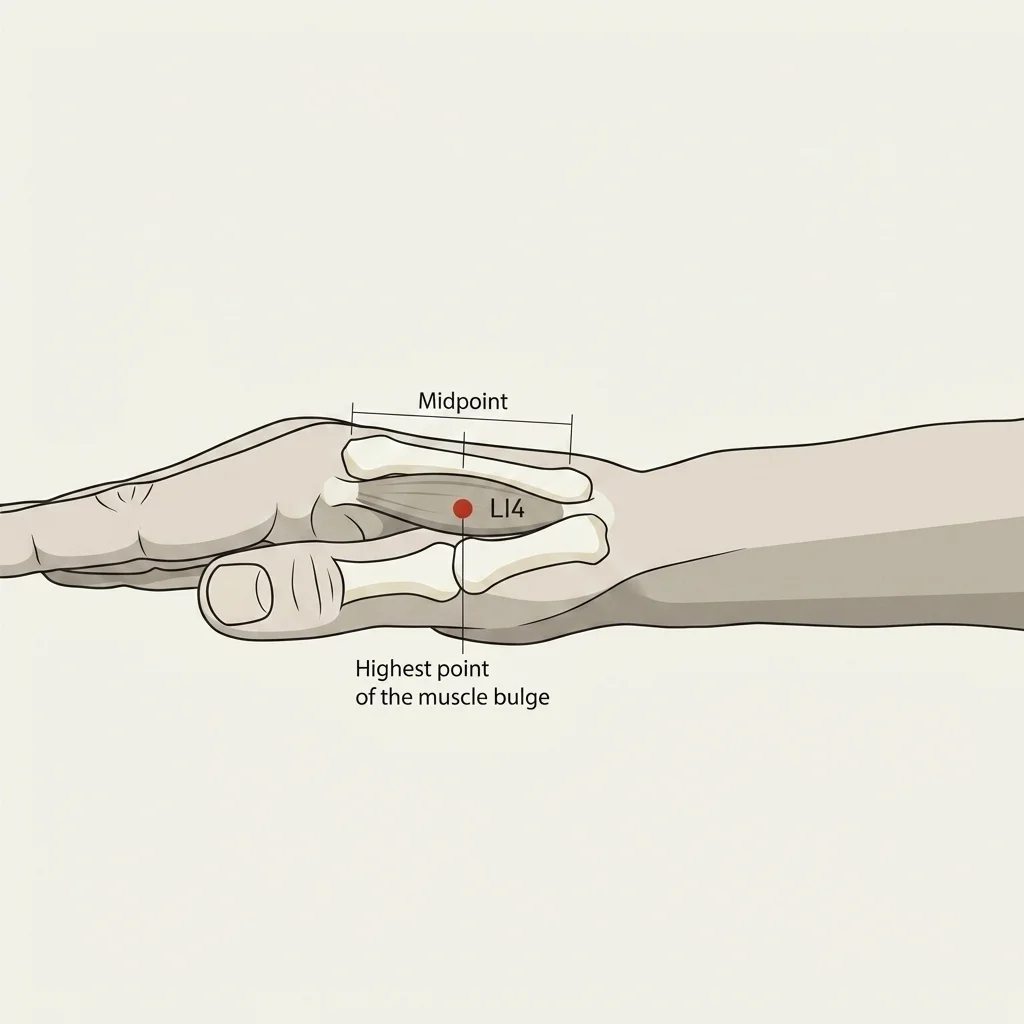
- Location
- On the radial aspect of the hand, between the first and second metacarpal bones, closer to the second metacarpal and approximately at its midpoint — corresponds to the apex of the muscular bulge when the thumb and index finger are brought together.
Prognosis
The prognosis is excellent. Colic is a self-limited condition that resolves spontaneously by 3-4 months in the vast majority of infants, coinciding with maturation of the enteric nervous system and a more diverse microbiota.
There is no evidence that colic harms development; most children develop normally, although some studies report associations with migraine and functional complaints later on.
The main risk is the impact on parental well-being — postpartum depression, marital stress, and, in extreme cases, risk of maltreatment. Parental support is an essential component of management.
Myths and Facts
Myth vs. Fact
Colic is caused by "gas" and gas medications fix it
Simethicone (gas drops) has not outperformed placebo in clinical trials. Colic involves an immature enteric nervous system, not just excess gas.
The mother is doing something wrong with her diet
In most cases, colic has nothing to do with the maternal diet. CMPA, which affects 2-3% of infants in general, is a contributing factor in only a minority of colic cases. The mother is not to blame.
Switching formula resolves colic
Repeated formula switches rarely improve colic and can cause confusion and added stress. Switching to extensively hydrolyzed formula is only indicated when CMPA is clinically suspected.
Babies with colic will have intestinal problems in the future
Some follow-up studies suggest a higher frequency of functional abdominal pain in childhood, but the association is modest and most children do well. Colic is transient.
When to Seek Help
Most cases of colic can be managed with guidance and support. But alarm signs require medical evaluation to rule out organic causes.
Frequently Asked Questions
Colic is self-limited — it resolves spontaneously by 3-4 months in the vast majority of babies. It is not a disease that needs a cure but a developmental phase that passes. The goal of treatment is to ease family suffering during this period.
Yes. Medical acupuncturists have safe, gentle approaches for infants: pediatric tuina (Chinese therapeutic massage) is the best fit, with targeted abdominal massage techniques and stimulation at intestinal regulation points. Laser acupuncture is also painless and well tolerated. Needles can be used in selected cases by an experienced medical acupuncturist.
In most cases it is not necessary — typical colic has no relation to the maternal diet. Dietary exclusion (no dairy) is indicated only when there is clinical suspicion of cow's milk protein allergy, which affects 2-3% of infants in general. The decision should be guided by the physician, not made empirically without evaluation.
Techniques that may help: rhythmic holding (gentle rocking), white noise (a running shower or vacuum), gentle clockwise abdominal massage, prone position over the forearm, swaddling. No single technique works for everyone — try a few and find what works for your baby.
Meta-analyses show that Lactobacillus reuteri DSM 17938 reduces crying time in breastfed infants with colic. The evidence is stronger for exclusively breastfed babies and less consistent for formula-fed infants. Ask your pediatrician whether it is right for your baby.
Clinical studies have not shown simethicone to outperform placebo in reducing colic crying. Its continued use reflects a parental placebo effect and the fact that colic is self-limited. Although safe, it is not recommended as first-line treatment by current pediatric guidelines.
In a minority of cases, yes. Cow's milk protein allergy can cause intense crying similar to colic. Signs that increase this suspicion include blood in the stool, eczema, strong family history of allergy, and crying that does not follow the typical evening pattern of colic. In that case, the physician may indicate an elimination diet for diagnosis.
Pediatric tuina uses therapeutic massage at acupuncture points and along the meridians, which may promote relaxation and help regulate intestinal motility, although clinical evidence is limited. Clockwise abdominal massage (following the path of the large intestine) is a core technique. Parents can learn it and apply it daily at home.
Take the baby to the pediatrician immediately if: fever, projectile or bilious vomiting, blood in the stool, feeding refusal, weight loss, lethargy outside crying episodes, or crying with very intense paroxysmal pain alternating with intervals of lethargy (may indicate intussusception, a surgical emergency).
In the vast majority of cases, no. Colic is transient and most children develop normally. Some follow-up studies associate colic with more migraine, functional abdominal pain or behavior problems in childhood, but it has not been proven that colic causes these conditions. The main impact is on parental well-being — postpartum depression, marital stress. Caring for the parents is an essential part of management.
Related Reading
Deepen your knowledge with related articles