What Is Interstitial Cystitis?
Interstitial cystitis (IC), also called bladder pain syndrome, is a chronic condition characterized by pain or discomfort perceived as related to the bladder, accompanied by urinary urgency and increased frequency, in the absence of infection or another identifiable cause.
It predominantly affects women (5:1 ratio), with an estimated prevalence of 2-5% in the female population. Diagnosis is often delayed — symptoms typically persist for 4-7 years before a correct diagnosis, during which patients are repeatedly treated for urinary infections that are never confirmed.
IC is a chronic pain condition that shares central sensitization mechanisms with fibromyalgia, irritable bowel syndrome, and chronic pelvic pain. Overlap with these conditions is common, suggesting a shared vulnerability to central sensitization syndromes.
Urothelial Barrier Dysfunction
Loss of the protective GAG (glycosaminoglycan) layer from the urothelium lets irritating urinary solutes penetrate the bladder submucosa.
Central Sensitization
Chronic bladder pain sensitizes nociceptive pathways, amplifying pain perception and producing referred pain in the pelvis, perineum, and abdomen.
Diagnosis of Exclusion
Diagnosis requires ruling out urinary infection, bladder cancer, endometriosis, overactive bladder, and other causes of similar symptoms.
Pathophysiology
The pathophysiology of IC is multifactorial. The most accepted theory involves urothelial barrier dysfunction: the layer of glycosaminoglycans (GAG) that lines the urothelium is defective, allowing potassium, urea, and other urinary solutes to penetrate the submucosa, activating mast cells and nociceptive fibers.
Mast cells play a central role, releasing histamine, tryptase, substance P, and inflammatory cytokines in the bladder wall. The resulting neurogenic inflammation activates and sensitizes C afferent fibers, which transmit pain and urgency signals to the sacral segments and higher centers.
Over time, central sensitization sets in: neurons of the dorsal horn of the spinal cord become hyper-responsive, descending inhibitory modulation diminishes, and cortical áreas of pain processing are reorganized. This explains pain amplification, bladder allodynia (pain with normal filling), and pain expansion to neighboring áreas (perineum, abdomen, vulva).
Phenotypes of Interstitial Cystitis
| Phenotype | Features | Principal Mechanism | Therapeutic Response |
|---|---|---|---|
| Hunner ulcer (10-20%) | Ulcerative lesions in the bladder mucosa, reduced capacity | Focal inflammation with lymphocytic infiltrate | Fulguration/injection of the lesion, cyclosporine |
| Non-ulcerative (80-90%) | Glomerulations on cystoscopy, no focal lesion | Barrier dysfunction, neural sensitization | Multimodal treatment, neuromodulation |
| Associated with central sensitization | Overlap with fibromyalgia, IBS, vulvodynia | Predominant central sensitization | Chronic pain approach, neuromodulation |
Symptoms
The classic triad is pelvic/bladder pain, urinary urgency, and increased frequency. Pain typically worsens with bladder filling and is partially relieved by urination. Symptoms fluctuate in flares and remissions, with exacerbations associated with specific foods, stress, and the menstrual cycle.
Clinical Picture of Interstitial Cystitis
Suprapubic pain that worsens with bladder filling
Suprapubic pain, pressure, or discomfort that intensifies as the bladder fills and partially eases after voiding. May radiate to the perineum, vagina, rectum, and urethra.
Extreme urinary frequency
Patients may urinate 20-60 times a day in severe cases, passing very small volumes (50-100 mL). The frequency is driven by the need to keep the bladder empty and avoid pain.
Painful urinary urgency
Unlike OAB, urgency in IC is often accompanied by pain. The patient urinates not only from urgency but to relieve mounting discomfort.
Severe nocturia
Waking multiple times at night to urinate is common. Nocturia in IC is often driven by pain, not just urgency, causing severe sleep deprivation.
Exacerbation by foods and beverages
Caffeine, alcohol, citrus, tomato, artificial sweeteners, and spicy foods often worsen symptoms. An elimination diet can identify individual triggers.
Dyspareunia and pelvic pain
Pain during or after intercourse is very common. Pelvic pain may broaden to include vulvodynia, rectal pain, and pelvic floor musculoskeletal pain.
Diagnosis
The diagnosis of IC is one of exclusion: it requires ruling out urinary infection, carcinoma in situ, bladder endometriosis, bladder stone, and overactive bladder. Cystoscopy with hydrodistension can identify glomerulations and Hunner ulcer but is not mandatory for diagnosis.
Diagnostic Criteria
Source: AUA/SUFU and ESSIC Guidelines
Inclusion Criteria
- Bladder-related pain, pressure, or discomfort lasting > 6 weeks
- At least one urinary symptom: urgency and/or frequency
- Absence of urinary infection or other identifiable cause
- Symptoms must cause significant functional impact
Mandatory Exclusions
- Negative urine culture (repeat if necessary)
- Urinary cytology or cystoscopy if hematuria or risk of neoplasia
- Pelvic ultrasonography: rule out masses
- Gynecologic evaluation: rule out endometriosis and pelvic pathology
Complementary Evaluation
- Potassium sensitivity test (PST): a positive result suggests urothelial barrier dysfunction
- Cystoscopy with hydrodistension: identifies glomerulations and Hunner ulcer
- Bladder biopsy: confirms mastocytosis and inflammatory infiltrate
- Urodynamic study: distinguishes IC from overactive bladder (optional)
Differential Diagnosis
Urinary Tract Infection
- Acute onset
- Dysuria present
- Positive urine culture
- Fever and flank pain — pyelonephritis
Not indicated during acute UTI; can treat residual hypersensitivity
Overactive Bladder
Read more- Urgency and frequency without painful component
- Negative urine culture
- No pain with full bladder
Neuromodulation for overactive bladder; specifically indicated to reduce urgency
Bladder Endometriosis
Read more- Urinary symptoms that worsen with menstruation
- Catamenial hematuria
- Woman of reproductive age
- Cyclic hematuria — mandatory investigation
Modulates central sensitization and associated chronic pelvic pain
Bladder Cancer
- Macroscopic hematuria
- Persistent symptoms in older adults
- Smoking as a risk factor
- Macroscopic hematuria — urgent investigation
Has no role in oncologic treatment
Chronic Prostatitis (in men)
Read more- Perineal and pelvic pain in men
- Obstructive and irritative voiding symptoms
- Normal or mildly elevated PSA
- Fever — acute bacterial prostatitis
Neuromodulates chronic pelvic pain and reduces prostatic inflammation
Recurrent Urinary Tract Infection
Interstitial cystitis is often mistaken for recurrent UTI, causing diagnostic delays of several years. The key to the differential is simple: in IC, urine cultures are consistently negative. Women with recurring urinary symptoms and negative cultures should be investigated for IC before further antibiotic courses.
Beyond negative cultures, IC features pain as the central component — suprapubic or pelvic pain that progressively worsens as the bladder fills. This pain, typically relieved by voiding, is the clinical marker that distinguishes IC from OAB and UTI. A voiding diary that also records pain is a valuable diagnostic tool.
Bladder Endometriosis
Endometriosis affects the bladder in 1-2% of cases, producing cyclic urinary symptoms that worsen during menstruation — catamenial hematuria, urgency, and frequency that intensify around the cycle. This cyclic pattern distinguishes bladder endometriosis from IC, which is not tied to the menstrual cycle.
Cystoscopy can reveal endometriotic implants in the bladder mucosa, often with a characteristic blue-violet color. Pelvic MRI is the test of choice for surgical planning. Treatment is hormonal and, in cases with transmural involvement, surgical.
Overactive Bladder
Distinguishing IC from OAB is essential because the treatments differ. In OAB, the dominant symptom is urinary urgency with or without incontinence, without a significant pain component. In IC, pain is the central symptom — urgency without pain is unlikely in IC.
The Pelvic Pain and Urgency/Frequency (PUF) scale aids differentiation. High pain scores favor IC; dominant urgency without pain favors OAB. Many patients have a mixed picture, which requires a combined therapeutic approach.
Treatment
Treatment of IC is multimodal and individualized. There is no cure, but symptoms can be significantly controlled with a combination of approaches. The AUA stepwise approach guides progressive treatment.
Education and Self-Care
Elimination diet (identify and avoid food triggers). Stress management. Pelvic relaxation techniques. Heat application. Adapted bladder training. Psychological support and support groups.
Physical Therapy and Oral Therapy
Pelvic floor physical therapy with relaxation techniques (trigger points, stretching). Amitriptyline (10-75 mg) for neuropathic pain and improved sleep. Hydroxyzine (antihistamine). Pentosan polysulfate sodium (restores the GAG barrier).
Intravesical Instillations
DMSO (dimethyl sulfoxide): intravesical anti-inflammatory and analgesic. Intravesical heparin + lidocaine. Intravesical hyaluronic acid (restores the GAG barrier). DMSO + heparin + bicarbonate + triamcinolone cocktail.
Fourth-Line Treatments
Bladder hydrodistension (temporary therapeutic effect). Sacral neuromodulation. Fulguration or injection of Hunner ulcers. Intravesical botulinum toxin. Cyclosporine A for cases with Hunner ulcers.
- Treatment of IC is multimodal and individualized.
- There is no cure, but symptoms can be significantly controlled with a combination of approaches.
- The AUA stepwise approach guides progressive treatment.
Acupuncture as Treatment
Acupuncture has been studied in IC as an intervention with the potential to act on multiple pathologic mechanisms — proposed mechanisms include pain modulation (involving the endogenous opioid system), reduction of neurogenic inflammation (with described modulation of substance P and CGRP in experimental models), and effect on central sensitization.
Points such as CV-3, CV-4, SP-6, BL-32, BL-33, and LR-3 are used to modulate bladder afferents, reduce mast cell hyperactivity, and promote pelvic floor relaxation. Electroacupuncture at sacral points can directly modulate the S2-S4 nerves that control bladder sensitivity.
Acupuncture also addresses components often overlooked in IC: stress, anxiety, sleep disturbances, and pelvic floor muscle tension. An integrative approach to IC that includes acupuncture aligns with the multidimensional nature of the condition.
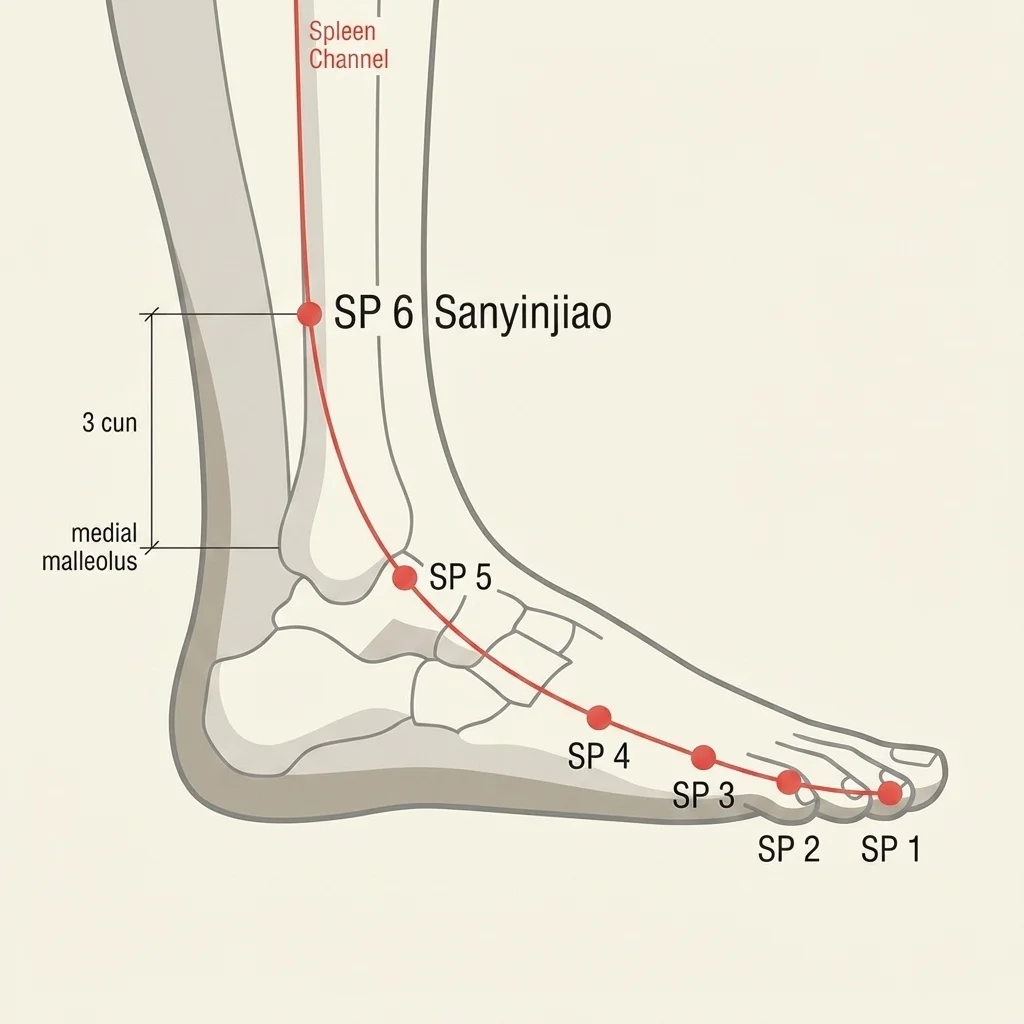
- Location
- On the medial aspect of the leg, 3 cun above the most prominent point of the medial malleolus, in a depression near the posterior border of the medial crest of the tibia.
Prognosis
IC is a chronic condition with a fluctuating course. Spontaneous remissions occur in 30-50% of patients and may last months to years. Most patients achieve adequate symptom control with multimodal treatment, although complete cure is rare.
Prognosis is better when diagnosis is early, treatment is multimodal, and comorbidities (fibromyalgia, IBS, depression) are treated simultaneously. A patient-centered approach with active participation in management is associated with better long-term outcomes.
Myths and Facts
Myth vs. Fact
Interstitial cystitis is just chronic urinary infection.
IC is NOT caused by infection. Urine cultures are negative. The condition involves urothelial barrier dysfunction, neurogenic inflammation, and central sensitization. Repeated antibiotics are ineffective and cause unnecessary adverse effects.
Myth vs. Fact
There is no effective treatment for IC.
Although there is no cure, multiple treatments can improve symptoms: diet, physical therapy, oral medications, intravesical instillations, and neuromodulation; acupuncture can be used as a complement, with limited evidence. A multimodal approach gives most patients adequate control.
Myth vs. Fact
IC is a psychosomatic disease.
IC has a well-established pathophysiologic basis: GAG barrier dysfunction, mastocytosis, neurogenic inflammation, and central sensitization. It is a real chronic pain condition with demonstrable mechanisms, not a psychological manifestation.
When to Seek Help
Frequently Asked Questions
Interstitial cystitis (IC), also called bladder pain syndrome, is a chronic condition marked by bladder-related pelvic pain, pressure, or discomfort, along with increased urinary frequency (up to 60 times a day in severe cases) and urgency. The diagnostic delay — on average 4 to 7 years after symptom onset — occurs because there is no specific laboratory marker and conventional urine tests are usually normal. The condition is often mistaken for recurrent urinary infections, overactive bladder, or endometriosis.
Medical acupuncture targets the central mechanisms of interstitial cystitis on multiple fronts. First, it modulates central sensitization — the process by which the nervous system amplifies pain signals — reducing visceral bladder hypersensitivity. Second, it triggers release of endorphins and enkephalins, neurotransmitters with natural analgesic effect. Third, an effect on local microcirculation has been proposed, not yet confirmed in humans. Small clinical studies suggest reduced pain and urinary frequency after acupuncture cycles, but the evidence is still limited.
There is currently no curative treatment for interstitial cystitis — the goal is symptom control and better quality of life. Even só, many patients achieve prolonged remission or minimal symptoms with proper treatment. A multimodal approach — combining dietary changes, bladder training, physician-directed pelvic floor physical therapy, medical acupuncture, and pharmacotherapy when needed — gives the best results. Some patients report periods of spontaneous remission, especially after identifying and avoiding their individual triggers.
The foods most often reported as interstitial cystitis triggers include caffeine (coffee, tea, cola sodas), alcohol, citrus fruits and acidic juices, tomato and tomato products, spicy foods, artificial sweeteners (especially saccharin and aspartame), chocolate, and vinegar. Food sensitivity is highly individual — keeping a food diary is recommended to identify your specific triggers. An elimination diet followed by gradual reintroduction under medical guidance is the most precise way to identify which foods worsen your symptoms.
Yes, interstitial cystitis can significantly affect sex life. Dyspareunia (pain during intercourse) is reported by up to 60% of women with IC and may occur during or after intercourse. In men, it can cause post-ejaculatory pelvic pain. Useful strategies include intercourse positions that reduce bladder pressure, urinating before and immediately after intercourse, and using adequate lubricants. Medical acupuncture can be considered for the associated pelvic pain, but there is no evidence that it improves sexual function. Communication with the partner and, when indicated, psychological support are an important part of treatment.
Telling them apart is essential because treatment is completely different. In bacterial urinary tract infection (UTI), urine cultures show bacterial growth (positive urine culture), symptoms arise acutely, often with fever, and respond to antibiotics within days. In interstitial cystitis, urine cultures are negative, symptoms are chronic (present for more than 6 weeks), there is no fever, and antibiotics do not help. IC patients often receive multiple courses of antibiotics without improvement before the correct diagnosis is reached.
Because it is a chronic condition driven by central sensitization, interstitial cystitis generally requires a greater commitment to acupuncture treatment than acute conditions do. A typical initial cycle is 12 to 16 sessions, at 1 to 2 sessions per week. Improvement is usually gradual — reduced urinary frequency and lower pain intensity are the first noticeable gains, generally from the 4th to 6th session. After the initial cycle, monthly maintenance sessions are recommended to preserve results, especially during periods of greater stress.
Yes, interstitial cystitis frequently coexists with other centralized pain syndromes, suggesting shared pathophysiologic mechanisms. The most common comorbidities include: fibromyalgia (up to 30% of patients with IC), irritable bowel syndrome, chronic fatigue syndrome, vulvodynia, migraine, and autoimmune diseases such as lupus and Sjogren syndrome. This overlap of conditions is known as "central sensitivity syndromes" and reinforces the importance of a treatment approach that includes modulation of the central nervous system — an área in which medical acupuncture is being studied, with still limited evidence.
Yes, stress is one of the triggers most consistently reported by patients with interstitial cystitis. The mechanism involves activation of the hypothalamic-pituitary-adrenal axis, which releases cortisol and catecholamines that increase urothelial barrier permeability and amplify central pain sensitization. Many patients report IC flares during periods of intense stress. By activating the parasympathetic nervous system and modulating the stress response, medical acupuncture can reduce both the frequency and intensity of flares. Complementary stress-management techniques, recommended by the physician, enhance results.
Seek specialized medical evaluation if you have chronic pelvic or bladder pain (more than 6 weeks), markedly increased urinary frequency without confirmed infection, symptoms that do not improve with antibiotics, symptoms that worsen with foods or stress, or significant impact on daily activities, work, or sex life. Interstitial cystitis is diagnosed by ruling out other causes, só a thorough medical workup is essential. A medical acupuncturist experienced in chronic pelvic pain can help with both the differential diagnosis and the integrated treatment of the condition.
Related Reading
Deepen your knowledge with related articles