Skip to content





Channel Flow Telemetry · SP
- 21
- Channel points
- 6/21 (29%)
- With clinical trials
- 264
- Study citations
- 86
- Randomized RCTs
Quick jump to top trial-backed points:SP6Sanyinjiao(167 trials)SP9Yinlingquan(42 trials)SP10Xuehai(36 trials)SP4Gongsun(8 trials)SP8Diji(8 trials)SP3Taibai(3 trials)
The meridian line
The points in order, like the stations of a line. Each station opens the point’s page.
See the numbers: The meridian line
| Point | Special role | Safety |
|---|---|---|
| SP 1 | Five Shu | Caution |
| SP 2 | Five Shu | Caution |
| SP 3 | Yuan-Source, Five Shu | Caution |
| SP 4 | Luo-Connecting | Safe |
| SP 5 | Five Shu | Caution |
| SP 6 | — | Caution |
| SP 7 | — | Safe |
| SP 8 | Xi-Cleft | Safe |
| SP 9 | Five Shu | Safe |
| SP 10 | — | Safe |
| SP 11 | — | Caution |
| SP 12 | — | Caution |
| SP 13 | — | Danger |
| SP 14 | — | Caution |
| SP 15 | — | Danger |
| SP 16 | — | Danger |
| SP 17 | — | Danger |
| SP 18 | — | Danger |
| SP 19 | — | Danger |
| SP 20 | — | Danger |
| SP 21 | Luo-Connecting | Danger |
SP 1Yinbai
Hidden WhiteCaution
SP 2Dadu
Great CapitalCaution
SP 3Taibai
Supreme WhiteCaution
SP 4Gongsun
Grandfather-GrandsonSafe
SP 5Shangqiu
Shang MoundCaution
SP 6Sanyinjiao
Three Yin IntersectionCaution
SP 7Lougu
Leaking ValleySafe
SP 8Diji
Earth PivotSafe
SP 9Yinlingquan
Yin Mound SpringSafe
SP 10Xuehai
Sea of BloodSafe
SP 11Jimen
Winnower GateCaution
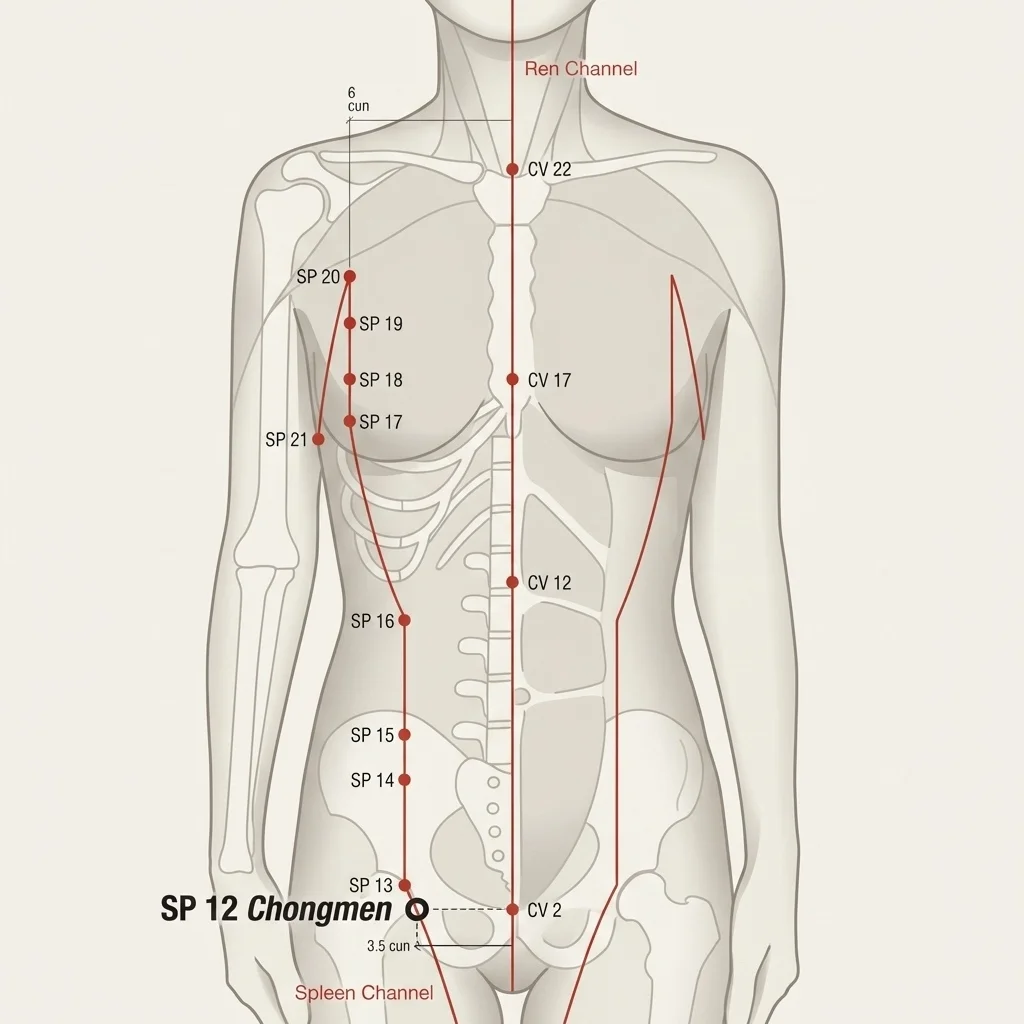
SP 12Chongmen
Surging GateCaution
SP 13Fushe
Bowel AbodeDanger
SP 14Fujie
Abdomen KnotCaution
SP 15Daheng
Great HorizontalDanger
SP 16Fuai
Abdomen SorrowDanger
SP 17Shidou
Food HoleDanger
SP 18Tianxi
Heavenly StreamDanger
SP 19Xiongxiang
Chest VillageDanger
SP 20Zhourong
All-Around FlourishingDanger
SP 21Dabao
Great EmbracementDanger
Depth profile
Needling depth along the meridian, point by point, measured in cun.
Each band runs from the minimum to the maximum depth recorded for the point, in cun, the unit proportional to each patient’s body (not millimetres). Where there is room, a mark above the band shows the direction of insertion: upright (perpendicular), slanted (oblique), flat (transverse), dot (prick-to-bleed); the table gives it for every point. Red square: point marked as danger.
See the numbers: Depth profile
| Point | Depth | Insertion | Danger |
|---|---|---|---|
| SP 1 | 0.1 cun | Prick-to-bleed | — |
| SP 2 | 0.2–0.4 cun | Perpendicular | — |
| SP 3 | 0.5–0.8 cun | Perpendicular | — |
| SP 4 | 0.5–0.7 cun | Perpendicular | — |
| SP 5 | 0.2–0.3 cun | Perpendicular | — |
| SP 6 | 0.5–1 cun | Oblique | — |
| SP 7 | 0.5–1 cun | Perpendicular | — |
| SP 8 | 0.5–1 cun | Perpendicular | — |
| SP 9 | 0.5–1 cun | Perpendicular | — |
| SP 10 | 0.7–1.2 cun | Oblique | — |
| SP 11 | 0.8–1.2 cun | Perpendicular | — |
| SP 12 | 0.5–0.7 cun | Perpendicular | — |
| SP 13 | 0.7–1 cun | Perpendicular | yes |
| SP 14 | 0.7–1 cun | Perpendicular | — |
| SP 15 | 0.7–1 cun | Perpendicular | yes |
| SP 16 | 0.7–1 cun | Perpendicular | yes |
| SP 17 | 0.3–0.5 cun | Transverse | yes |
| SP 18 | 0.3–0.5 cun | Transverse | yes |
| SP 19 | 0.3–0.5 cun | Transverse | yes |
| SP 20 | 0.3–0.5 cun | Transverse | yes |
| SP 21 | 0.3–0.5 cun | Transverse | yes |