What Is Segmental Acupuncture?
Segmental acupuncture is a medical acupuncture approach that uses knowledge of the segmental neuroanatomy of the spinal cord to select needle insertion points. Instead of selecting points based on traditional classifications, the medical acupuncturist chooses points located in the dermatomes, myotomes, and sclerotomes corresponding to the spinal segment involved in generating the patient's pain.
The concept is elegantly simple: if pain originates from a nerve root at L4-L5 (as in a lumbar disc herniation), needling tissues innervated by the same segment — thigh, leg, the corresponding paravertebral muscles — modulates nociception directly at the spinal level where the problem originates. The "gate" closes in the same pathway the pain signal travels.
The Neuroanatomical Basis of Segmental Modulation
The spinal cord is not just a cable carrying signals between periphery and brain. It is a processing center with its own inhibitory and excitatory circuits, able to modulate nociceptive transmission independently of the brain. In the dorsal horn — particularly Rexed laminae I, II, and V — gate control theory operates, and segmental acupuncture exerts its greatest local effect.
Dorsal horn neurons receive convergent afferents from multiple structures in the same segment: skin (dermatome), muscle (myotome), periosteum and joints (sclerotome), and viscera (viscerotome). This convergence explains referred pain — and also why stimulating any structure within the same dermatome can modulate pain originating in another structure of the same segment.
Diagnosis of the involved spinal segment
The physician identifies the nerve root driving the pain — through neurological exam, affected dermatome, radiation pattern, and imaging (MRI, electromyography). E.g., an L4-L5 herniation compressing the L5 root.
Selecting points in the corresponding dermatome and myotome
Points in the L5 dermatome (lateral leg, dorsum of the foot) and L5 myotome (hallux extensors, peroneals) are chosen for insertion. Paravertebral Jiaji points at L4-L5 are added.
Insertion and generation of segmental afferent signal
The needle activates A-delta and A-beta fibers in the L5 dermatome/myotome. These afferents reach the spinal dorsal horn at exactly the L4-L5 level — the same segment where the compressed root fires the nociceptive signal.
Segmental inhibition in the dorsal horn
Inhibitory interneurons of the dorsal horn (GABAergic and enkephalinergic) can be activated by the needle signal, partially suppressing the transmission of the nociceptive signal from the compressed root. The "gate" tends to close at the same level as the lesion, according to neurophysiological models.
Local anti-inflammatory effect and reflex neuromodulation
Segmental stimulation can reduce local release of substance P, CGRP, and glutamate — pro-inflammatory neuropeptides that sustain peripheral and central hypersensitization, per experimental studies. Segmental autonomic reflexes can also ease paravertebral muscle spasm.
Jiaji Points: Acupuncture Directly at the Nerve Root
The Jiaji points (also called Huatuojiaji, EX-B2) are a set of 34 paravertebral acupuncture points located bilaterally, 0.5 cun lateral to the spinous process of each vertebra, from T1 to L5 bilaterally — 17 pairs = 34 points. These points have particular relevance in segmental acupuncture because they are anatomically superimposed on the exit site of the nerve roots.
Needling the Jiaji points at the affected level stimulates the dorsal ramus of the spinal nerve and the paravertebral multifidus muscles of the same segment. The effect is high-specificity segmental neuromodulation — acting directly at the "source" of the radiculopathy.
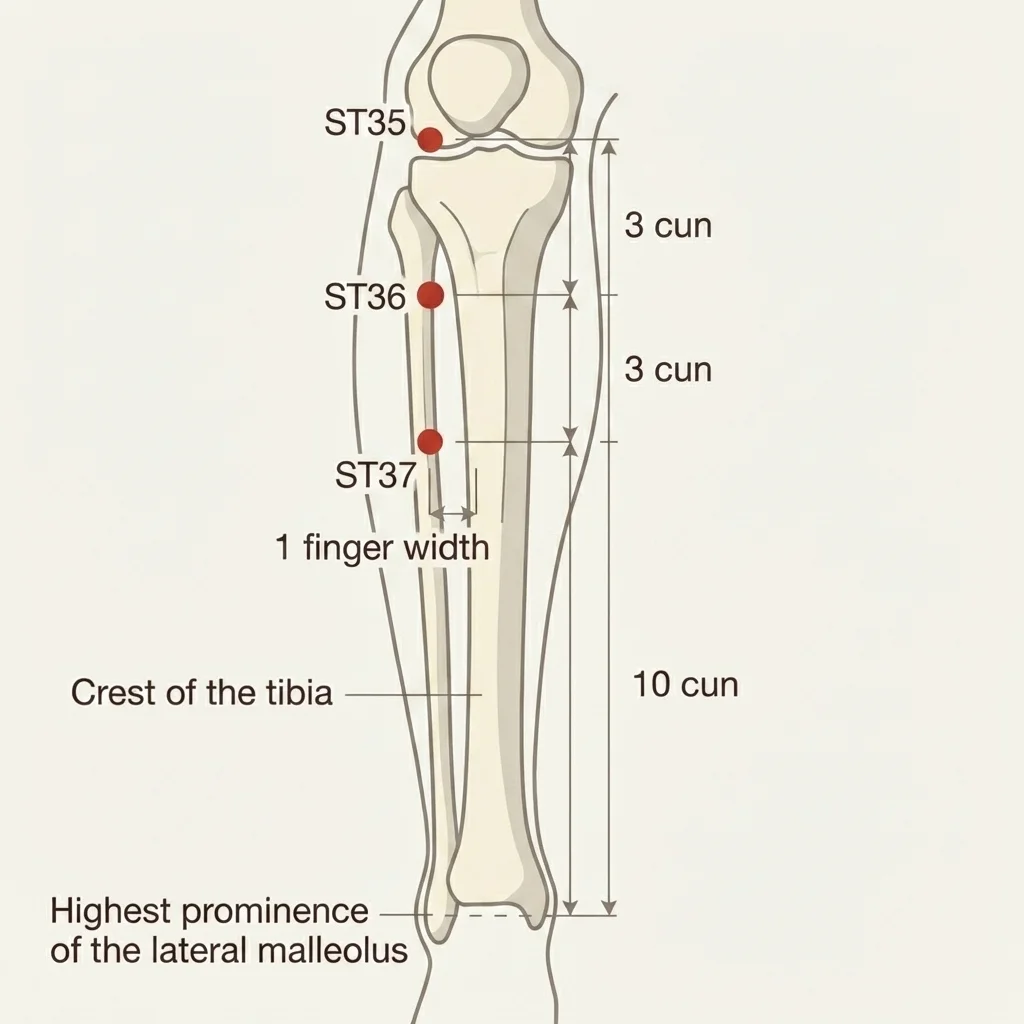
- Location
- On the anterior surface of the leg, 3 cun below ST-35, one finger-breadth (middle finger) lateral to the anterior crest of the tibia
Clinical Applications of Segmental Acupuncture
Segmental acupuncture is especially relevant when the nerve root or spinal segment is the primary pain generator:
| Condition | Segment Involved | Segmental Approach |
|---|---|---|
| Low back pain with L4-L5 radiculopathy | L4, L5 | Jiaji L4-L5 + points in the L4/L5 dermatome on the leg |
| Sciatica from L5-S1 herniation | L5, S1 | Jiaji L5-S1 + BL40, BL57, BL60 along the sciatic nerve path |
| Cervicalgia with C6-C7 brachialgia | C6, C7 | Jiaji C6-C7 + points in the C6/C7 dermatome on the forearm/hand |
| Thoracic post-herpetic neuralgia | Affected dermatome | Jiaji + points in the corresponding thoracic dermatome |
| Distal diabetic neuropathy | L4–S1 (predominant) | Distal points in the foot/ankle + lumbosacral Jiaji |
| Carpal tunnel syndrome | C6-C8, T1 | Cervical segmental combination + local at the wrist |
Segmental vs. Systemic Acupuncture: Complementary, Not Competing
Segmental acupuncture is not the only approach within medical acupuncture — it is one tool in the medical acupuncturist's arsenal. It complements the systemic approach, which uses points with possible supraspinal action — capable of modulating endogenous opioid circuits and the HPA axis, as described in experimental and clinical studies — contributing to more generalized analgesia.
The experienced physician integrates both approaches: segmental points to target the specific origin of the pain and systemic points (such as ST36, SP6, LI4, GV20) to amplify the central analgesic response. This combination is standard practice in modern medical acupuncture.
Segmental acupuncture
- Uses the segmental neuroanatomy of the spinal cord to select needle insertion points.
- Targets the specific origin of the pain.
- Combines paravertebral Jiaji points with points in the corresponding dermatome.
- Exerts its greatest local effect in the dorsal horn.
Systemic acupuncture
- Uses points with possible supraspinal action.
- Capable of modulating endogenous opioid circuits and the HPA axis, as described in experimental and clinical studies.
- Contributes to more generalized analgesia.
- Uses points such as ST36, SP6, LI4, GV20 to amplify the central analgesic response.
Clinical Evidence for Segmental Acupuncture
Acupuncture with a segmental approach — including Jiaji points and points in the corresponding dermatome — has growing evidence in studies of chronic low back pain with a radicular component, cervicalgia with brachialgia, and peripheral neuropathies.
- Individual patient data meta-analysis by Vickers et al. (<em>J Pain</em>, 2018; Acupuncture Trialists Collaboration): modest benefit of acupuncture over sham and larger benefit over no treatment in chronic pain, including low back pain.
- Trial by Molsberger et al. (Pain, 2002): acupuncture added to conservative orthopedic treatment outperformed sham in chronic low back pain — a single trial that does not by itself confirm the specificity of the segmental effect.
- Paravertebral Jiaji points for discogenic low back pain: available studies are generally small, and evidence of superiority over conventional treatment remains limited.
- Preliminary electromyography studies are investigating the effect of acupuncture at Jiaji points on multifidus activity, but conclusive data are lacking.
Frequently Asked Questions
Frequently Asked Questions
For herniations without severe neurological déficit (no paresis, no cauda equina syndrome), segmental acupuncture can effectively control pain and reduce associated muscle spasm. It does not mechanically reduce the herniation, but it modulates the pain perception caused by root compression. Some studies suggest improvement in pain and function, but evidence comparing it with conservative pharmacological treatment is limited. The physician decides between surgical and conservative options based on the full clinical picture.
Dry needling inserts needles into myofascial trigger points, primarily targeting local muscle spasm. Segmental acupuncture goes further: it treats the entire spinal segment, dermatome, and myotome, including paravertebral Jiaji points and distal points along the nerve path. Both use needles, but their point-selection logic and therapeutic goals differ.
When performed by a trained physician, Jiaji-point insertion is safe. The physician relies on precise anatomical knowledge to set safe depth and angle. Jiaji points are needled with fine needles (0.20–0.25 mm) at an oblique angle, avoiding neural and vascular structures. Medical acupuncture training covers the at-risk anatomy for these points.
Segmental acupuncture and interventional blocks (epidural, facet block, radiofrequency) have distinct mechanisms and are not directly comparable. For severe radicular pain with acute inflammation, an epidural corticosteroid block may bring faster relief. For maintenance and preventing recurrences, segmental acupuncture serves as an adjuvant. The physician decides the best combination of modalities based on pain intensity, chronicity, and character.