Skip to content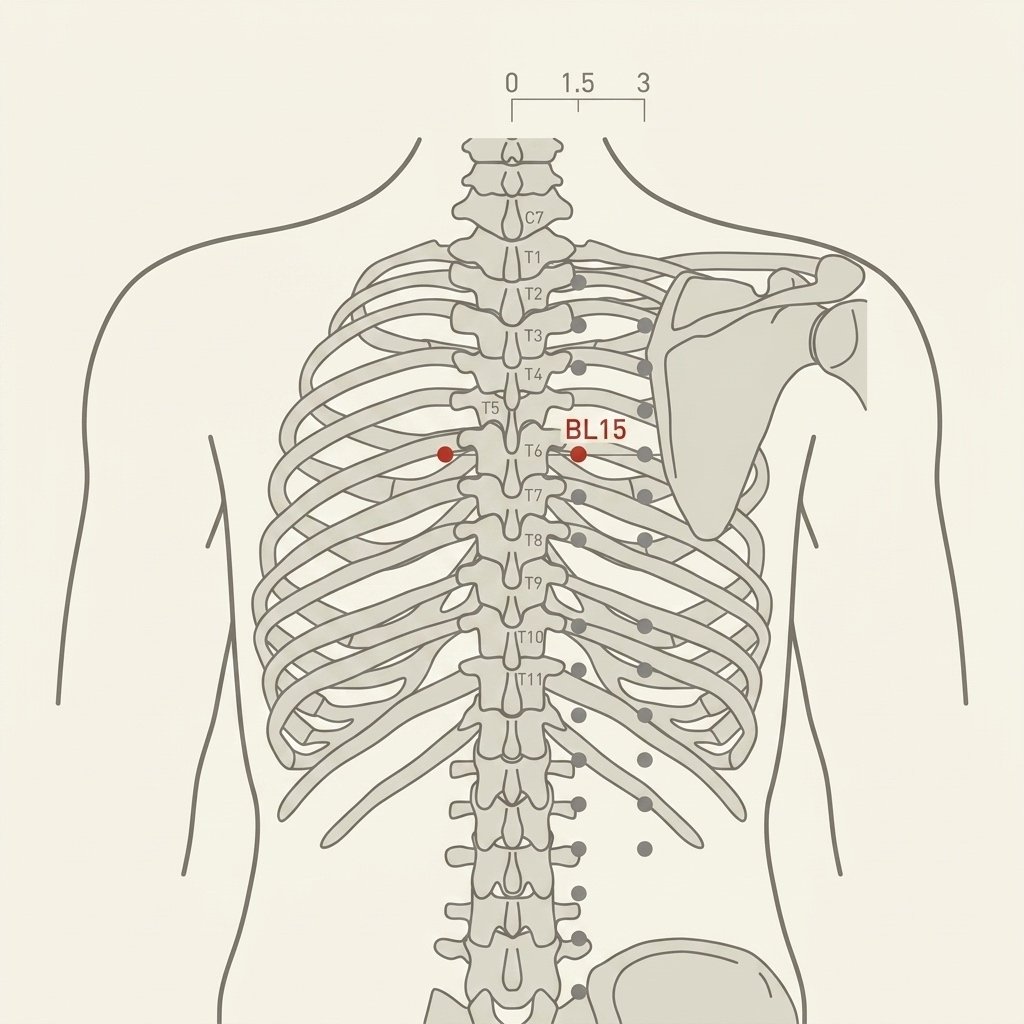
BL-15 Xinshu (心俞) — Heart Shu
Depth
00.5–0.8 cun3.0
Oblique insertion
Precautions
High risk of pneumothorax.
Location (classical)
1.5 cun lateral to the inferior border of the spinous process of the fifth thoracic vertebra (T5), at the highest point of the paravertebral musculature.
How to find it (practical)
Seated with the neck flexed or in prone position, locate the point below the spinous process of the fifth thoracic vertebra (T5), 1.5 cun lateral to the posterior midline, level with Shen Dao (GV-11) (WHO 2008, §BL-15).
Anatomy
Trapezius, rhomboid major, and erector spinae muscles.
Needling
Oblique insertion toward the spine, 0.5–0.8 cun.
Etymology
Xin (心), Heart; Shu (俞), transport point. The place where the Qi of the Xin (Heart) reaches the back and emerges on the Bladder Meridian, designating the Back-Shu (Bei Shu) point of the Heart (Deadman, A Manual of Acupuncture, 2007, p. 282).
CLASSICAL SOURCELing Shu
Clinical Relations
Point Pairs
Back-Shu/Front-MuCV-14 Juque
Adjacent Points on the Meridian