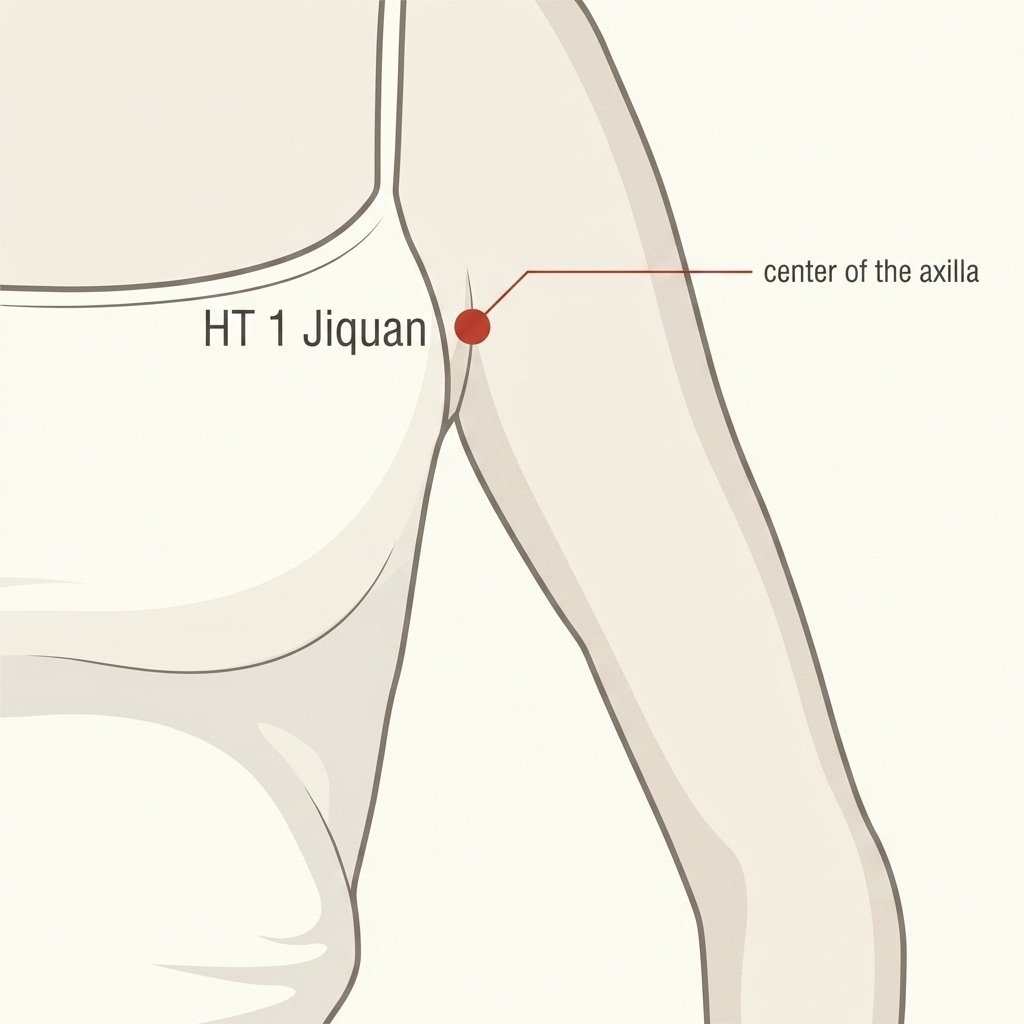
Avoid puncturing the axillary artery. Medial insertion toward the chest wall carries a high risk of pneumothorax.
📍 Location (classical)
In the center of the axilla, in the depression on the medial side of the axillary artery. Locate with the arm abducted.
🧭 How to find it (practical)
With the elbow flexed and the arm abducted, locate the point in the center of the axillary fossa.
🔬 Anatomy
Inferior border of the pectoralis major and latissimus dorsi muscles, coracobrachialis muscle. Innervated by the ulnar nerve, median nerve, and medial cutaneous nerve of the arm. The axillary artery and vein lie directly adjacent.
💉 Needling
Perpendicular insertion, 0.5–1.0 cun.
📜 Etymology
Ji (極), extreme; Quan (泉), spring. The point lies in the deepest part of the axillary depression.