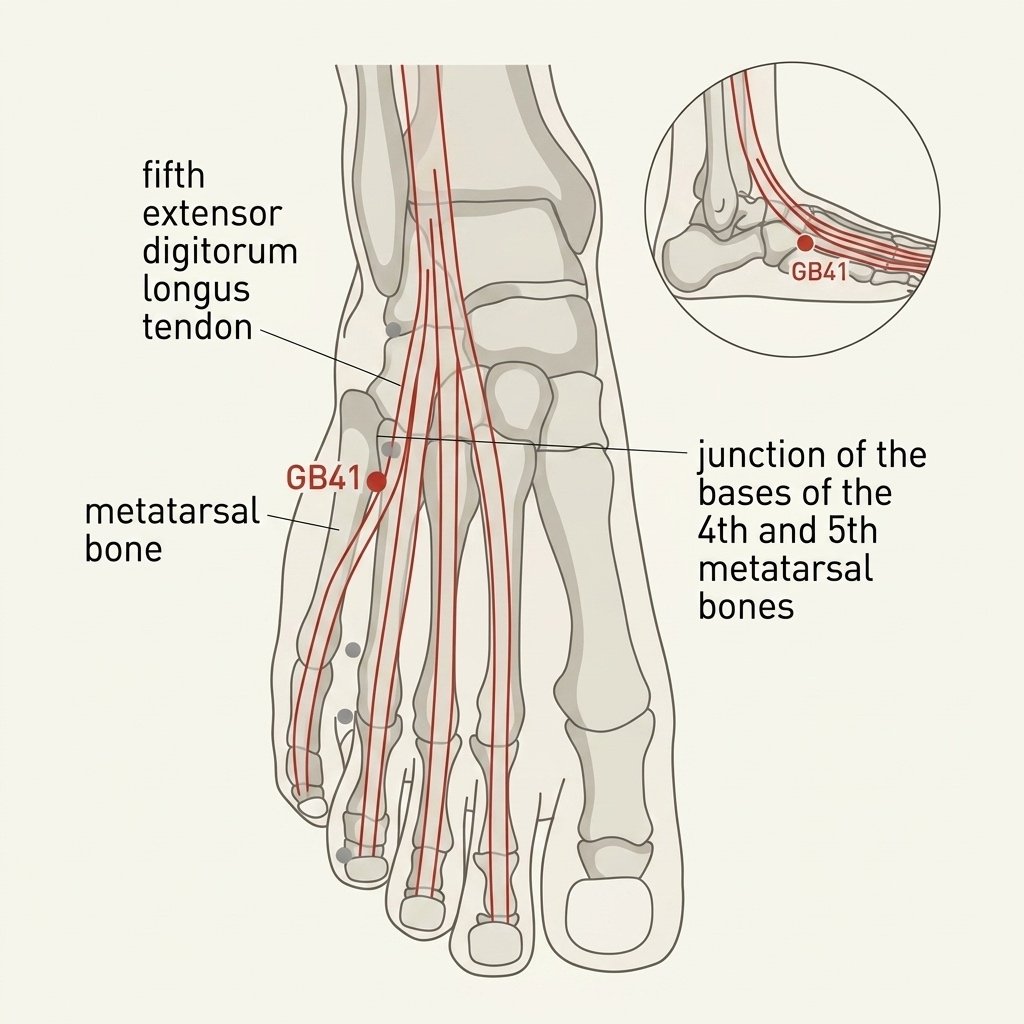
Ponto Shu-Riacho (Madeira)Ponto Confluente do Dai Mai (Vaso da Cintura)Ponto Confluente do Dai MaiSafeMembro Inferior
Depth
00.5–0.8 cun3.0
Oblique insertion
Precautions
No special precautions.
📍 Location (classical)
On the dorsum of the foot, in the depression distal to the junction of the 4th and 5th metatarsal bones, on the lateral side of the tendon of the extensor digitorum longus (the branch to the little toe).
🧭 How to find it (practical)
Seated with the feet supported, locate the point on the lateral border of the dorsum of the foot, between the fourth and fifth metatarsals, proximal to the metatarsophalangeal joint of the fourth and fifth toes, on the lateral aspect of the tendon of the extensor digitorum longus muscle.
🔬 Anatomy
Fourth dorsal interosseous muscle. Innervated by the intermediate dorsal cutaneous nerve (a branch of the superficial fibular nerve).
💉 Needling
Perpendicular or slightly oblique insertion, 0.5–0.8 cun.
📜 Etymology
Zu (足), foot; Lin (临), treatment; Qi (泣), to weep. Although the point lies on the foot, it is indicated in the treatment of lacrimation and other eye disorders.