Skip to content
Skip to content

GV-20 Baihui (百會) — Hundred Convergences

GV-20
Baihui
百會
Hundred Convergences · Hundred Meetings
GV-20 Baihui — Hundred Convergences
★ MajorEncontro Du Mai-BexigaVesícula BiliarTriplo AquecedorSafeCabeça
Depth
00.5–0.8 cun3.0
Transverse insertion
Precautions
No standard precautions
Location (classical)
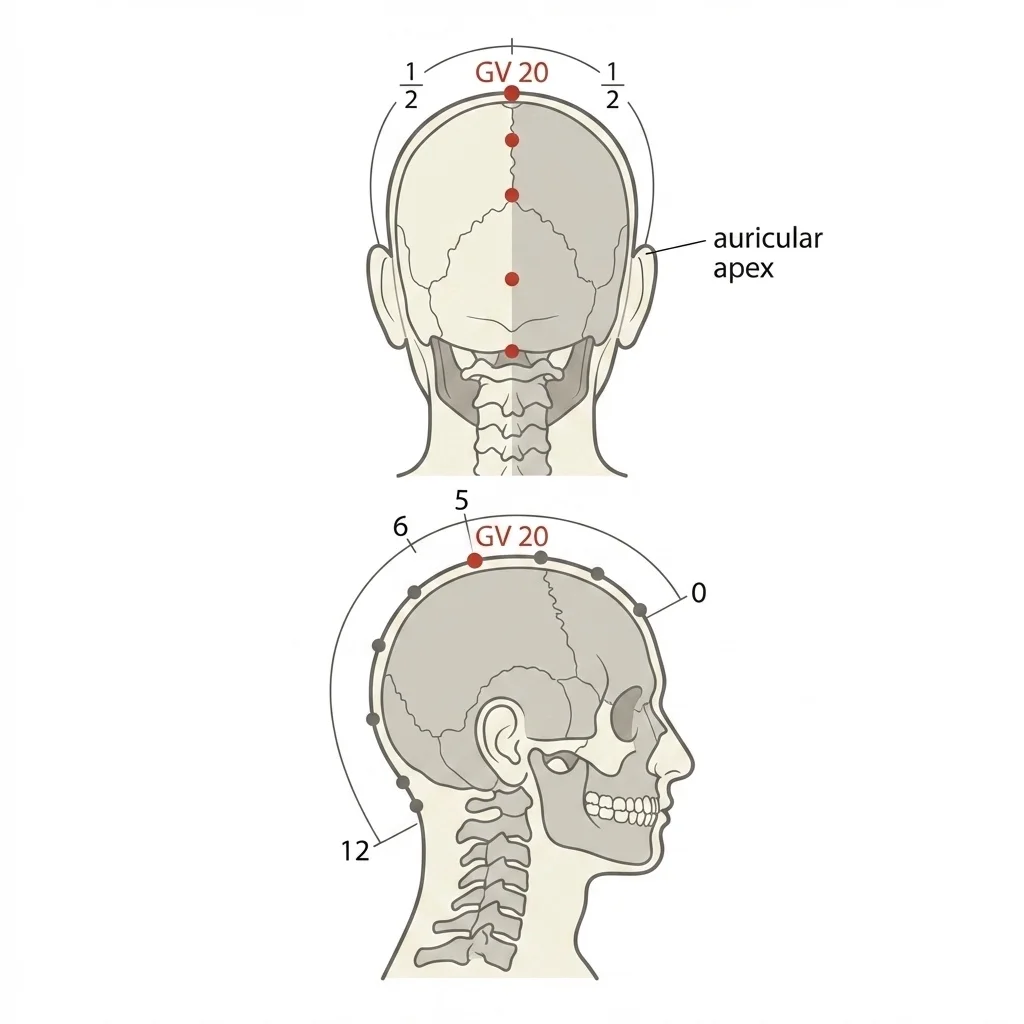
At the vertex of the head, on the midline, 5 cun posterior to the anterior hairline (and 7 cun superior to the posterior hairline) — directly at the intersection of the midline with the line connecting the auricular apices
How to find it (practical)
With the patient seated, locate the point 1 cun anterior to the midpoint of the line connecting the anterior and posterior hairlines. Alternatively, locate it at the intersection of the median line of the head with the line connecting both auricular apices, with the ears folded forward.
Anatomy
Epicranial aponeurosis. Innervated by the greater occipital nerve and the frontal nerve
Needling
Transverse (subcutaneous) insertion, directed anteriorly or posteriorly, 0.5–0.8 cun
Etymology
Bai (百), hundred; Hui (會), meeting. The point sits at the vertex where the three Hand and Foot Yang meridians, the Hand and Foot Jue Yin meridians, and the Du Mai all converge.

Clinical Relations

Classical Combinations
Hypertension, dizziness, loss of consciousness, calming the mind
Adjacent Points on the Meridian

GV 20 in research

How many Library studies cite this point, since when, and with which designs and verdicts.

Studies
69Library studies cite GV 20
By year
20022026
Verdict
  • Strong19
  • Moderate48
  • Limited1
  • Weak1
Study designs
  • Meta-analysis15
  • Systematic Review9
  • RCT16
  • Clinical Guideline1
  • Case Series1
  • Narrative Review18
  • Other designs9
Depth
0.5–0.8 cunTransverse

Each study counts once, under the most specific design it states. The verdict is the Library’s word for the strength of each study’s evidence.

See the numbers: GV 20 in research
YearStudies
20022
20041
20071
20081
20091
20101
20122
20132
20143
20161
20171
20181
20193
20207
202111
20228
20237
20248
20252
20266

Often appears with

Points the Library studies cite together with GV 20. It shows research practice, not a prescription.

  1. ST 3639 studies in common
  2. SP 627 studies in common
  3. LI 426 studies in common
  4. HT 722 studies in common
  5. PC 621 studies in common
  6. LR 321 studies in common
  7. GB 2010 studies in common
  8. EX-HN310 studies in common

Each filled mark stands for 5 studies; an open mark, for 1 to 4.

Related Articles

6

Translation and clinical dataProf. Dr. Hong Jin Pai — Meridians: Theory and Clinical Practice, 4th edition. CEIMEC · São Paulo.

CodingWHO Standard Acupuncture Point Locations (2008) for classical and extra points.