Deep insertion carries a risk of puncturing the jugular vein or the carotid artery — the common carotid artery must be strictly avoided.
📍 Location (classical)
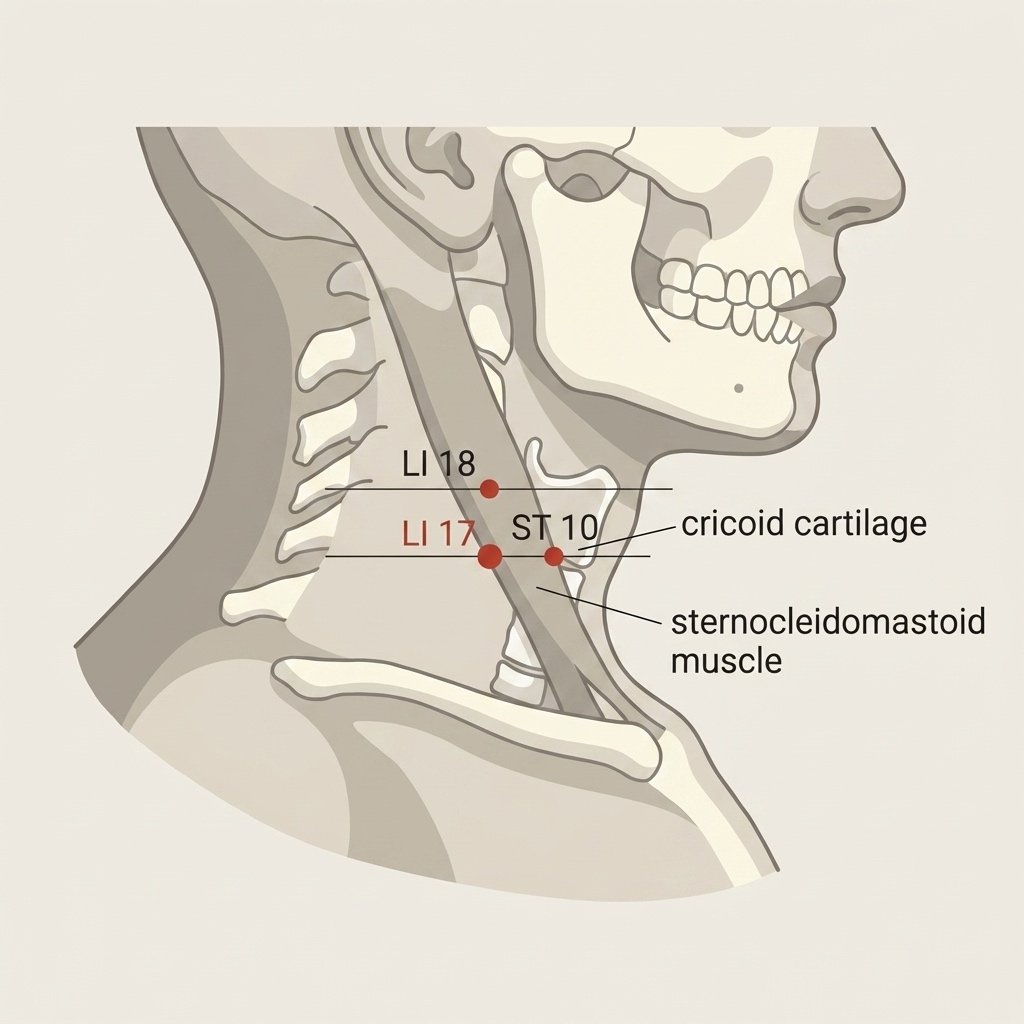
On the lateral aspect of the neck, along the posterior border of the sternocleidomastoid muscle (at the level of the laryngeal prominence), 1 cun inferior to LI-18.
🧭 How to find it (practical)
Seated with the neck slightly tilted laterally and extended, first locate Fu Tu (LI-18), 3 cun lateral to the laryngeal prominence (Adam's apple). Locate the point at the posterior border of the sternocleidomastoid muscle, 1 cun directly below Fu Tu (LI-18).
🔬 Anatomy
Skin, subcutaneous tissue, platysma, cervical fascia, posterior aspect of the sternocleidomastoid muscle, lateral border of the external jugular vein, supraclavicular nerve (C3 and C4), transverse cervical nerve (C2 and C3), transverse cervical artery, levator scapulae muscle, scalene muscle, cervical plexus.
💉 Needling
Perpendicular insertion, 0.5–0.8 cun.
📜 Etymology
Tian (天), heaven; Ding (鼎), an ancient vessel with two handles and three feet. Tian Ding (LI-17) together with Que Pen (ST-12) and Qi She (ST-11) form a triangle.