Skip to content
Skip to content

LU-6 Kongzui (孔最) — Collection Hole

LU-6
Kongzui
孔最
Collection Hole · Maximum Opening
LU-6 Kongzui — Collection Hole
Ponto Xi-FendaPonto Xi-Fenda do canal do PulmãoSafeMembro Superior
Depth
00.5–1 cun3.0
Perpendicular insertion
Precautions
No special precautions.
Location (classical)
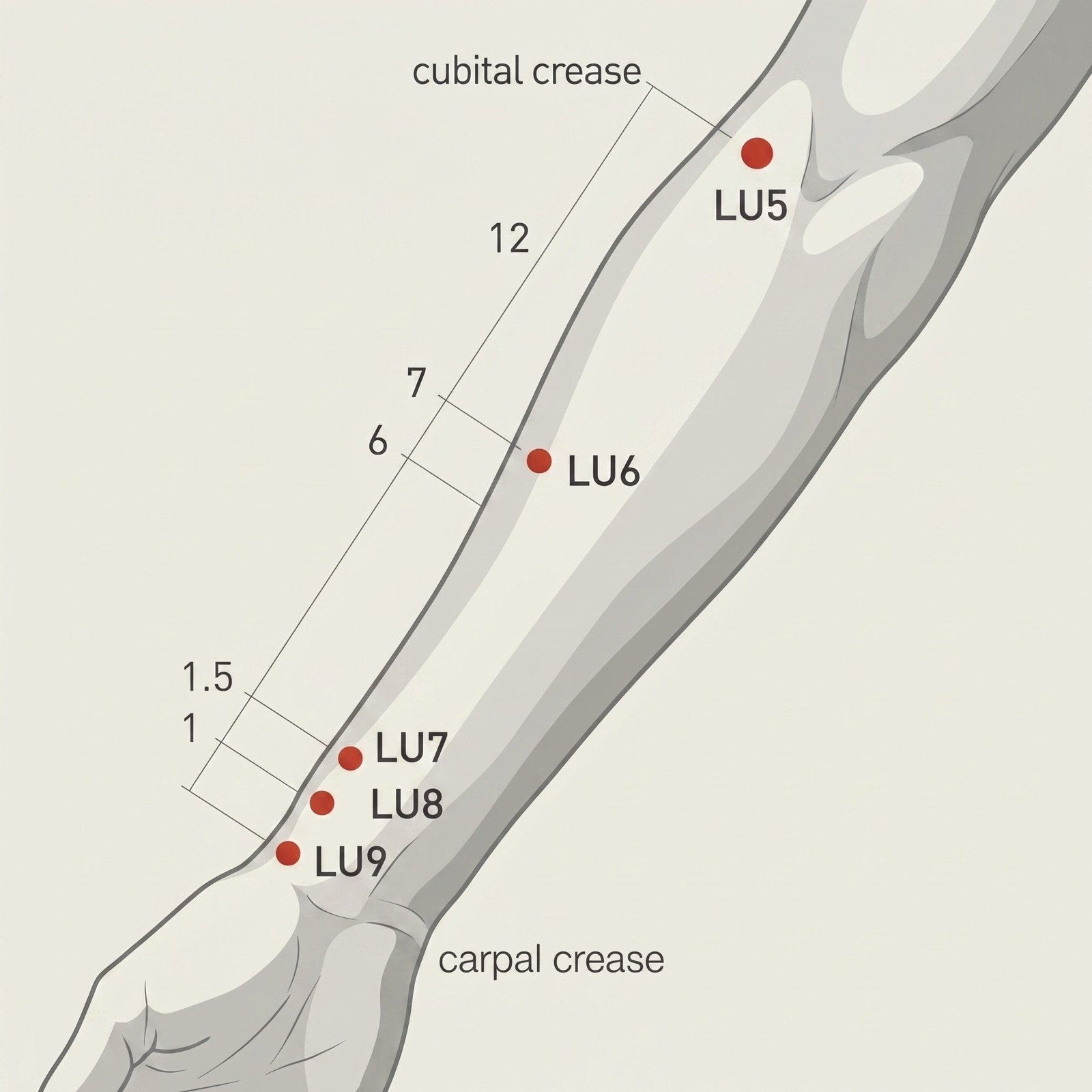
On the anterolateral aspect of the forearm, on the line connecting LU-5 with LU-9, 7 B-cun superior to the palmar wrist crease.
How to find it (practical)
With the palm facing up, draw the line from LU-9, next to the wrist crease, to LU-5, at the elbow crease. Divide the path into 12 equal parts. LU-6 lies 7 parts from the wrist and 5 from the elbow.
Anatomy
Brachioradialis muscle, pronator teres muscle. Innervated by the lateral cutaneous nerve of the forearm and the superficial branch of the radial nerve.
Needling
Perpendicular insertion, 0.5–1.0 cun.
Etymology
Kong (孔), opening, aperture; Zui (最), the supreme, the maximum. As the Xi-Cleft point of the Lung Meridian, it is the maximum aperture where the channel Qi gathers most deeply — the best point for releasing blocked flow of Lung Qi (Deadman, A Manual of Acupuncture, 2007, p. 74).
CLASSICAL SOURCEJia Yi Jing

Clinical Relations

Adjacent Points on the Meridian

LU 6 in research

How many Library studies cite this point, since when, and with which designs and verdicts.

Studies
1Library study cites LU 6
By year
2019
Verdict
  • Strong1
Study designs
  • RCT1
Classical source
Jia Yi Jing
Depth
0.5–1 cunPerpendicular

Each study counts once, under the most specific design it states. The verdict is the Library’s word for the strength of each study’s evidence.

See the numbers: LU 6 in research
YearStudies
20191

Often appears with

Points the Library studies cite together with LU 6. It shows research practice, not a prescription.

  1. LU 91 study in common
  2. HT 51 study in common
  3. PC 61 study in common

Each filled mark stands for 5 studies; an open mark, for 1 to 4.

Related Articles

6

Translation and clinical dataProf. Dr. Hong Jin Pai — Meridians: Theory and Clinical Practice, 4th edition. CEIMEC · São Paulo.

CodingWHO Standard Acupuncture Point Locations (2008) for classical and extra points.