Skip to content
Skip to content

LU-5 Chize (尺澤) — Cubit Marsh

LU-5
Chize
尺澤
Cubit Marsh
LU-5 Chize — Cubit Marsh
Ponto He-Mar (Água)Ponto de SedaçãoPonto He-MarCautionMembro Superior
Depth
00.3–0.5 cun3.0
Perpendicular insertion
Precautions
Avoid the cubital vein.
Location (classical)
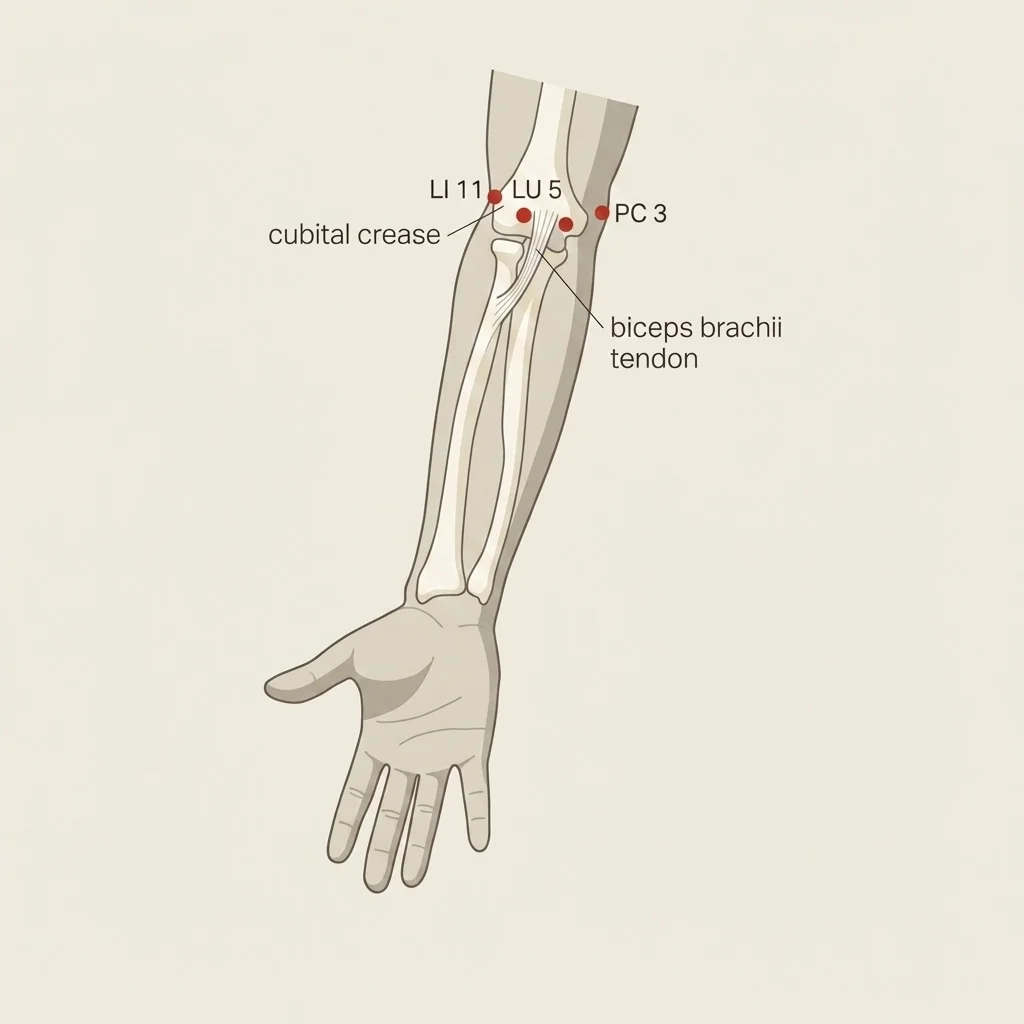
On the cubital crease, in the depression at the radial margin of the biceps brachii tendon. Located with the elbow slightly flexed.
How to find it (practical)
With the elbow slightly flexed and the palm facing up, locate the point in the cubital crease, in the depression immediately lateral (radial) to the tendon of the biceps brachii muscle (WHO 2008, §LU-5).
Anatomy
Brachioradialis muscle, lateral to the biceps tendon. Innervated by the musculocutaneous nerve and the radial nerve.
Needling
Perpendicular (vertical) insertion 0.3–0.5 cun.
Etymology
Chi (尺), cubit, forearm (the classical body-measure of the forearm); Ze (澤), marsh, low boggy land. The point lies in the cubital crease, in a moist depression that collects the descending flow of the Lung channel as a marsh collects rain water — the classical image of a He-Sea point, where channel Qi "enters" as a river reaches the sea (Deadman, A Manual of Acupuncture, 2007, p. 69; Ling Shu, chapter 1).
CLASSICAL SOURCELing Shu

Clinical Relations

Adjacent Points on the Meridian

LU 5 in research

How many Library studies cite this point, since when, and with which designs and verdicts.

Studies
4Library studies cite LU 5
By year
20072024
Verdict
  • Strong2
  • Moderate2
Study designs
  • RCT2
  • Other designs2
Classical source
Ling Shu
Depth
0.3–0.5 cunPerpendicular

Each study counts once, under the most specific design it states. The verdict is the Library’s word for the strength of each study’s evidence.

See the numbers: LU 5 in research
YearStudies
20071
20081
20191
20241

Often appears with

Points the Library studies cite together with LU 5. It shows research practice, not a prescription.

  1. LI 102 studies in common
  2. LI 41 study in common
  3. LI 51 study in common
  4. LI 111 study in common
  5. LI 121 study in common
  6. ST 361 study in common
  7. SP 61 study in common
  8. HT 11 study in common

Each filled mark stands for 5 studies; an open mark, for 1 to 4.

Related Articles

6

Translation and clinical dataProf. Dr. Hong Jin Pai — Meridians: Theory and Clinical Practice, 4th edition. CEIMEC · São Paulo.

CodingWHO Standard Acupuncture Point Locations (2008) for classical and extra points.