Why Combining Is More Effective Than a Single Approach?
Chronic pain involves several processes at once: central sensitization (which requires neurological modulation), persistent inflammation (which requires pharmacological control or acupuncture), physical deconditioning (which requires exercise), dysfunctional cognitive patterns (which require psychotherapy), and sleep disturbances (which require specific management). No single intervention addresses all of these components.
Beyond mechanism coverage, there is plausible synergy: as a mechanistic hypothesis, acupuncture possibly reduces pain enough to allow the patient to exercise; exercise plausibly increases endogenous opioids that potentiate acupuncture; psychotherapy has been proposed as a way to reduce the catastrophizing that limits response to other interventions; and sleep management possibly restores inhibitory systems that make the remaining approaches more effective.
Biological
Medical acupuncture, adjunctive pharmacology (neuromodulators, NSAIDs when indicated), inflammation and sleep management.
Physical
Graded exercise (EIH, DNIC, deconditioning), functional rehabilitation, return to meaningful activities.
Psychosocial
CBT for pain, pain neuroscience education, emotional support, comorbid anxiety and depression management.
Acupuncture + Pharmacology: Opioid Sparing
One of the most clinically relevant outcomes of combining acupuncture with pharmacology is opioid sparing: patients treated with adjunctive acupuncture require significantly lower doses of opioids for the same pain control, reducing exposure, dependence risk, and side effects.
Meta-analyses in the postoperative setting (for example, Sun et al., Br J Anaesth 2008; Cho et al., Anesth Analg 2015) suggest reduced morphine consumption in the first 24–48 hours among patients who received perioperative acupuncture, with magnitude varying across studies. The mechanism is synergistic: pharmacological opioids and endogenous opioids released by acupuncture act on the same receptors, with additive or supra-additive effect.
For chronic pain, combining acupuncture with neuromodulators (duloxetine, gabapentin) covers complementary mechanisms: acupuncture acts via DNIC and endogenous opioids; neuromodulators reduce central neuronal excitability directly. The medical acupuncturist evaluates which combination is most appropriate for each predominant mechanism.
Acupuncture + Exercise: Mechanism Synergism
Acupuncture and exercise share analgesic mechanisms — both activate endogenous opioids and the DNIC pathway. But they have complementary advantages: acupuncture provides immediate relief (session by session) while exercise produces gradual, sustained change; acupuncture is passive (the patient receives) while exercise is active (the patient performs), building self-efficacy.
In clinical practice, acupuncture is frequently used as a facilitator of exercise: as a mechanistic hypothesis, it possibly lowers the pain threshold enough for the patient to initiate and sustain physical activity. This is especially important in patients with severe central sensitization, in whom any physical effort feels unbearable.
Studies in fibromyalgia and chronic low back pain suggest that combining acupuncture and aerobic exercise may produce improvement superior to any single intervention — in pain intensity, physical function, and quality of life.
Acupuncture
- Activates endogenous opioids and the DNIC pathway
- Provides immediate relief (session by session)
- Is passive (the patient receives)
Exercise
- Activates endogenous opioids and the DNIC pathway
- Produces gradual, sustained change
- Is active (the patient performs), building self-efficacy
Acupuncture + Psychology: Shared Targets
Medical acupuncture and Cognitive-Behavioral Therapy for pain (CBT for pain) are proposed to share neurobiological targets: as a mechanistic hypothesis, both may modulate activity in the anterior cingulate córtex, the amygdala, and the HPA axis. Acupuncture acts via bottom-up mechanisms (needle to nerve to spinal cord to brain); CBT for pain acts via top-down mechanisms (cognition to prefrontal córtex to descending pain modulation).
This complementarity is clinical and practical: acupuncture reduces pain intensity enough for the patient to engage in psychotherapy (less pain = more cognitive and emotional capacity for therapeutic work); psychotherapy reduces the catastrophizing that limited the response to acupuncture.
In a coordinated medical-care model, the medical acupuncturist and the psychologist work together — with regular communication about the patient's progress — to maximize outcomes.
Synergism: Acupuncture + CBT for Pain
| Dimension | Medical Acupuncture | CBT for Pain |
|---|---|---|
| Route of action | Bottom-up: nerve to spinal cord to brain | Top-down: cognition to córtex to descending modulation |
| Neural target | modulates regions involved in pain processing (proposed: PAG, insula, anterior cingulate) | Prefrontal córtex, amygdala, anterior cingulate |
| Effect on catastrophizing | Reduces via lower cingulate activation | Reduces via direct cognitive restructuring |
| Effect on HPA | May modulate the HPA axis (preliminary evidence) | Reduces via decreased threat perception |
| Self-efficacy | Experience of real relief | Active coping skills |
Acupuncture + Sleep Management: Breaking the Cycle
Sleep and pain have a bidirectional relationship — each worsens the other. Medical acupuncture acts on both sides: it treats pain (reducing the main cause of sleep disturbance) and treats sleep directly (via autonomic and serotonergic modulation).
Anatomical points traditionally named HT7, SP6, KI3, Yintang, and auricular Shenmen are frequently used for anxiety and sleep disorders; controlled studies suggest benefit on subjective outcomes, with variable evidence quality. Auriculotherapy with seeds at the Shenmen point may be applied between sessions for continuous effect.
Combined with sleep hygiene guidance and, when indicated, CBT-I (Cognitive-Behavioral Therapy for Insomnia), acupuncture is part of an integrated strategy that sustainably breaks the sleep-pain cycle.
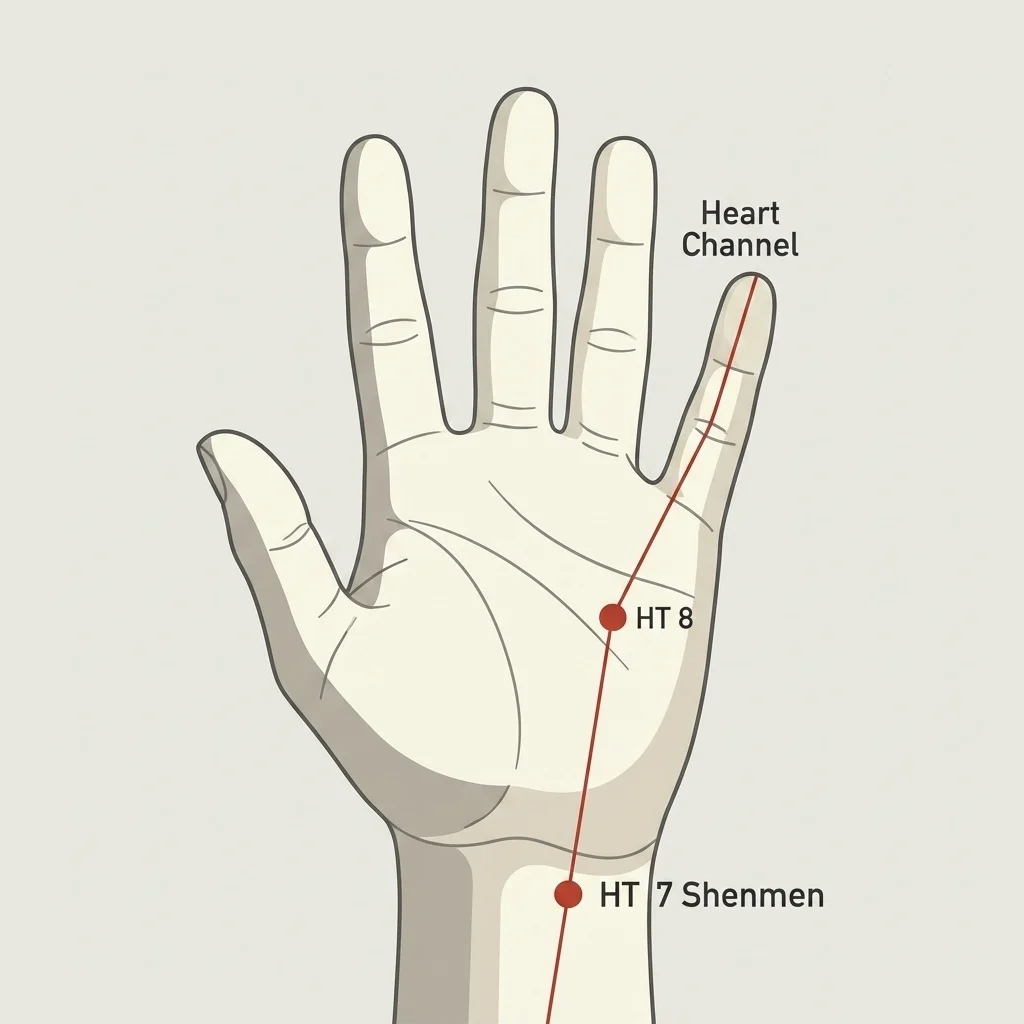
- Location
- On the palmar wrist crease, immediately radial to the flexor carpi ulnaris tendon, in the depression at the proximal border of the pisiform bone.
- Sleep and pain have a bidirectional relationship: each worsens the other.
- Medical acupuncture acts on both sides: it treats pain and treats sleep directly.
- Combined with sleep hygiene guidance and, when indicated, CBT-I, acupuncture is part of an integrated strategy that breaks the sleep-pain cycle.
Multimodal Care Timeline
Multimodal Protocol for Moderate to Severe Chronic Pain
Complete biopsychosocial evaluation
Pain scales (VAS, BPI), catastrophizing (PCS), sleep (ISI/PSQI), function (ODI/NDI). Complementary tests as indicated. Define diagnosis and predominant mechanisms.
Intensive acupuncture + adjunctive pharmacology
2 medical acupuncture sessions per week. Adjunctive pharmacology by mechanism (neuromodulator, anti-inflammatory if active inflammation). Sleep hygiene guidance. Introduce graded walking (5–10 min/day).
Exercise progression + start of CBT for pain
1 acupuncture session per week. Progress aerobic exercise (20–30 min, 3–5x per week). Start CBT for pain or pain neuroscience education. Reassess scales.
Maintenance and autonomy
Acupuncture every two weeks or as maintenance. Independent exercise with functional goals (work, sport, enjoyable activities). Continued CBT for pain. Reassess and adjust the plan.
International Guidelines: Recognition of Acupuncture
Medical acupuncture has moved from "alternative" practice to a recognized component of major chronic pain management guidelines:
Integrative medicine is not alternative medicine — it combines the best evidence from conventional medicine with complementary interventions that have a scientific basis. Medical acupuncture aligns well with this approach.
Dr. Marcus Yu Bin Pai · Medical Acupuncturist — CRM-SP: 158074
Myths and Facts
Myth vs. Fact
Acupuncture is alternative medicine — and alternative means not scientifically proven.
Medical acupuncture has meta-analytic evidence for specific conditions (chronic low back pain, headache, musculoskeletal pain, oncology neuropathy), albeit with heterogeneity across studies. The correct term is integrative medicine — combining conventional interventions (pharmacology, rehabilitation) with evidence-based complementary interventions. Acupuncture is cited in WHO, NICE, ACP, ASCO, and NCCN guidelines for specific indications.
Myth vs. Fact
If you need acupuncture, a psychologist, AND exercise, it's because your pain isn't 'real'.
On the contrary — the need for a multimodal approach reflects the real complexity of chronic pain. Conditions like fibromyalgia, chronic low back pain, and chronic headache have real biological, psychological, and behavioral components that require treatment proportional to their complexity. The more components addressed, the better the outcomes.
Myth vs. Fact
Multimodal treatment is expensive and inaccessible — it's only for those with premium insurance.
The core of multimodal treatment (medical acupuncture + walking + pain education + sleep hygiene) is accessible and can be implemented gradually. Walking is free; pain education can be delivered during consultations; sleep hygiene is behavioral. Acupuncture has a cost, but it can be part of a care plan that reduces the need for other treatments in selected cases.
When to Seek Evaluation for Multimodal Treatment
Frequently Asked Questions about Multimodal Acupuncture
Multimodal treatment combines multiple interventions that act on different dimensions of chronic pain: pharmacology (neuromodulators, anti-inflammatories when indicated), medical acupuncture (neurological, anti-inflammatory, and autonomic modulation), graded exercise (EIH, deconditioning), psychological support (CBT for pain, catastrophizing), and sleep management. The combination tends to produce better outcomes than a single modality in many chronic pain scenarios, with heterogeneity across conditions and studies.
Medications for chronic pain have limited efficacy, side effects with prolonged use, and do not address the neurological, behavioral, and psychosocial components of chronic pain. Medical acupuncture complements pharmacology with distinct mechanisms (endogenous opioids, DNIC, autonomic modulation) and often allows clinicians to reduce medication doses — lowering risks and costs.
Acupuncture and exercise activate similar mechanisms (endogenous opioids, DNIC) with complementary advantages. Acupuncture provides immediate relief and lowers the pain threshold, making exercise more accessible for patients who previously could not move. Exercise produces gradual, sustained change, building self-efficacy and independence from treatment. Studies suggest that the combination may outperform each single intervention, with heterogeneous results.
Yes. WHO, NICE (UK), the American College of Physicians, ASCO (oncology), and NCCN include acupuncture in their chronic pain management guidelines. The ACP recommends acupuncture for acute and chronic low back pain as an alternative to opioids. ASCO recommends it for cancer pain, neuropathy, and fatigue in survivors.
Yes — there is specific evidence. Meta-analyses in postoperative pain suggest reduced morphine consumption with adjunctive acupuncture, with magnitude varying across studies. For chronic pain, acupuncture as a multimodal component may help reduce opioid doses under medical supervision, although this evidence is limited. The ACP and the CDC include acupuncture among non-opioid options for pain.
The biopsychosocial assessment includes: detailed pain history (mechanism, location, aggravating and relieving factors); validated scales (VAS or NRS for intensity, PCS for catastrophizing, ISI for insomnia, PHQ-9 for depression); prior-treatment history; functional and occupational evaluation; and complementary tests when indicated. With this complete map, the medical acupuncturist designs an individualized multimodal plan.
The medical acupuncturist coordinates the biopsychosocial treatment plan: performs the full diagnostic evaluation, prescribes medical acupuncture with an individualized protocol, guides adjunctive pharmacology, prescribes exercise and sleep hygiene, refers to a psychologist and other specialists when indicated, and monitors the global response to treatment. This is the role of a generalist physician specialized in pain — not merely a needle technician.
In general, an initial cycle of 8–12 sessions over 6–10 weeks, with reassessment at the end. For severe chronic pain, more frequent sessions at the start (2x per week) and progressive spacing based on response. Monthly or bimonthly maintenance may be indicated for cases prone to recurrence. The goal is for the patient to need acupuncture less and less over time — thanks to the other components of the multimodal program.
Fibromyalgia is one of the cases in which multimodal treatment is most essential — because it has biological components (central sensitization), psychological components (catastrophizing, frequent depression), and behavioral components (exercise avoidance) that require simultaneous management. Acupuncture may be considered as an adjunct in fibromyalgia; the EULAR 2017 guidelines classify acupuncture as a conditional recommendation ("weak for"). The combination with graded aerobic exercise, pain education, and sleep management has the most consistent evidence base.
The medical acupuncturist collaborates with other specialists involved in the patient's care. Bring reports, test results, and information about current medications to the acupuncture consultation só the plan stays coordinated. In complex cases, the medical acupuncturist may communicate directly with the specialist coordinating overall treatment — team communication is part of the integrated care model.
Related Reading
Deepen your knowledge with related articles