Skip to content
Skip to content

HT-7 Shenmen (神門) — Spirit Gate

HT-7
Shenmen
神門
Spirit Gate
HT-7 Shenmen — Spirit Gate
★ MajorPonto Shu-Riacho (Terra)Ponto Yuan-FontePonto de SedaçãoCautionMembro Superior
Depth
00.3–0.5 cun3.0
Perpendicular insertion
Precautions
Avoid the ulnar artery and the ulnar nerve. The flexion crease for locating this point lies between the radius and ulna on one side and the carpal bones on the other. Use the wrist flexion crease proximal to the pisiform bone.
Location (classical)
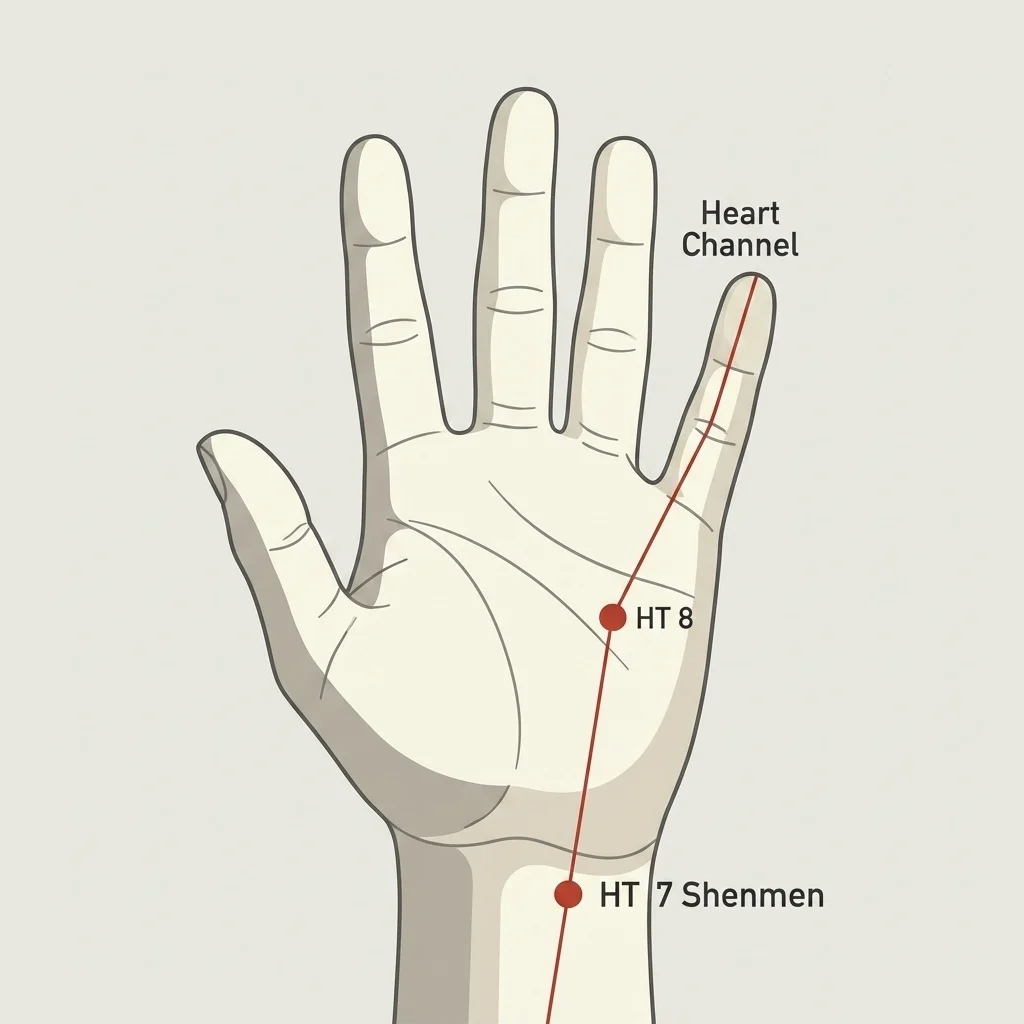
On the palmar wrist crease, immediately radial to the flexor carpi ulnaris tendon, in the depression at the proximal border of the pisiform bone.
How to find it (practical)
With the palm facing up, locate the point on the radial border of the pisiform bone, on the wrist crease.
Anatomy
Skin, subcutaneous tissue, median antebrachial vein, medial cutaneous branch of the forearm, palmar branch of the ulnar nerve, radial to the tendon of the flexor carpi ulnaris muscle.
Needling
Perpendicular insertion, 0.3–0.5 cun.
Etymology
Shen (神), mind; Men (門), gate. The Xin (Heart) houses the mind. This point is the gate to the mind.
CLASSICAL SOURCEJia Yi Jing

Clinical Relations

Point Pairs
Classical Combinations
Insomnia, anxiety, palpitations, calming the mind
Adjacent Points on the Meridian

HT 7 in research

How many Library studies cite this point, since when, and with which designs and verdicts.

Studies
51Library studies cite HT 7
By year
20072026
Verdict
  • Strong12
  • Moderate31
  • Limited4
  • Weak4
Study designs
  • Meta-analysis14
  • Systematic Review9
  • RCT9
  • Narrative Review13
  • Other designs6
Classical source
Jia Yi Jing
Depth
0.3–0.5 cunPerpendicular

Each study counts once, under the most specific design it states. The verdict is the Library’s word for the strength of each study’s evidence.

See the numbers: HT 7 in research
YearStudies
20072
20101
20112
20122
20132
20142
20152
20161
20171
20186
20192
20204
20214
20225
20236
20246
20251
20262

Often appears with

Points the Library studies cite together with HT 7. It shows research practice, not a prescription.

  1. ST 3631 studies in common
  2. SP 627 studies in common
  3. PC 627 studies in common
  4. GV 2022 studies in common
  5. LI 414 studies in common
  6. EX-HN312 studies in common
  7. LR 310 studies in common
  8. KI 38 studies in common

Each filled mark stands for 5 studies; an open mark, for 1 to 4.

Related Articles

6

Translation and clinical dataProf. Dr. Hong Jin Pai — Meridians: Theory and Clinical Practice, 4th edition. CEIMEC · São Paulo.

CodingWHO Standard Acupuncture Point Locations (2008) for classical and extra points.