Skip to content
Skip to content

KI-3 Taixi (太谿) — Great Ravine

KI-3
Taixi
太谿
Great Ravine · Supreme Stream
KI-3 Taixi — Great Ravine
★ MajorPonto Shu-Riacho (Terra)Ponto Yuan-FonteCautionMembro Inferior
Depth
00.5–1 cun3.0
Perpendicular insertion
Precautions
Avoid the posterior tibial artery and vein.
Location (classical)
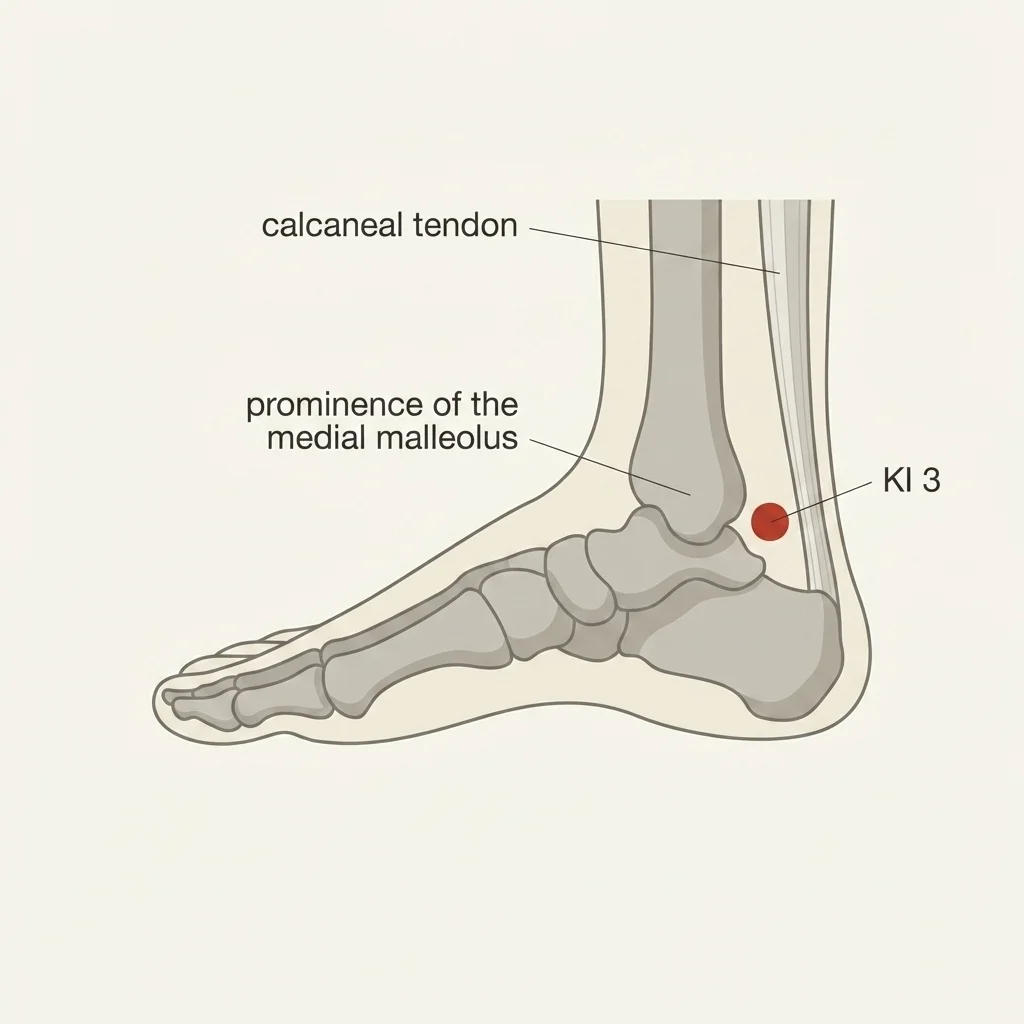
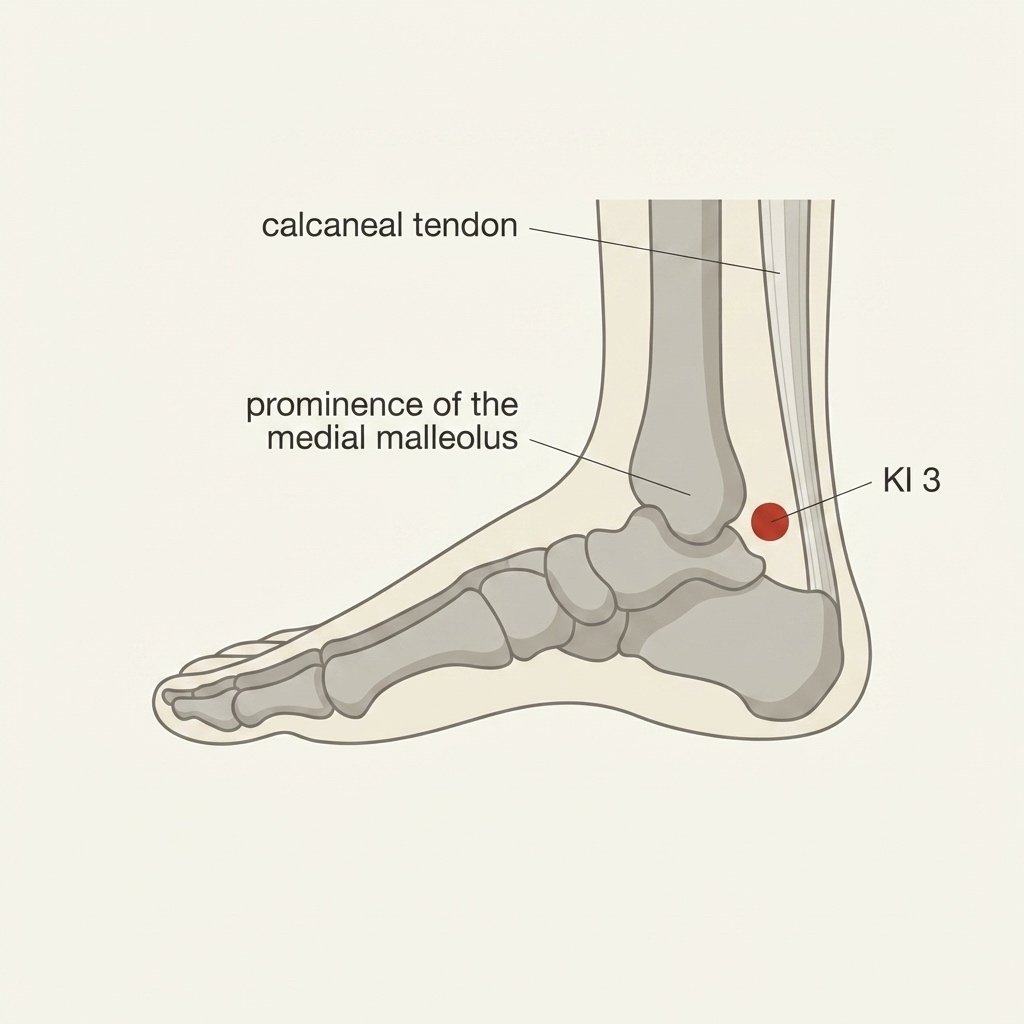
On the medial side of the ankle, in the depression equidistant between the prominence of the medial malleolus and the Achilles tendon.
How to find it (practical)
Seated or in dorsal decubitus, locate the point at the midpoint between the posterior border of the medial malleolus and the anterior border of the calcaneal tendon, at the level of the apex of the medial malleolus.
Anatomy
Anterior to the Achilles tendon. Innervated by the saphenous nerve and the tibial nerve. The posterior tibial artery and vein run deep and adjacent.
Needling
Perpendicular insertion, 0.5–1.0 cun (may be directed toward BL-60).
Etymology
Tai (太), great; Xi (溪), ravine. The point lies in the depression between the medial malleolus and the calcaneal tendon, like an immense ravine.
CLASSICAL SOURCELing Shu

Clinical Relations

Point Pairs
Classical Combinations
Kidney and Spleen deficiency, menstrual disorders, insomnia
Kidney deficiency, low back pain, tinnitus, sexual dysfunction
Adjacent Points on the Meridian

KI 3 in research

How many Library studies cite this point, since when, and with which designs and verdicts.

Studies
39Library studies cite KI 3
By year
20002026
Verdict
  • Strong10
  • Moderate24
  • Limited4
  • Weak1
Study designs
  • Meta-analysis8
  • Systematic Review6
  • RCT14
  • Narrative Review2
  • Preclinical / Animal1
  • Other designs8
Classical source
Ling Shu
Depth
0.5–1 cunPerpendicular

Each study counts once, under the most specific design it states. The verdict is the Library’s word for the strength of each study’s evidence.

See the numbers: KI 3 in research
YearStudies
20001
20081
20101
20111
20121
20133
20144
20151
20172
20181
20194
20203
20211
20224
20235
20241
20253
20262

Often appears with

Points the Library studies cite together with KI 3. It shows research practice, not a prescription.

  1. SP 623 studies in common
  2. ST 3622 studies in common
  3. LI 417 studies in common
  4. LR 315 studies in common
  5. CV 410 studies in common
  6. HT 78 studies in common
  7. BL 238 studies in common
  8. BL 608 studies in common

Each filled mark stands for 5 studies; an open mark, for 1 to 4.

Related Articles

6

Translation and clinical dataProf. Dr. Hong Jin Pai — Meridians: Theory and Clinical Practice, 4th edition. CEIMEC · São Paulo.

CodingWHO Standard Acupuncture Point Locations (2008) for classical and extra points.