Skip to content
Skip to content

KI-2 Rangu (然谷) — Blazing Valley

KI-2
Rangu
然谷
Blazing Valley
KI-2 Rangu — Blazing Valley
Ponto Ying-Nascente (Fogo)SafeMembro Inferior
Depth
00.8–1.2 cun3.0
Perpendicular insertion
Precautions
No special precautions.
Location (classical)
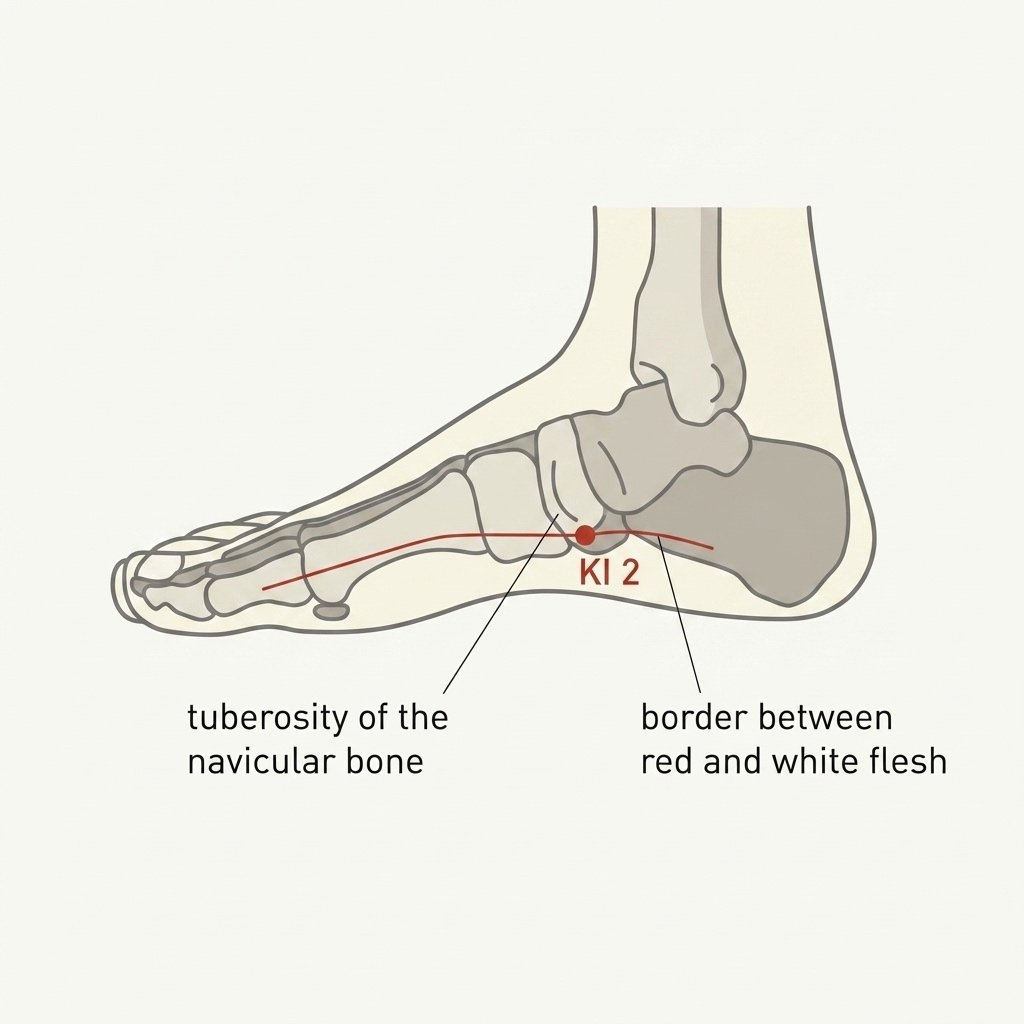
On the medial side of the foot, inferior to the tuberosity of the navicular bone, at the junction of the red and white skin.
How to find it (practical)
On the medial aspect of the foot, identify the tuberosity of the navicular. KI-2 lies below it, at the transition between the plantar skin and the skin of the medial aspect of the foot.
Anatomy
Abductor hallucis muscle. Innervated by the medial plantar nerve and the saphenous nerve.
Needling
Perpendicular insertion, 0.8–1.2 cun.
Etymology
Ran (然), tuberosity of the navicular bone; Gu (谷), valley. The point lies in the depression below the tuberosity of the navicular bone, at the transition between light and dark skin.
CLASSICAL SOURCELing Shu

Clinical Relations

Adjacent Points on the Meridian

KI 2 in research

How many Library studies cite this point, since when, and with which designs and verdicts.

Studies
1Library study cites KI 2
By year
2007
Verdict
  • Moderate1
Study designs
  • RCT1
Classical source
Ling Shu
Depth
0.8–1.2 cunPerpendicular

Each study counts once, under the most specific design it states. The verdict is the Library’s word for the strength of each study’s evidence.

See the numbers: KI 2 in research
YearStudies
20071

Often appears with

Points the Library studies cite together with KI 2. It shows research practice, not a prescription.

  1. LU 91 study in common
  2. LI 11 study in common
  3. LI 111 study in common
  4. ST 361 study in common
  5. SP 31 study in common
  6. HT 71 study in common
  7. BL 131 study in common
  8. BL 251 study in common

Each filled mark stands for 5 studies; an open mark, for 1 to 4.

Related Articles

6

Translation and clinical dataProf. Dr. Hong Jin Pai — Meridians: Theory and Clinical Practice, 4th edition. CEIMEC · São Paulo.

CodingWHO Standard Acupuncture Point Locations (2008) for classical and extra points.