Skip to content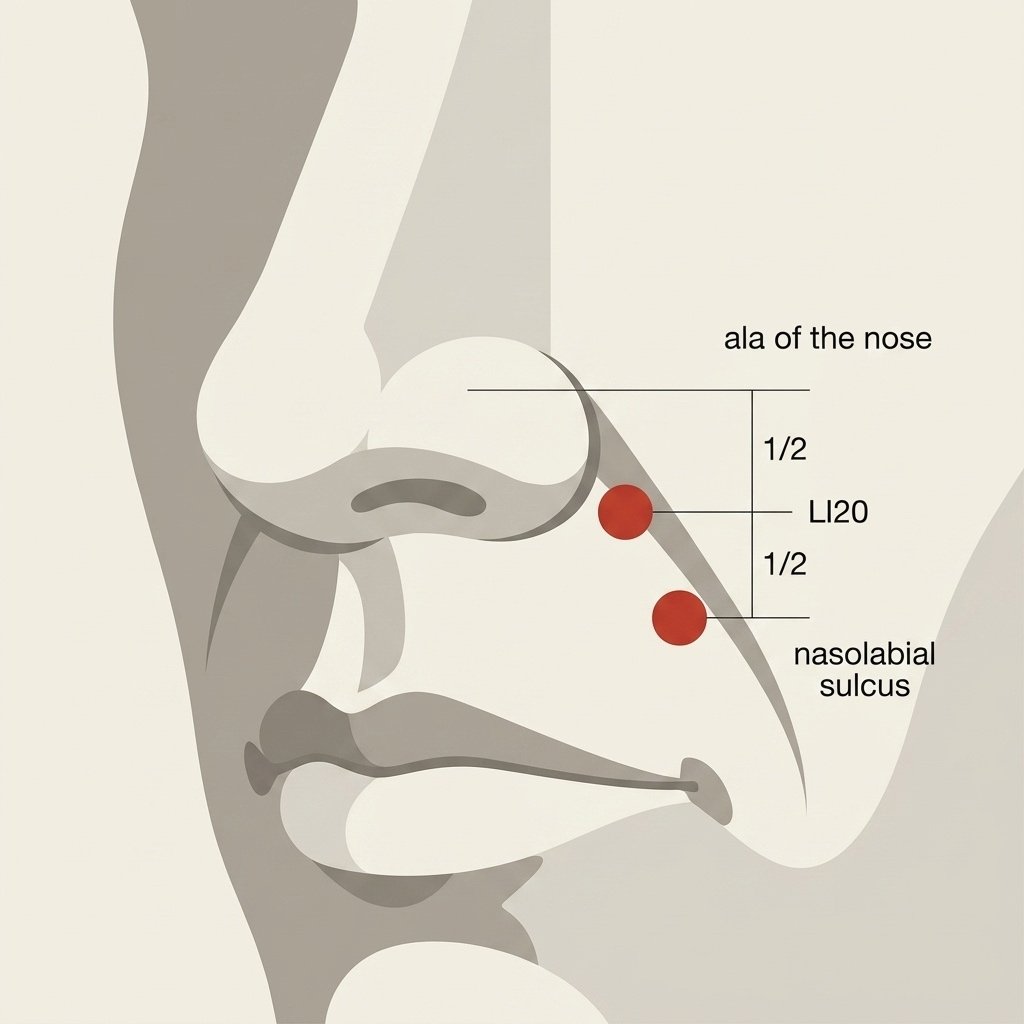
LI-20 Yingxiang (迎香) — Welcome Fragrance
LI-20
Yingxiang
迎香
Welcome Fragrance
Encontro Intestino Grosso-EstômagoEncontro com canal do EstômagoPonto de SaídaCautionCabeça
Depth
00.3–0.5 cun3.0
Transverse insertion
Precautions
According to some authors, moxibustion is contraindicated at this point. Hygiene is particularly important. Infected regions must never be needled under any circumstances, given the proximity of the angular vein and its anastomosis with the ophthalmic vein — there is a risk of cavernous sinus thrombosis and central inflammatory processes.
Location (classical)
On the outer border of the wing of the nose, in the nasolabial groove, approximately 0.5 cun lateral to the midpoint of the lateral border of the nasal wing.
How to find it (practical)
Seated with the neck extended, locate the point in the nasolabial groove, at the level of the lateral border of the wing of the nose.
Anatomy
Skin, subcutaneous tissue, second branch of the trigeminal nerve, nasalis muscle and levator labii superioris muscle, branches of the facial arteries and veins, angular vein, mandible.
Needling
Insertion of 0.3–0.5 cun — vertical, oblique, or transverse (subcutaneous) directed medially and superiorly toward EX-HN-8, or 3–8 mm obliquely directed craniomedially.
Etymology
Ying (迎), to meet; Xiang (香), fragrance. Used in the treatment of nasal problems and to restore the sense of smell, enabling the nose to "perceive fragrances."
CLASSICAL SOURCEJia Yi Jing
Clinical Relations
Adjacent Points on the Meridian