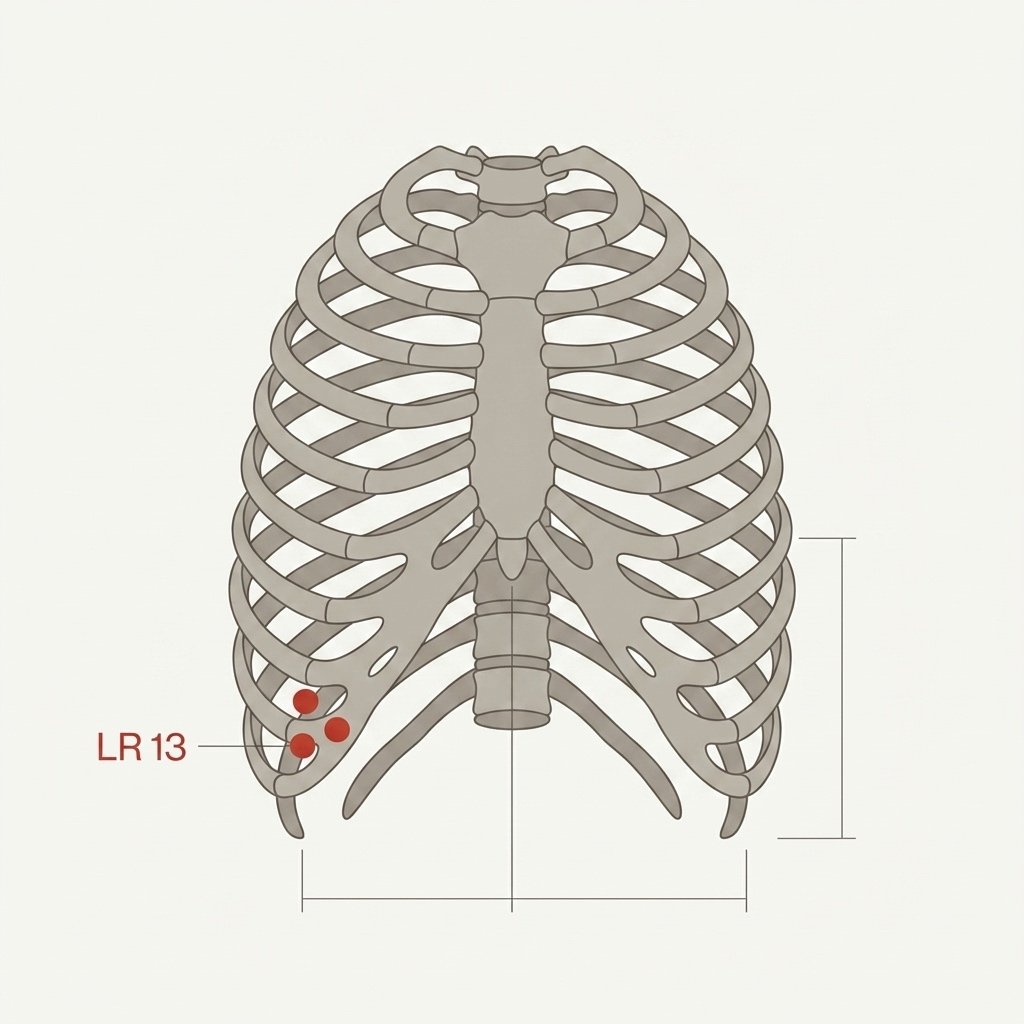
Ponto Mu do BaçoPonto Hui-Reunião dos Órgãos Zang (Yin)Encontro Fígado-VBDangerAbdômen
Depth
00.5–1 cun3.0
Oblique insertion
Precautions
Deep perpendicular insertion carries a high risk of puncturing an enlarged liver (on the right) or an enlarged spleen (on the left).
📍 Location (classical)
On the lateral aspect of the abdomen, directly anterior and inferior to the free end of the 11th rib (approximately 2 cun above the umbilicus and 6 cun lateral to the midline).
🧭 How to find it (practical)
In dorsal decubitus, locate the point on the midaxillary line, below the tip of the eleventh rib, or at the level of the olecranon when the elbow is flexed.
🔬 Anatomy
Skin, subcutaneous tissue, thoracoepigastric vein, external oblique, internal oblique, transversus abdominis, subcostal and lower intercostal arteries, lateral thoracic artery, and lateral cutaneous branches of the intercostal nerves.
💉 Needling
0.5–1.0 cun vertically or obliquely in a lateral direction, or 0.5 cun obliquely.
📜 Etymology
Zhang (章), clarity; Men (门), gate. The point belongs to the Liver Meridian, Foot Jue Yin, responsible for growth and clarity.