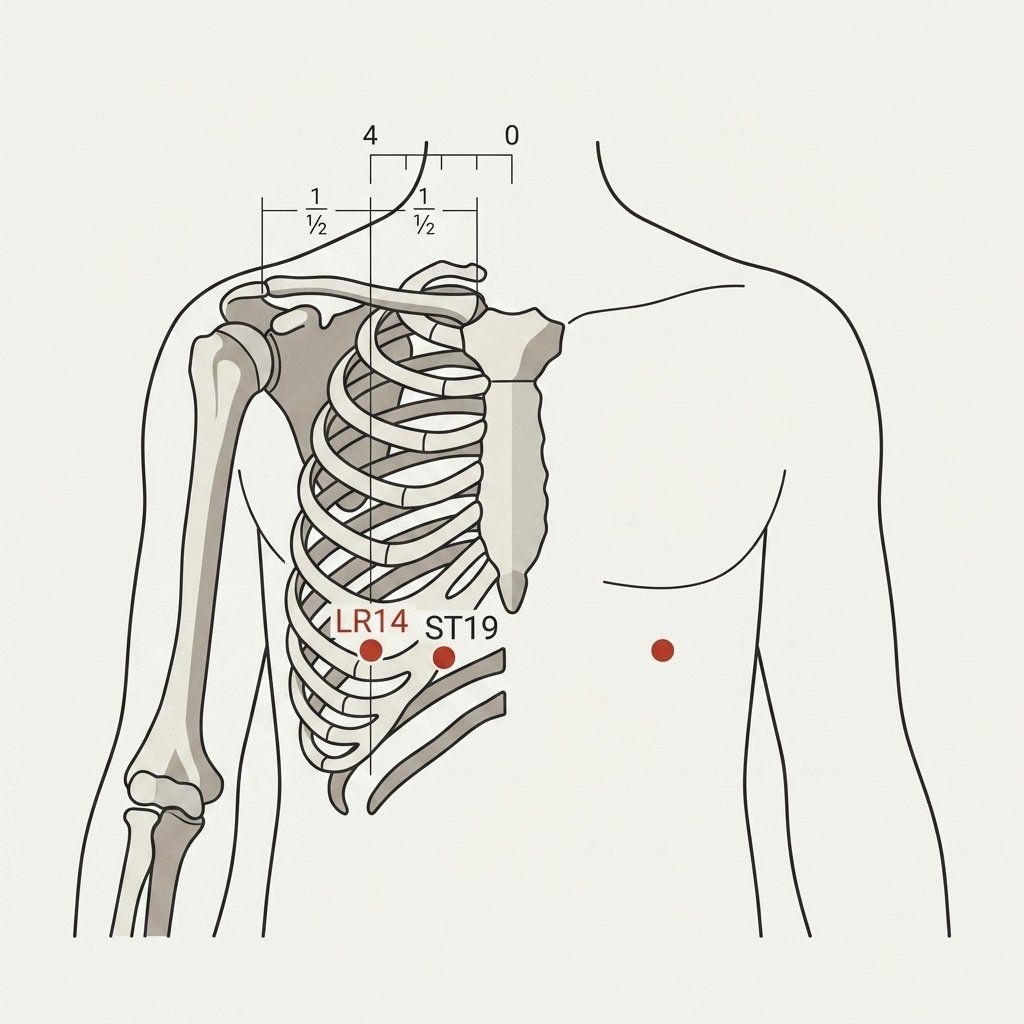
★ MajorPonto Mu do FígadoEncontro do FígadoBaçoDangerTórax
Depth
00.5–1 cun3.0
Oblique insertion
Precautions
High risk of pneumothorax. Deep perpendicular insertion is strictly contraindicated. Deep insertion may also puncture the liver (right side).
📍 Location (classical)
On the anterior wall of the chest/mammillary line, in the 6th intercostal space, 4 cun lateral to the midline (directly below the nipple).
🧭 How to find it (practical)
In dorsal decubitus, locate the point in the sixth intercostal space, immediately below the nipple. In women, the point is located in the sixth intercostal space, on the midclavicular line.
🔬 Anatomy
Skin, subcutaneous tissue, thoracoepigastric vein, lateral cutaneous branches of the intercostal nerves, intercostal nerves, arteries and veins, and intercostal muscle.
💉 Needling
Oblique medial or lateral insertion (along the intercostal space), 0.5–1.0 cun.
📜 Etymology
Qi (期), cycle; Men (门), gate. The Qi and Xue (Blood) of the twelve meridians begin to circulate from the Yun Men point (LU-2) and end at Qi Men (LR-14), completing a cycle.