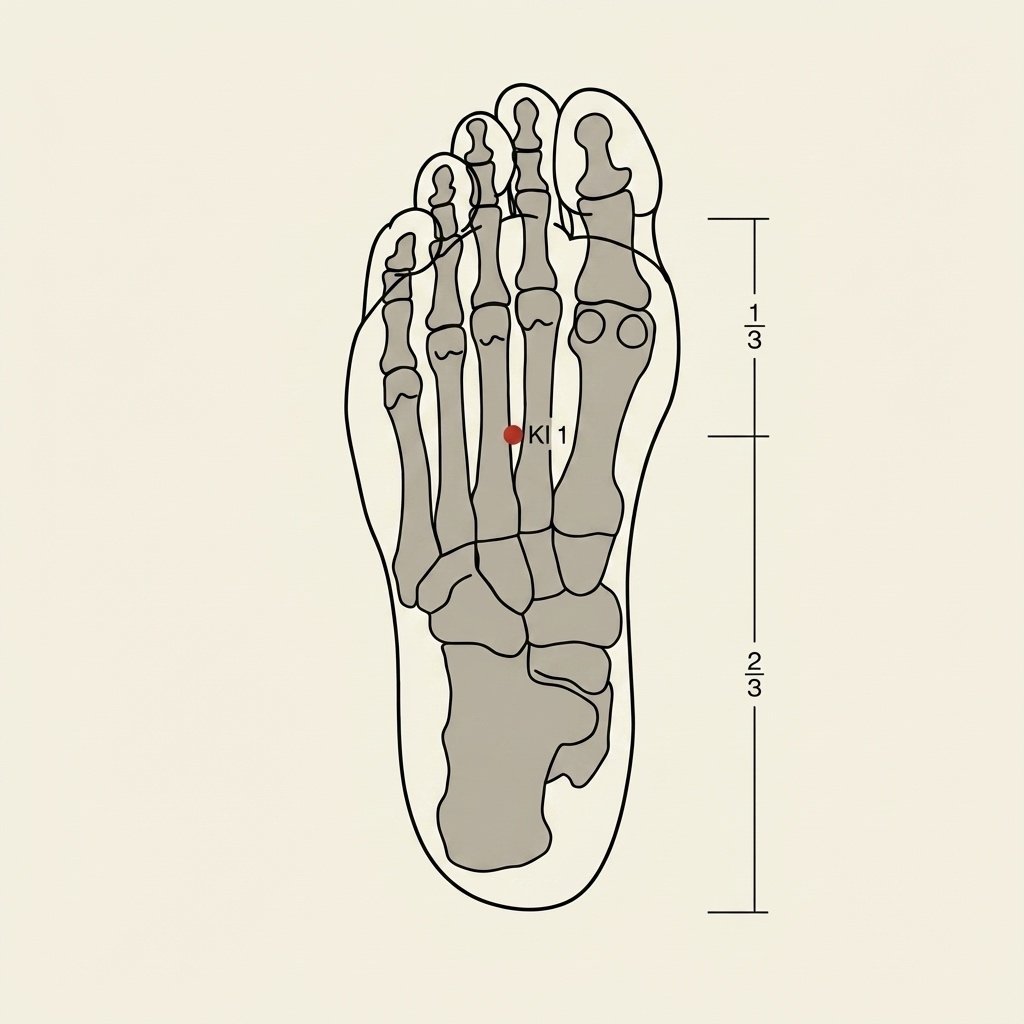
Ponto Jing-Poço (Madeira)Ponto de SedaçãoSafeMembro Inferior
Depth
00.5–1 cun3.0
Perpendicular insertion
Precautions
Highly sensitive/painful point.
📍 Location (classical)
On the sole of the foot, between the second and third metatarsal bones, approximately one-third of the distance from the interdigital folds to the heel, in the depression formed when the foot is in plantar flexion.
🧭 How to find it (practical)
In dorsal decubitus, with the ankle in plantar flexion, locate the point in the depression at the junction of the anterior and middle thirds of the distance between the heel and the base of the second and third toes, just posterior to the second and third metatarsophalangeal joints.
🔬 Anatomy
Plantar aponeurosis and flexor digitorum brevis muscle. Innervated by the medial and lateral plantar nerves. Plantar arterial arch.
💉 Needling
Perpendicular insertion, 0.5–1.0 cun.
📜 Etymology
Yong (涌), to gush; Quan (泉), spring, source. The point lies in the plantar depression. The Qi of the meridian flows upward as if from a spring.