Skip to content
Skip to content

KI-3 Taixi (太谿) — Great Ravine

KI-3
Taixi
太谿
Great Ravine · Supreme Stream
★ MajorPonto Shu-Riacho (Terra)Ponto Yuan-FonteCautionMembro Inferior
KI-3 Taixi — Great Ravine
Depth
00.5–1 cun3.0
Perpendicular insertion
Precautions
Avoid the posterior tibial artery and vein.
Location (classical)
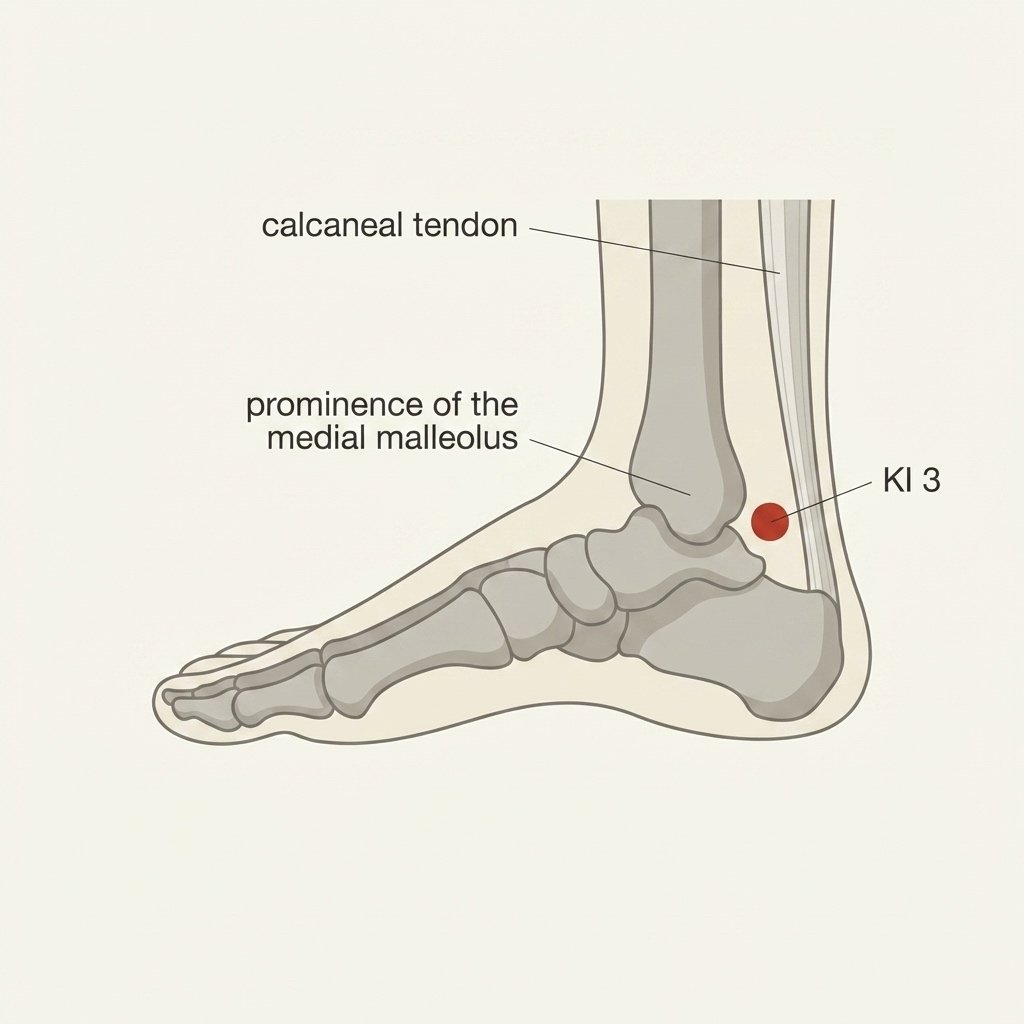
On the medial side of the ankle, in the depression equidistant between the prominence of the medial malleolus and the Achilles tendon.
How to find it (practical)
Seated or in dorsal decubitus, locate the point at the midpoint between the posterior border of the medial malleolus and the anterior border of the calcaneal tendon, at the level of the apex of the medial malleolus.
Anatomy
Anterior to the Achilles tendon. Innervated by the saphenous nerve and the tibial nerve. The posterior tibial artery and vein run deep and adjacent.
Needling
Perpendicular insertion, 0.5–1.0 cun (may be directed toward BL-60).
Etymology
Tai (太), great; Xi (溪), ravine. The point lies in the depression between the medial malleolus and the calcaneal tendon, like an immense ravine.
CLASSICAL SOURCELing Shu

Clinical Relations

Point Pairs
Classical Combinations
Kidney and Spleen deficiency, menstrual disorders, insomnia
Kidney deficiency, low back pain, tinnitus, sexual dysfunction
Adjacent Points on the Meridian

Related Articles

6

Translation and clinical dataProf. Dr. Hong Jin Pai — Meridians: Theory and Clinical Practice, 4th edition. CEIMEC · São Paulo.

CodingWHO Standard Acupuncture Point Locations (2008) for classical and extra points.