Skip to content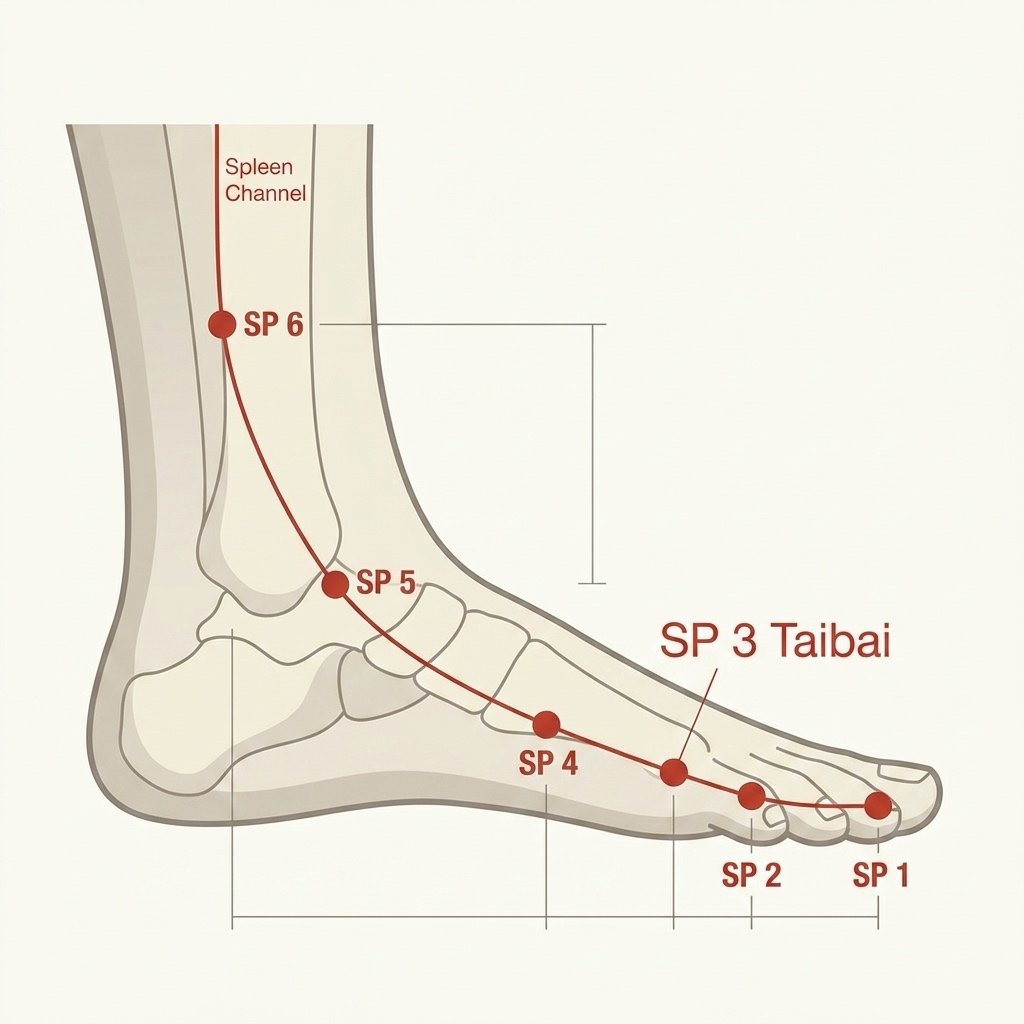
SP-3 Taibai (太白) — Supreme White
SP-3
Taibai
太白
Supreme White
Ponto Shu-Riacho (Terra)Ponto Yuan-FontePonto Shu-Riacho (Terra)CautionMembro Inferior
Depth
00.5–1 cun3.0
Oblique insertion
Precautions
No standard precaution. Caution: needling this point tends to be painful.
Location (classical)
On the medial aspect of the foot/great toe, in the depression behind/proximal to the metatarsophalangeal joint (head of the first metatarsal), along the border between the reddish and white skin (lateral aspect of the foot and sole).
How to find it (practical)
Seated with the feet supported or supine, locate the point on the medial aspect of the foot, in the depression proximal and posteroinferior to the first metatarsophalangeal joint.
Anatomy
Skin, subcutaneous tissue, dorsal digital nerve and vein of the medial side of the great toe, crural fascia, digital branches of the medial plantar nerve and artery, medial crural cutaneous branches of the saphenous nerve, dorsal digital branches of the superficial fibular nerve, medial head of the flexor hallucis brevis and abductor hallucis, and the first metatarsal.
Needling
0.5–1 cun perpendicular or oblique from the medial to the lateral aspect (or 3 to 6 mm perpendicular).
Etymology
Tai (太), great; Bai (白), white. Tai Bai means Golden Star, which in English corresponds to the Morning Star (planet Venus).
CLASSICAL SOURCELing Shu
Clinical Relations
Point Pairs
Yuan-LuoST-40 Fenglong
Adjacent Points on the Meridian