Encontro com o Ren MaiYang Motility (Yang Qiao)e Vaso GovernadorSafeCabeça
Depth
00.5–1 cun3.0
Perpendicular insertion
Precautions
High Risk. Do not lift, thrust, or rotate the needle, in order to avoid hemorrhage or injury to the optic nerve and eyeball. Press firmly with cotton for one minute when withdrawing the needle to prevent hematoma. Classical texts contraindicate moxibustion at this point.
📍 Location (classical)
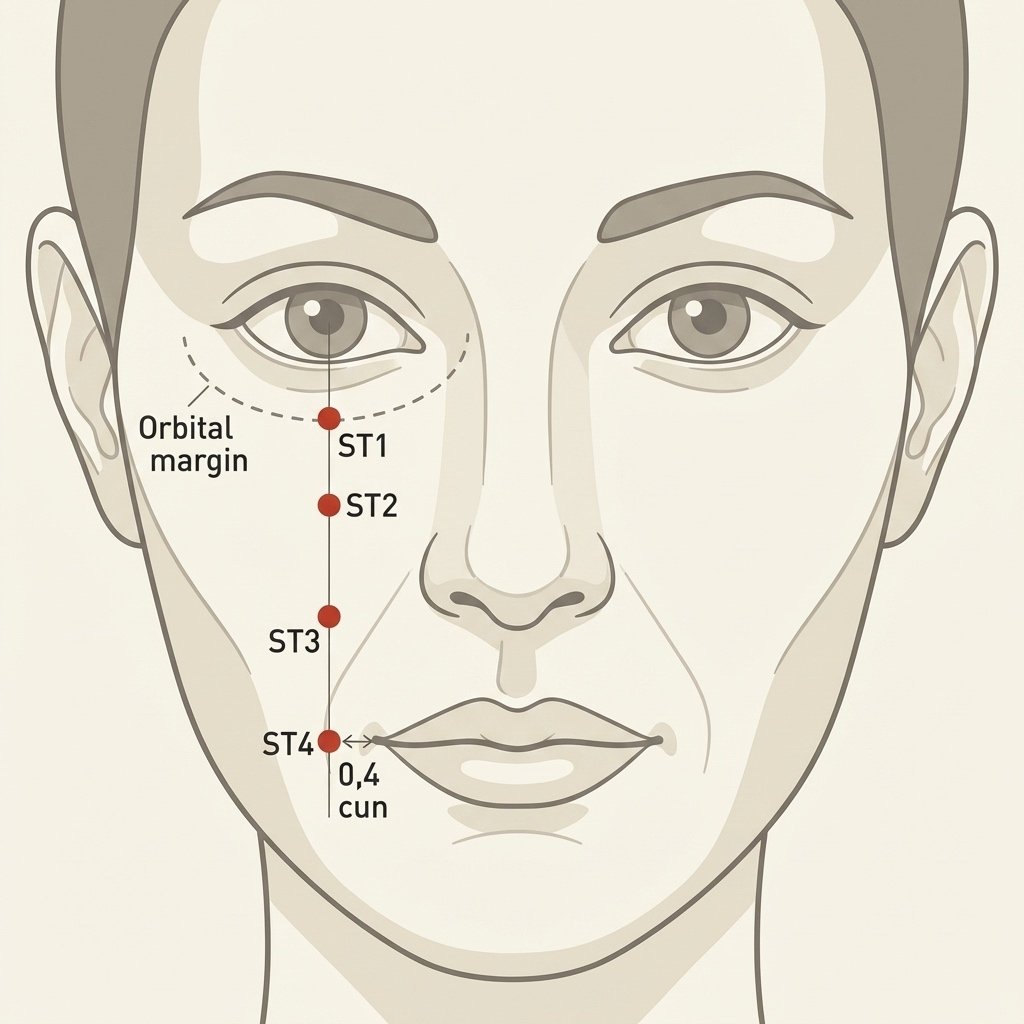
With the eyes looking straight ahead, directly below the center of the pupil, in the depression between the eyeball and the infraorbital margin.
🧭 How to find it (practical)
Seated or supine, with the patient looking straight ahead, locate the point directly below the pupil, between the eyeball and the infraorbital margin.
🔬 Anatomy
Orbicularis oculi muscle. Innervated by the infraorbital nerve (second division of the trigeminal nerve) and the facial nerve. Infraorbital artery and vein.
💉 Needling
Ask the patient to close the eyes. Gently push the eyeball upward. Insert slightly downward, then perpendicularly 0.5–1.0 cun (or 0.2–0.4 cun) between the eyeball and the inferior wall of the orbit.
📜 Etymology
Cheng (承), to receive; Qi (泣), tears. The point lies below the eye, in the place where tears are received.