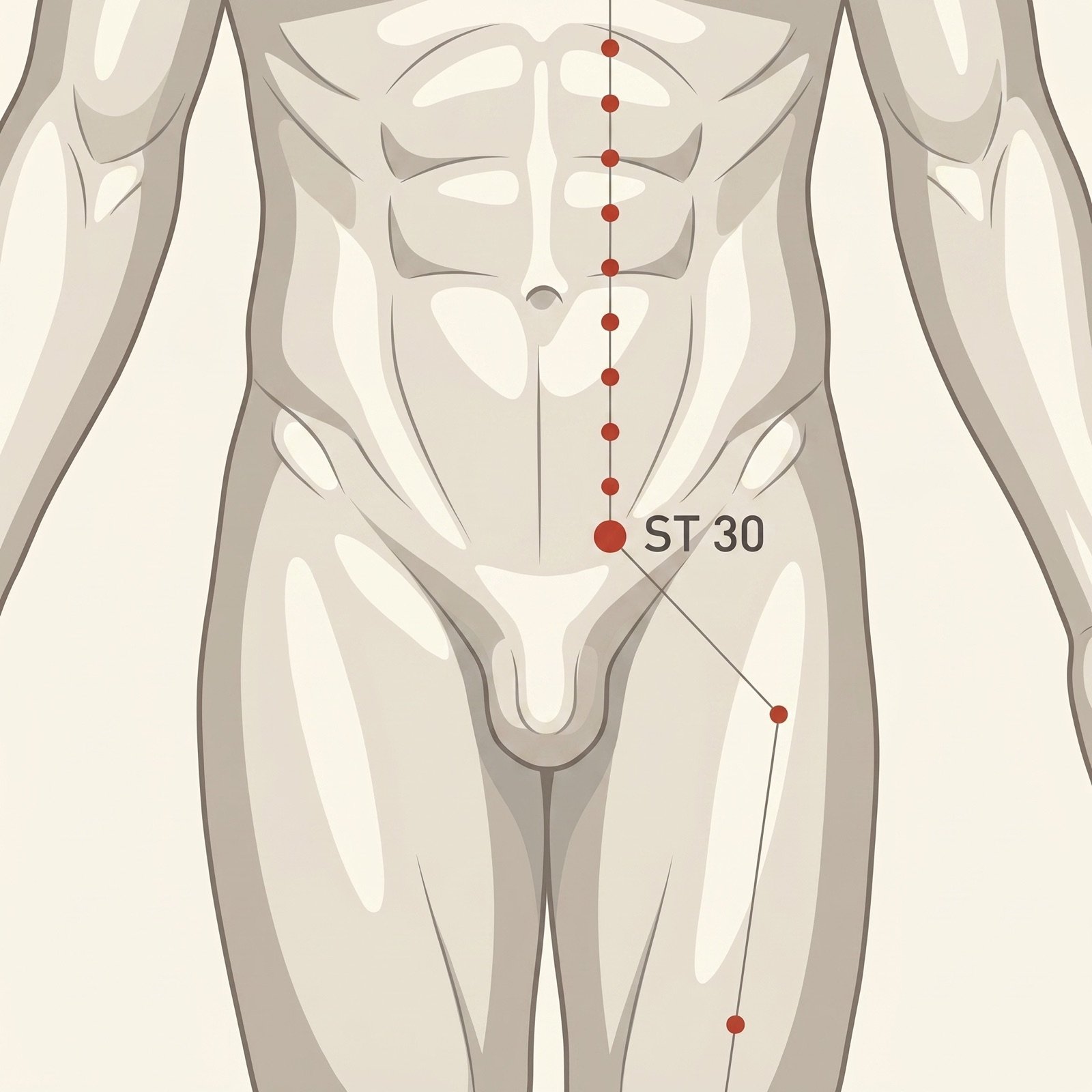
Encontro Estômago-Chong MaiPonto do Mar de Água e GrãosCautionAbdômen
Depth
00.5–1 cun3.0
Perpendicular insertion
Precautions
Avoid the femoral artery. Empty the bladder.
📍 Location (classical)
In the groin, 5 cun below the umbilicus, 2 cun lateral to the anterior midline (level of CV-2 and the upper border of the pubic symphysis).
🧭 How to find it (practical)
Supine, locate the point 2 cun lateral to Qu Gu (CV-2), which lies in the depression on the upper aspect of the pubis.
🔬 Anatomy
Aponeurosis of the external oblique muscle. Ilioinguinal nerve. The femoral artery and vein lie slightly lateral to this point.
💉 Needling
Perpendicular insertion 0.5–1.0 cun.
📜 Etymology
Qi (气), meridian Qi; Chong (冲), to surge. The point lies on the path of Qi (near the femoral artery). It corresponds to the origin of the Chong Mai, and on palpation the pulsation of Qi (the femoral artery) can be felt.