
- Strong
- Moderate
See the numbers: What this page rests on
| Year | Study type | Verdict | Study |
|---|---|---|---|
| 2017 | Case-Control | Moderate | Acupuncture Treatment for Idiopathic Trigeminal Neuralgia: A Longitudinal Case-Control Double Blinded Study |
| 2023 | Narrative Review | Strong | The mechanistic basis for the effects of electroacupuncture on neuropathic pain within the central nervous system |
Evidence behind this recommendation.
Selected studies from our library that inform the recommendations on this page. Evidence grade shown when available.
Acupuncture Treatment for Idiopathic Trigeminal Neuralgia: A Longitudinal Case-Control Double Blinded Study
“Idiopathic trigeminal neuralgia represents one of the most debilitating facial pain conditions known. This disease affects the trigeminal nerve, one of the main nerves responsible for facial sensation, causing episodes of intense pain, ...”
The mechanistic basis for the effects of electroacupuncture on neuropathic pain within the central nervous system
“A mechanistic review suggests that electroacupuncture may modulate central pathways involved in neuropathic pain (dorsal horn, descending inhibitory system, neuroinflammation). Application to trigeminal neuralgia is plausible through the trigeminal pathway — but clinical translation requires specific studies, and first-line pharmacological treatment (carbamazepine/oxcarbazepine) remains essential.”
What Is Trigeminal Neuralgia?
Trigeminal neuralgia is a facial neuropathic pain syndrome considered one of the worst pains known in medicine. It is characterized by sudden, lancinating episodes of intense pain, similar to electric shocks, affecting one or more divisions of the trigeminal nerve — the fifth cranial nerve responsible for facial sensation.
Pain episodes can be triggered by trivial stimuli such as chewing, speaking, brushing the teeth, or even a light breeze on the face. The condition predominantly affects people over 50 and is more frequent in women. The classic cause involves neurovascular compression of the trigeminal root by an arterial loop, leading to focal demyelination and spontaneous ectopic firing of the nerve.
When anticonvulsant drugs — the first-line treatment — lose efficacy or cause incapacitating side effects, medical acupuncture offers a complementary therapeutic pathway with well-grounded neurophysiological mechanisms for the control of facial neuropathic pain.
Extreme Pain
Known as "tic douloureux", it is classified as one of the most intense pains in medicine, with a devastating impact on quality of life.
Chronic and Recurrent
Episodes tend to become more frequent and intense over the years, with progressively shorter periods of remission.
Responsive to Neuromodulation
Medical acupuncture modulates the spinal trigeminal nucleus (caudal subnucleus) and may reduce the frequency and intensity of neuropathic pain attacks.
Why Conventional Treatments Are Not Always Sufficient?
Carbamazepine is the first-line drug for trigeminal neuralgia, with an initial response rate of up to 70-80%. However, a significant portion of patients develop pharmacological tolerance over time, requiring progressively higher doses to obtain the same analgesic effect.
At high doses, carbamazepine and other anticonvulsants (oxcarbazepine, gabapentin, pregabalin) cause important cognitive and systemic side effects: excessive drowsiness, dizziness, ataxia, double vision, hyponatremia and, in severe cases, aplastic anemia. These effects are particularly problematic in the elderly population.
Surgical options — microvascular decompression, percutaneous rhizotomy, and radiosurgery — are effective but carry their own risks, including permanent facial anesthesia, anesthesia dolorosa, and recurrence in up to 30% of cases after 5 years. For many patients, there is a therapeutic gap between insufficient medication and invasive surgery.
Comparison: Conventional Treatment vs. Acupuncture
| Aspect | Conventional (Anticonvulsants) | Medical Acupuncture |
|---|---|---|
| Pain relief | First line; partial response or tolerance in some patients | Can help as a complement; variable effect |
| Side effects | Drowsiness, dizziness, ataxia, hyponatremia | Generally minor (local hematoma, transient pain); serious events rare |
| Long-term use | Risk of hepatic and hematological toxicity; requires monitoring | Favorable safety profile in chronic treatment, in qualified hands |
| Mechanism | Blockade of voltage-dependent sodium channels | Proposed modulation of the spinal trigeminal nucleus (caudal subnucleus) and endogenous opioid pathways |
| Attack frequency | Reduces while the drug is acting | May contribute to a reduction in baseline frequency in some patients |
Craniofacial trigeminal divisions (V1, V2, V3) and facial sensory neuromodulation
The trigeminal ganglion maps facial sensation into three anatomical territories essential to distinguish paroxysmal neuralgia from TMJ, dental, or sinus pain.
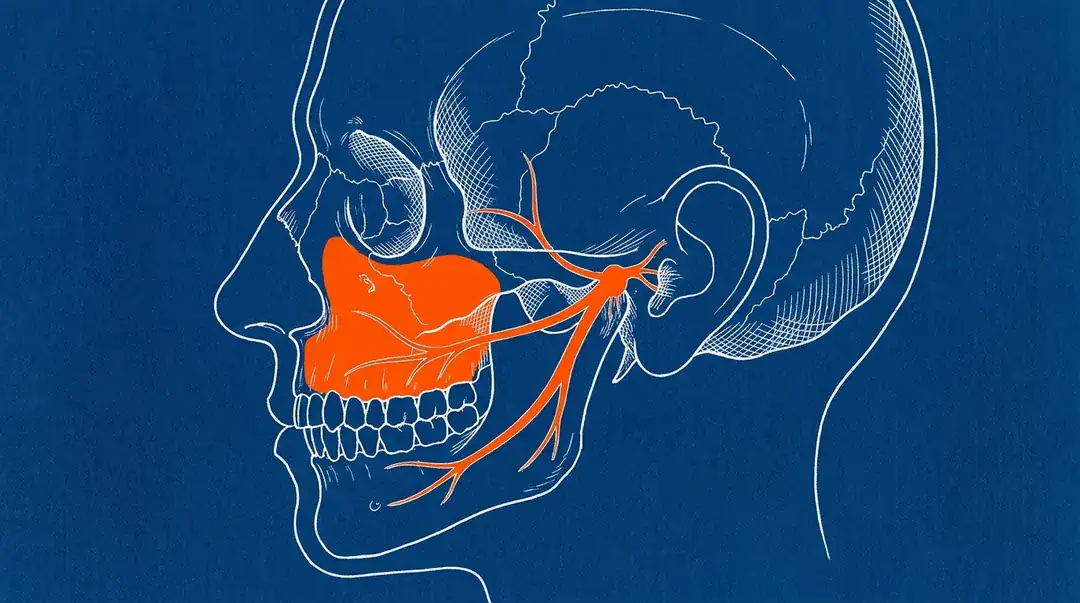
1. Maxillary territory (V2)
Supplies the cheek and upper dental arch, where light touch or breeze can trigger brief electric paroxysms.
2. Trigeminocervical convergence
Facial and upper cervical afferents meet in the spinal trigeminal nucleus, a key target for adjunctive modulation.
3. Mandibular branch (V3) & TMJ
Separates second-long neuropathic shocks along the jaw from continuous myofascial masseter and TMJ ache.
How Does Medical Acupuncture Work in Trigeminal Neuralgia?
Medical acupuncture acts on trigeminal neuralgia through neuromodulation mechanisms operating at multiple levels of the nervous system. The central target is the spinal trigeminal nucleus (caudal subnucleus) (subnucleus caudalis), located in the lower portion of the brainstem, which functions as the main processing station for facial pain.
Stimulation of specific points on the face and body activates afferent fibers that converge on the spinal trigeminal nucleus, where GABAergic and glycinergic inhibitory interneurons suppress the neuronal hyperexcitability responsible for ectopic firing. Low-frequency electroacupuncture (2 Hz) potentiates this effect by recruiting the descending inhibitory pain system, releasing enkephalins and beta-endorphins that modulate the trigeminovascular system.
In addition to central modulation, acupuncture reduces peripheral sensitization of the trigeminal nerve by decreasing the local release of pro-nociceptive neuropeptides such as CGRP (calcitonin gene-related peptide) and substance P, contributing to a reduction in both the intensity and the frequency of painful paroxysms.
Mechanism of Action of Acupuncture in Trigeminal Neuralgia
Stimulation of facial and distal points
Needling at points along the trigeminal branches (V1, V2, V3) and distal points (LI4, ST44) activates A-beta and A-delta fibers that converge on the spinal trigeminal nucleus (caudal subnucleus).
Modulation of the spinal trigeminal nucleus (caudal subnucleus)
GABAergic inhibitory interneurons in the subnucleus caudalis suppress neuronal hyperexcitability and reduce spontaneous ectopic firing of the trigeminal nerve.
Activation of the descending inhibitory system
Electroacupuncture at 2 Hz recruits the periaqueductal gray (PAG) and the nucleus raphe magnus, activating serotonergic and noradrenergic pathways that "close the gate" of trigeminal pain.
Release of endogenous opioids
Beta-endorphins and enkephalins are released at central and spinal levels, providing sustained analgesia and reducing chronic central sensitization.
Reduction of pro-nociceptive neuropeptides
Decreased peripheral release of CGRP and substance P, attenuating sensitization of the trigeminovascular system and reducing the frequency of paroxysms.
What Do the Scientific Studies Say?
Although the volume of evidence for trigeminal neuralgia is smaller than for some musculoskeletal conditions, the available studies — including randomized clinical trials and meta-analyses — show promising results. Acupuncture has been evaluated both as monotherapy and as an adjuvant to anticonvulsants, with consistent outcomes of pain reduction and functional improvement.
What Is Different About the Modern Approach?
Contemporary medical acupuncture for trigeminal neuralgia goes far beyond traditional needling. The medical acupuncturist uses electroacupuncture with specific frequency and intensity parameters, adjusted according to the severity and the affected trigeminal branch.
Low-frequency electrostimulation (2 Hz) is particularly effective in trigeminal neuropathic pain because it preferentially recruits the endorphinergic system, while alternating frequency (dense-disperse 2/100 Hz) simultaneously activates the endorphinergic and dynorphinergic systems, optimizing pain control through different mechanisms. Low-level laser therapy (LLLT) can be a valuable alternative for patients with very sensitive facial trigger zones, in whom direct needling of the trigger zone is initially contraindicated.
When to See a Physician?
If you have recurrent episodes of intense, shock-like facial pain triggered by everyday activities such as chewing, speaking, or touching the face, see a neurologist for evaluation. Trigeminal neuralgia requires differential diagnosis with other causes of facial pain, including dental conditions, sinusitis, temporal arteritis, and post-herpetic neuralgia. Neurological evaluation routinely includes brain MRI, indicated to exclude secondary causes (neurovascular compression, multiple sclerosis, cerebellopontine angle tumors) — this evaluation should precede or accompany any therapy, including acupuncture.
Frequently Asked Questions
The standard protocol involves 10 to 15 sessions, performed twice a week in the first weeks and then weekly. Most patients perceive a reduction in the frequency and intensity of attacks from the fourth or fifth session. After the initial protocol, biweekly or monthly maintenance sessions help to prolong the benefit.
This is a legitimate concern. The experienced medical acupuncturist uses specific techniques to minimize this risk: in the first sessions, often only distal points (hands, feet, legs) and cervical points are used, without directly needling the facial trigger zone. The facial approach is introduced gradually, with fine needles and delicate technique, as the patient's nociceptive system desensitizes.
Yes, and this is in fact the most frequently adopted approach. Acupuncture is compatible with anticonvulsants (carbamazepine, oxcarbazepine, gabapentin, pregabalin) and there is no known pharmacological interaction. In some cases with good clinical response, the attending neurologist evaluates the possibility of adjusting the medication dose — the decision to reduce an anticonvulsant is always made by the prescribing physician, never by the acupuncturist alone.
Studies suggest that electroacupuncture, especially at low frequency (2 Hz), may be superior to manual acupuncture for neuropathic pain such as trigeminal neuralgia. This is because electrostimulation allows precise control of the frequency and intensity of the stimulus, more efficiently recruiting the endorphinergic system and the descending inhibitory pain pathways.
Acupuncture does not eliminate the structural cause of the neuralgia (such as neurovascular compression), but it can significantly modify pain processing, reduce the frequency of attacks, and improve quality of life. Some patients achieve prolonged periods of remission. The therapeutic goal is pain control and reduction of the functional impact of the disease.
When performed by a qualified medical acupuncturist, facial acupuncture is safe. The risks are minimal and include local hematoma (mild bruising), transient discomfort and, rarely, the triggering of an attack in the initial phase of treatment. Serious complications are extremely rare. The use of disposable, sterile needles and proper insertion technique ensure the safety of the procedure.