What Is a Hamstring Strain?
A hamstring strain is a partial or complete rupture of the muscle fibers of the posterior thigh group — formed by the biceps femoris, semitendinosus, and semimembranosus. It is the most frequent muscle injury in sport, accounting for approximately 12-15% of all injuries in athletes of disciplines that involve high-speed running.
The most common mechanism of injury is eccentric overload during the late swing phase of running, when the hamstrings contract to decelerate knee and hip extension before foot contact with the ground. This intense eccentric demand is particularly pronounced during sprints, accelerations, and abrupt changes of direction.
The most consistent risk factor in the literature is history of prior strain — athletes with previous injury have a two- to six-fold higher risk of recurrence, reflecting both incomplete healing of muscle tissue and residual neuromuscular deficits that frequently persist after return to sport.
Eccentric Mechanism
Most injuries occur as the leg decelerates during high-speed running — the muscle lengthens while contracting to brake the movement
Myotendinous Junction
The most common rupture site is the proximal myotendinous junction of the biceps femoris — the region of greatest mechanical vulnerability
Prevention with Nordic
The Nordic hamstring curl is the gold standard for prevention, with up to 51% reduction in injury incidence in regular programs
Phased Rehabilitation
Return to sport requires progression through phases — isometric, eccentric, functional, and sport-specific — to minimize recurrence risk
Pathophysiology
The hamstrings are biarticular muscles that cross the hip and knee. During high-speed running, in the late swing phase, they contract eccentrically to brake knee extension and hip flexion — generating internal forces that may exceed the muscle fibers' resistance capacity. The injury results from this imbalance between load and resistance.
The biceps femoris (long head) is the most frequently injured muscle, accounting for about 70% of cases. This is due in part to its dual innervation (tibial nerve to the long head and fibular nerve to the short head), which can produce asynchronous muscle activation, and to its greater contribution to knee deceleration during sprinting.
Classification of Hamstring Strains
| Grade | Injury | Clinical | Estimated Return Time |
|---|---|---|---|
| Grade I (mild) | Rupture of a few fibers, with no significant structural loss | Localized pain, no significant strength loss, normal or slightly antalgic gait | 1-3 weeks |
| Grade II (moderate) | Partial rupture with more extensive damage, but not complete | Significant pain, partial strength loss, antalgic gait, possible bruising | 4-8 weeks |
| Grade III (severe) | Complete rupture or avulsion of the ischial tuberosity | Intense pain, functional disability, extensive hematoma, palpable gap | 12-16+ weeks (may require surgery) |
Muscle healing after a strain involves three overlapping phases: inflammatory (0-5 days), proliferative (5-21 days), and remodeling (21 days to months). Fibrotic scar tissue forming at the myotendinous junction is the main factor predisposing to recurrence, since this tissue is less elastic and less resistant to eccentric loading than the original muscle.

Signs and Symptoms
Clinical presentation varies with injury grade. In grade I strains, pain may appear only during or after sports activity. In grade II and III injuries, onset is typically acute and incapacitating, often with a "pop" or "snap" sensation in the posterior thigh during sprinting.
Clinical Picture by Severity
Acute pain in the posterior thigh during sprint or acceleration
Sensation of "pop" or "snap" at the moment of injury (grade II-III)
Inability to continue the sports activity
Pain on palpation at the proximal myotendinous junction (most common) or distal
Bruising on the posterior thigh (may appear 24-48h after injury)
Loss of strength in resisted knee flexion
Difficulty walking with long strides or climbing stairs
Pain on sitting with hip flexion and knee extended (tension sign)
Diagnosis
Hamstring strain diagnosis is predominantly clinical, based on a typical injury-mechanism history and physical examination findings. Imaging studies are indicated to grade the injury, guide prognosis, and rule out alternative diagnoses.
Clinical and Imaging Assessment
- History of acute pain in the posterior thigh during sprint, acceleration, or kick
- Pain on palpation of the proximal myotendinous junction (biceps femoris) or in the intramuscular region
- Loss of range of motion on knee extension with hip flexed (active knee extension test)
- Loss of strength in resisted knee flexion (grades II and III)
- Active compression test: pain on isometric contraction of the hamstrings with knee flexed at 15 degrees
- Musculoskeletal ultrasound: identifies location and extent of rupture, presence of hematoma, and fibrillar retraction
- MRI: indicated in recurrent injuries, suspected avulsion, or clinical-ultrasound discordance
Differential Diagnosis
Although the acute presentation of hamstring strain is generally characteristic, other conditions may mimic or coexist with the muscle injury. Differentiation is particularly important in subacute and chronic presentations.
Differential Diagnosis
Piriformis Syndrome
Read more- Deep gluteal pain with posterior radiation
- Positive FAIR test
- No defined traumatic mechanism
L5-S1 Lumbar Radiculopathy
Read more- Pain radiating below the knee
- Dermatomal paresthesias
- Possible reflex changes
Sciatica
Read more- Pain along the sciatic nerve pathway
- Radiation to leg and foot
- Neuropathic component (burning, electric shock)
Proximal Hamstring Tendinopathy
Read more- Insidious pain at the ischial tuberosity
- Worsens when sitting on hard surfaces
- No acute mechanism
Ischial Tuberosity Avulsion
- Severe acute pain with forced lengthening mechanism
- More common in adolescents
- Immediate functional disability
Treatments
Treatment of hamstring strain follows a progressive rehabilitation protocol, the duration of which depends on the grade of injury. The contemporary approach emphasizes early initiation of exercises within pain limits, avoiding both prolonged immobilization and premature return to sport.
- 01Grade I (mild)1-3 weeksRupture of a few fibers, with no significant structural loss.
- 02Grade II (moderate)4-8 weeksPartial rupture with more extensive damage, but not complete.
- 03Grade III (severe)12-16+ weeksComplete rupture or avulsion of the ischial tuberosity; may require surgery.
Rehabilitation Phases
Protection and Pain Control
Relative rest (avoid activities that reproduce pain). Cryotherapy in the first 48-72h. Submaximal isometric exercises in a painless position. Compression and elevation if significant edema is present.
Isometric Loading and Range of Motion
Progressive isometric exercises at multiple angles. Restore pain-free range of motion. Walking at increasing speed. Begin closed-chain exercises without excessive eccentric loading.
Eccentric Strengthening
Progressive eccentric exercises: Romanian deadlift, Nordic hamstring curl (assisted), eccentric leg curl. Progress load based on pain tolerance. Light straight-line running when range and strength allow.
Functional Training and Return to Sport
Sport-specific exercises: progressive sprints, direction changes, controlled deceleration. Return criteria: symmetric strength (less than 10% side-to-side difference), full range of motion, maximal-speed sprinting without pain.
Do
- Use cryotherapy in the first 48-72 hours
- Start exercises early, within pain limits
- Progress the load of eccentric exercises based on pain tolerance
Avoid
- Prolonged immobilization
- Premature return to sport
- Activities that reproduce pain in the protection phase
- Treatment follows a progressive rehabilitation protocol, the duration of which depends on the grade of injury.
- Light straight-line running enters the eccentric strengthening phase, when range and strength allow.
- Return criteria: symmetric strength (less than 10% side-to-side difference), full range of motion, maximal-speed sprinting without pain.
Medical Acupuncture
Acupuncture can support recovery from hamstring strain, acting as an adjunct to rehabilitation. Proposed mechanisms include modulation of local pain through segmental inhibition, release of endogenous opioids, improvement of tissue microcirculation, and reduction of reflex muscle spasm that frequently accompanies the injury.
Electroacupuncture at low frequencies (2-4 Hz) may be particularly useful in the pain control phase, facilitating progression of the exercise program. Stimulation of local points in the injured region promotes increased blood flow and may favor the healing process, although specific data for muscle strain remain limited.
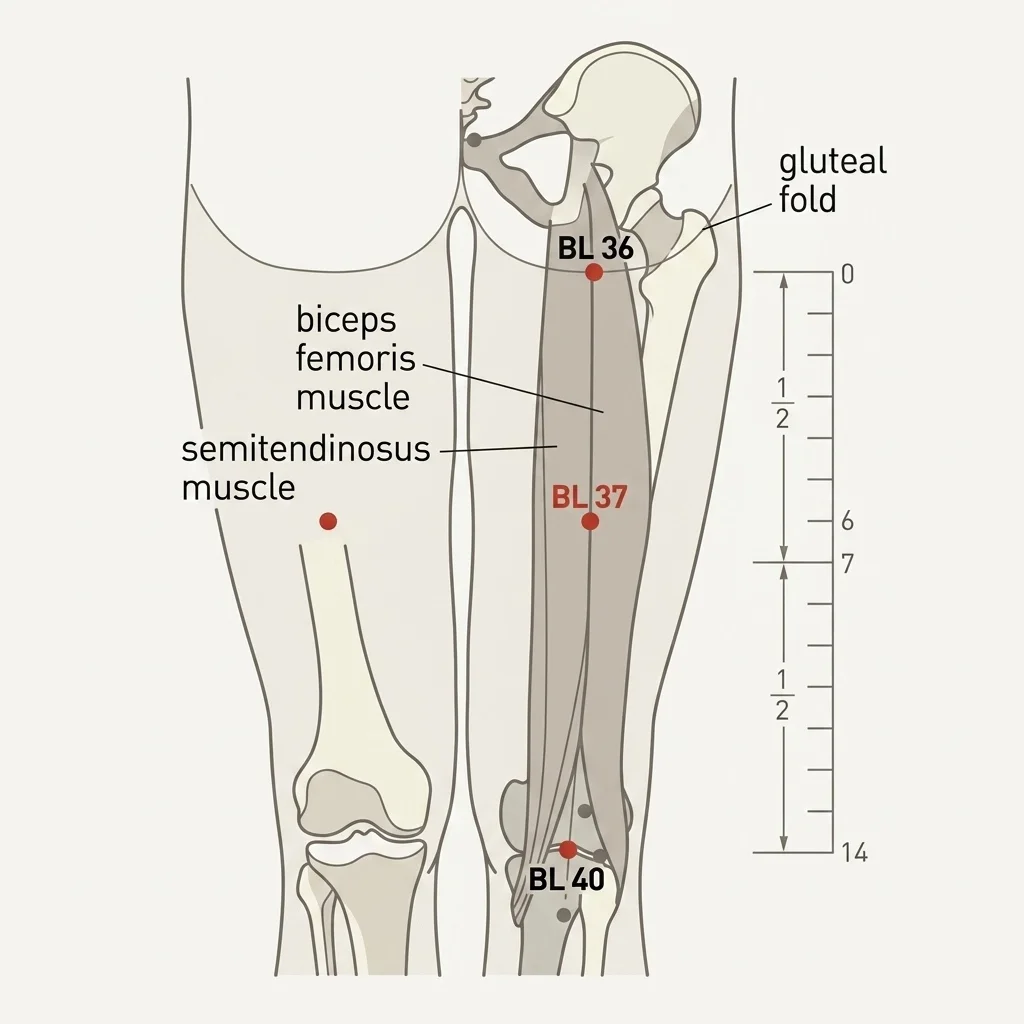
- Location
- On the posterior aspect of the thigh, 6 cun inferior to BL-36, on the line connecting BL-36 and BL-40.
When to See a Physician
Hamstring Strain: Frequently Asked Questions
Recovery time depends on injury grade. Grade I strains usually resolve in 1 to 3 weeks with adequate rehabilitation. Grade II injuries require 4 to 8 weeks. Grade III injuries may require 12 to 16 weeks or more, and some cases require surgical repair. Return to sport should be guided by objective criteria of strength, range of motion, and function — not by absence of pain alone.
The high recurrence rate (16-34% in the first 12 months) results from multiple factors: scar tissue formed at the myotendinous junction is less elastic and resistant than the original muscle; many athletes return to sport before fully recovering eccentric strength; and neuromuscular deficits frequently persist (such as reflex inhibition and altered activation pattern) that are only detected with specific functional tests.
The Nordic hamstring curl is an eccentric exercise in which the athlete kneels with ankles fixed and slowly leans the trunk forward, resisting the fall with hamstring strength. It increases eccentric strength and shifts the optimal length of force production toward more lengthened positions — exactly the positions in which injuries occur during sprinting. Meta-analyses show up to 51% reduction in strain incidence when the exercise is incorporated regularly.
Cryotherapy may be used in the first 48 to 72 hours for pain control and edema reduction. Apply for 15 to 20 minutes every 2 to 3 hours with skin protection. After this initial phase, isolated cryotherapy offers little benefit and the focus should shift to progressive mobilization and rehabilitation exercises.
Surgery is indicated in specific situations: complete avulsion of the ischial tuberosity with significant tendon retraction (generally more than 2 cm), grade III injuries with complete rupture in elite athletes, and cases of excessive scar tissue formation that compromises function despite adequate rehabilitation. In most grade I and II cases, conservative treatment is effective.
Acupuncture can contribute as an adjunct to rehabilitation, mainly for controlling pain and protective muscle spasm in the early recovery phases. Electroacupuncture at local points (BL-36, BL-37, BL-40) may help exercise progression by reducing the discomfort that limits load. Importantly, acupuncture does not replace the progressive eccentric strengthening program, which is the pillar of treatment.
The most used return-to-sport criteria include: symmetric isometric and eccentric strength between sides (less than 10% difference), active knee extension range equal to the contralateral side, ability to sprint at maximal speed without pain or restriction, and no discomfort in sport-specific exercises (direction changes, deceleration, jumps). The decision should be individualized by the responsible physician.
Related Reading
Deepen your knowledge with related articles