Skip to content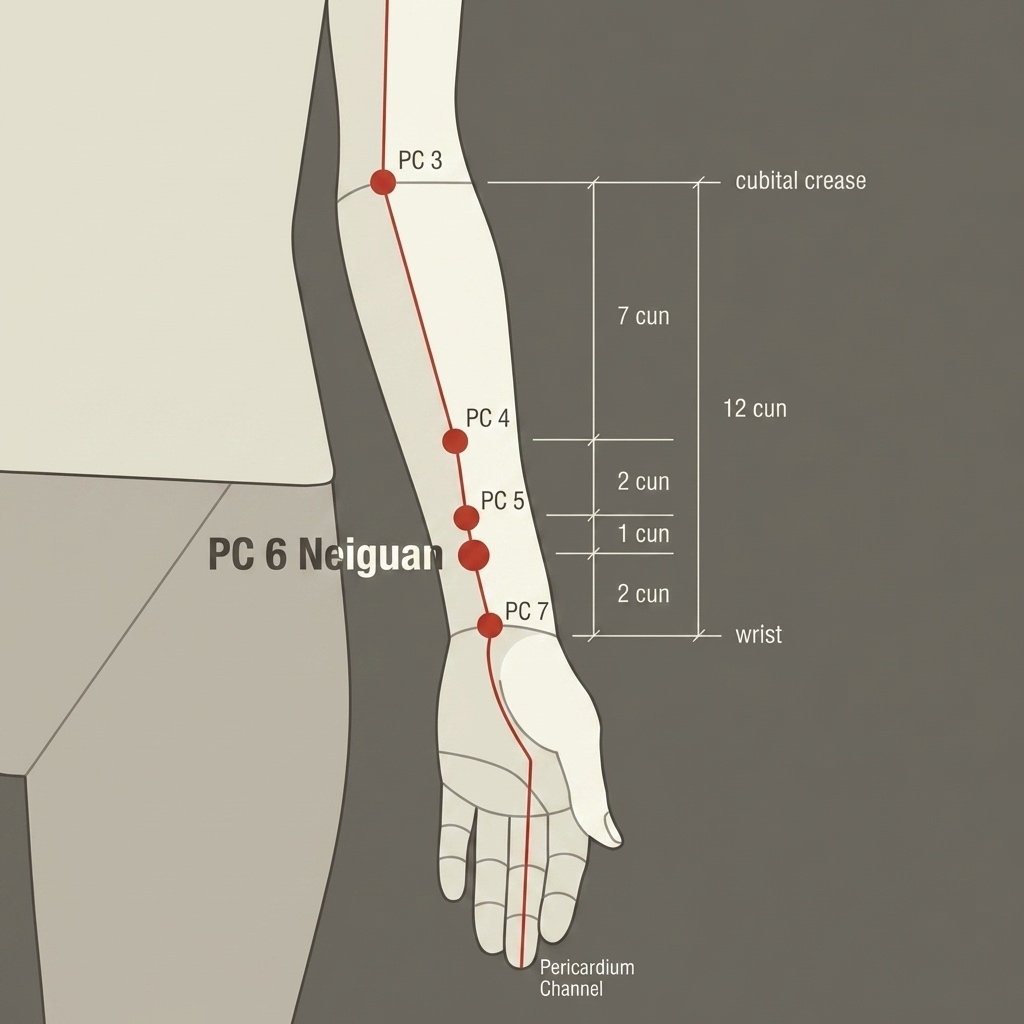
PC-6 Neiguan (內關) — Inner Pass
PC-6
Neiguan
內關
Inner Pass
★ MajorPonto Luo de ConexãoPonto Confluente do Yin Wei MaiPonto de Comando de Gao Wu do TóraxCautionMembro Superior
Depth
00.5 cun3.0
Oblique insertion
Precautions
Caution: the median nerve lies directly beneath this point. Insert slowly to avoid an electric-shock sensation.
Location (classical)
On the palmar aspect of the forearm, 2 cun proximal to the transverse crease of the wrist, between the tendons of the palmaris longus and flexor carpi radialis muscles.
How to find it (practical)
With the arm extended and the palmar surface facing up, locate the point 2 cun above Da Ling (PC-7) or 2 cun above the wrist crease.
Anatomy
Skin, subcutaneous tissue, medial and lateral cutaneous nerves of the forearm, palmar branch of the median nerve, median antebrachial vein, flexor digitorum superficialis muscle, tendon of the flexor digitorum profundus, and median nerve.
Needling
Perpendicularly 0.5 cun, or obliquely upward 0.1 cun.
Etymology
Nei (內), Inner; Guan (關), strategy. The point lies on the anterior aspect of the forearm and "has the function of internal strategy."
CLASSICAL SOURCELing Shu
Clinical Relations
Point Pairs
Yuan-LuoTE-4 Yangchi
Classical Combinations
Nausea, vomiting, digestive disorders
Insomnia, anxiety, palpitations, calming the mind
SP-4 GongsunConfluent pair (Chong Mai)
Chest and heart disorders, stomach pain, gynecological conditions
Adjacent Points on the Meridian