Skip to content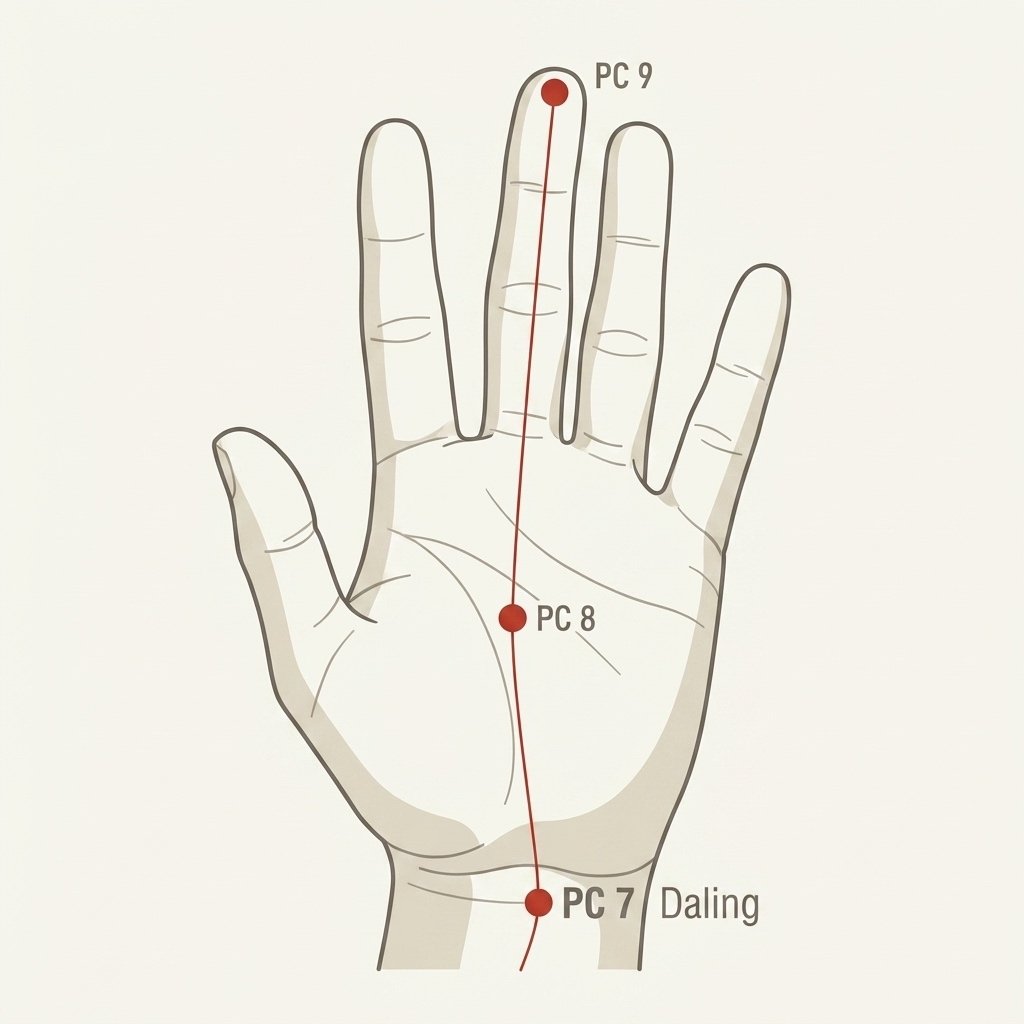
PC-7 Daling (大陵) — Great Mound
PC-7
Daling
大陵
Great Mound
Ponto Shu-Riacho (Terra)Ponto Yuan-FontePonto de SedaçãoCautionMembro Superior
Depth
00.3–0.5 cun3.0
Oblique insertion
Precautions
High risk of injury to the median nerve with aggressive manipulation. Caution: the median nerve lies directly beneath this point. Puncture often produces an intense electrical sensation; once triggered, any further manipulation is inappropriate and may injure the nerve.
Location (classical)
At the wrist joint, in the depression at the center of the transverse wrist crease, between the tendons of the palmaris longus and flexor carpi radialis muscles.
How to find it (practical)
With the arm extended and the palmar surface facing up, locate the point in the middle of the wrist crease, between the tendon of the palmaris longus and the ulnar side of the flexor carpi tendon.
Anatomy
Skin, subcutaneous tissue, medial and lateral cutaneous nerves of the forearm, palmar branch of the median nerve, median antebrachial vein, palmar carpal branches of the radial and ulnar arteries, palmar carpal ligament, pronator quadratus muscle, tendon of the flexor digitorum profundus, and median nerve.
Needling
Perpendicular insertion 0.3 to 0.5 cun. For carpal tunnel syndrome, distal oblique insertion along the tunnel, 0.5 to 1 cun.
Etymology
Da (大), great; Ling (陵), mound. The lunate bone is prominent, like a mound. The point lies in the depression proximal to the prominence of the wrist.
CLASSICAL SOURCELing Shu
Clinical Relations
Point Pairs
Yuan-LuoTE-5 Waiguan
Adjacent Points on the Meridian