Encontro do Intestino DelgadoIntestino GrossoTriplo AquecedorDangerMembro Superior
Depth
00.5–1 cun3.0
Oblique insertion
Precautions
Deep perpendicular insertion carries a risk of pneumothorax in lean patients. Caution: deep perpendicular insertion, especially in lean patients, carries substantial risk of inducing pneumothorax.
📍 Location (classical)
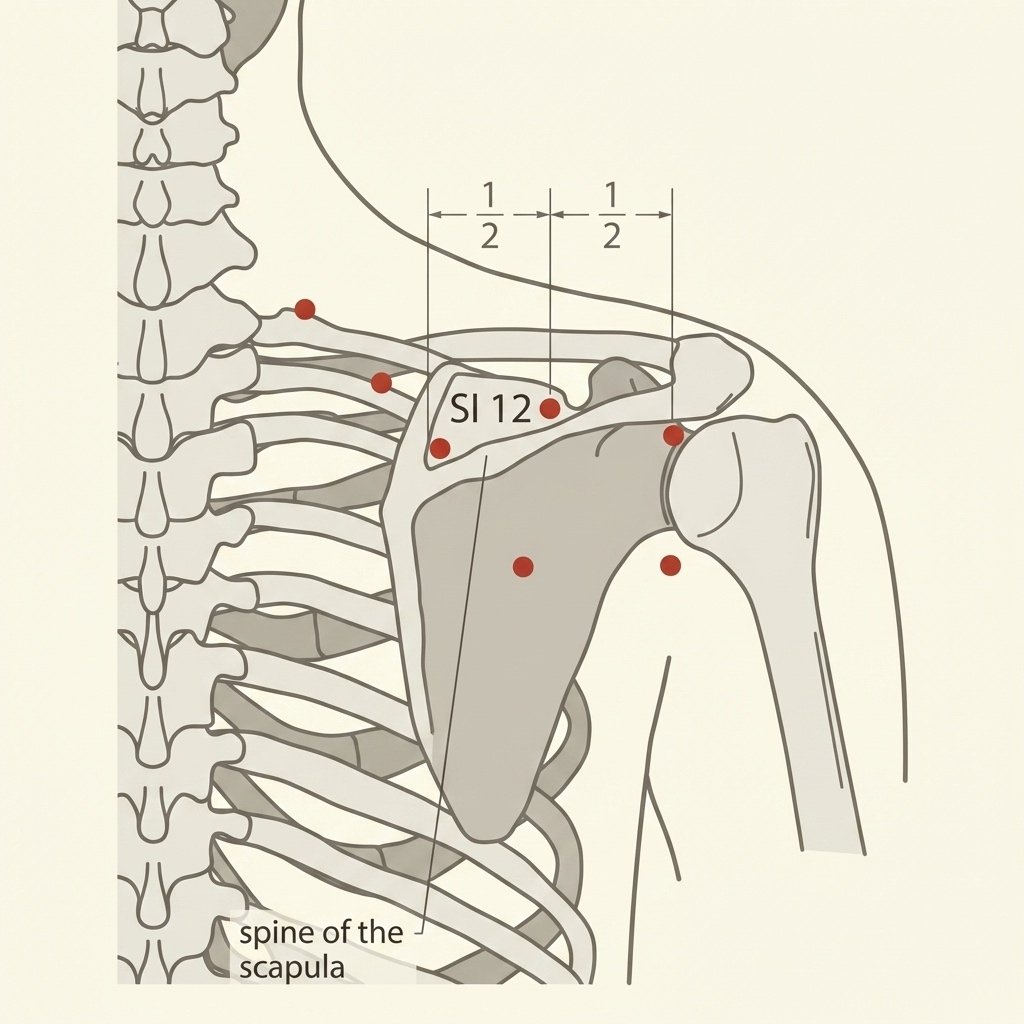
In the center of the suprascapular fossa, directly above Tianzong SI-11, in a depression formed when the arm is raised.
🧭 How to find it (practical)
Seated or in the prone position, locate the point 1 cun above the central point of the upper border of the spine of the scapula, that is, in the suprascapular fossa. The point forms a triangle with Nao Shu (SI-10) and Tian Zong (SI-11).
🔬 Anatomy
Trapezius and supraspinatus muscles. Innervated by the suprascapular nerve and accessory nerve. Suprascapular artery.
💉 Needling
Medial oblique insertion toward the spine 0.5 to 1 cun.
📜 Etymology
Bing (秉), to grasp; Feng (风), pathogenic wind. The point treats wind syndromes.