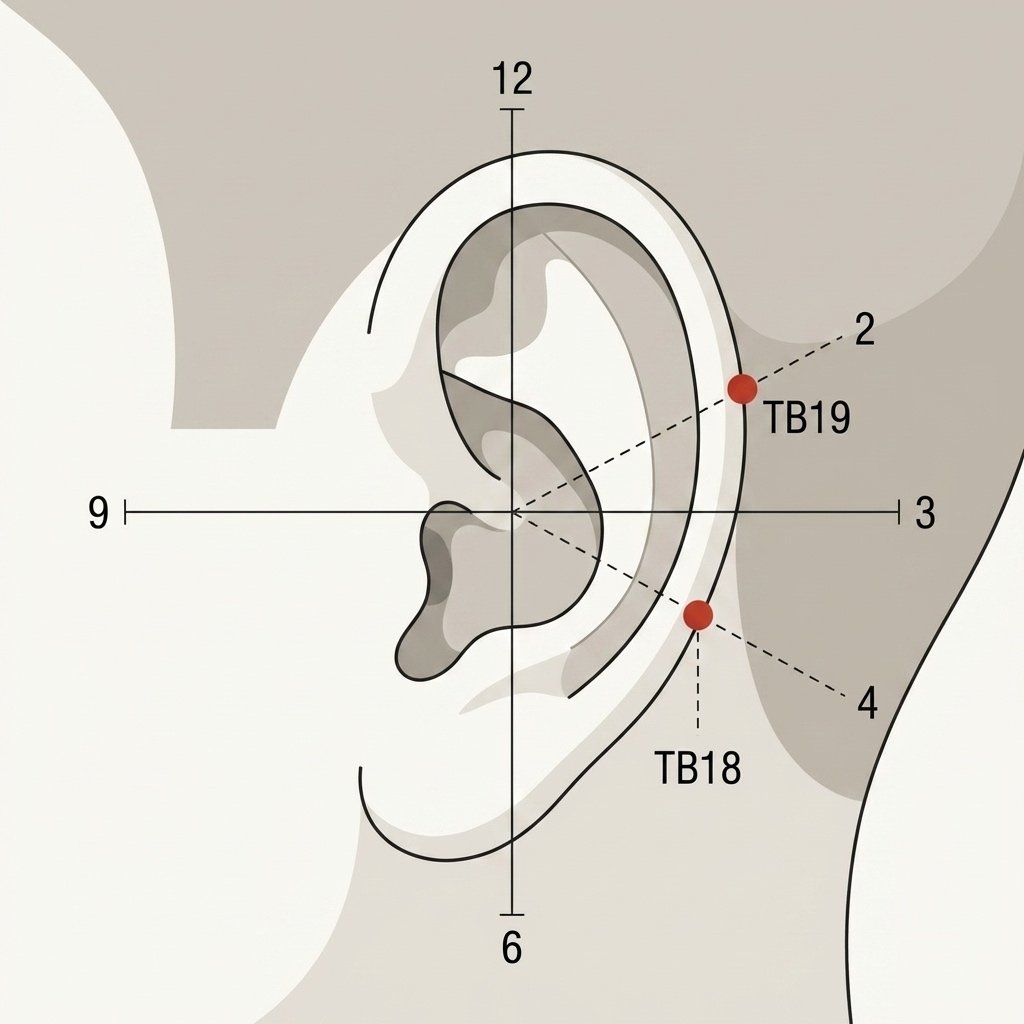
Posterior to the ear, at the center of the mastoid process, in the lower third of the curve connecting TE-17 and TE-20.
🧭 How to find it (practical)
Seated or in lateral decubitus, locate the point at the intersection of the retroauricular hairline and the line of the opening of the external auditory canal.
🔬 Anatomy
Posterior auricular muscle. Innervated by the great auricular nerve. Posterior auricular artery.
💉 Needling
Transverse (subcutaneous) insertion, 0.3–0.5 cun.
📜 Etymology
Chi (瘈), convulsion; Mai (脉), blood vessel. The point lies behind the ear, where the collaterals are distributed. It is used for the treatment of convulsions.