
- Strong
- Moderate
See the numbers: What this page rests on
| Year | Study type | Verdict | Study |
|---|---|---|---|
| 2023 | Narrative Review | Moderate | Acupuncture for gastrointestinal diseases |
| 2026 | Other | Strong | Multimodal Enhancement of Colonic Motility by Acupuncture at ST36 is Mediated by TRPV1+ Cutaneous Sensory Fibers |
Evidence behind this recommendation.
Selected studies from our library that inform the recommendations on this page. Evidence grade shown when available.
Acupuncture for gastrointestinal diseases
“This review shows that acupuncture may be a safe and effective option for several digestive disorders, including irritable bowel syndrome, constipation, reflux, and inflammatory bowel disease...”
Multimodal Enhancement of Colonic Motility by Acupuncture at ST36 is Mediated by TRPV1+ Cutaneous Sensory Fibers
“This study revealed how acupuncture works to improve bowel problems. Researchers found that specific receptors (TRPV1) in the skin overlying the ST36 point are responsible for the effects...”
Chronic Constipation: More Than Just a "Sluggish Bowel"
Chronic constipation (CC) is defined by the Rome IV criteria as the presence of 2 or more of the following for at least 6 months: straining during >25% of bowel movements, hard stools in >25%, sensation of incomplete evacuation in >25%, use of digital maneuvers in >25%, or fewer than 3 spontaneous bowel movements per week. It affects 14%–17% of the global population, with an estimated cost of US$ 1.7 billion/year in the United States for treatments and consultations. The impact on quality of life is comparable to moderate coronary artery disease.
Conventional Treatments: Moderate Efficacy and Adherence Problems
Treatments for Chronic Constipation
| Treatment | Efficacy | Limitations |
|---|---|---|
| Fiber + hydration (lifestyle modification) | Limited efficacy in severe functional constipation; minimum 25 g/day required | Insufficient alone in most moderate-severe cases; increased gas and bloating |
| Osmotic laxatives (PEG/macrogol) | Effective; first-line pharmacotherapy; well tolerated | Abdominal bloating and nausea in 18% (cause of discontinuation); chronic use creates functional dependence in some patients |
| Stimulant laxatives (bisacodyl, senna) | Rapid action; occasional use | Intense abdominal pain (cramping); chronic use: damage to the myenteric plexus (cathartic colon) |
| Prucalopride (5-HT4 agonist) | High efficacy in slow transit; approved for women | High cost; diarrhea as adverse effect; headache; limited availability in Brazil |
| Anorectal biofeedback | Excellent for outlet obstruction; 70% success rate | Requires specialized equipment; limited availability; multiple sessions |
| Acupuncture | CONSTIPATE trial: +1.9 bowel movements/week; equivalence to PEG; effect maintained 12 weeks post-treatment | Requires 28 sessions in CONSTIPATE; access and cost |
Three neurobiological levels of medical acupuncture: from muscle to central modulation
Mechanical stimulation of myelinated peripheral afferents engages local tissue perfusion, spinal dorsal horn gating, and descending brainstem analgesia across sessions.
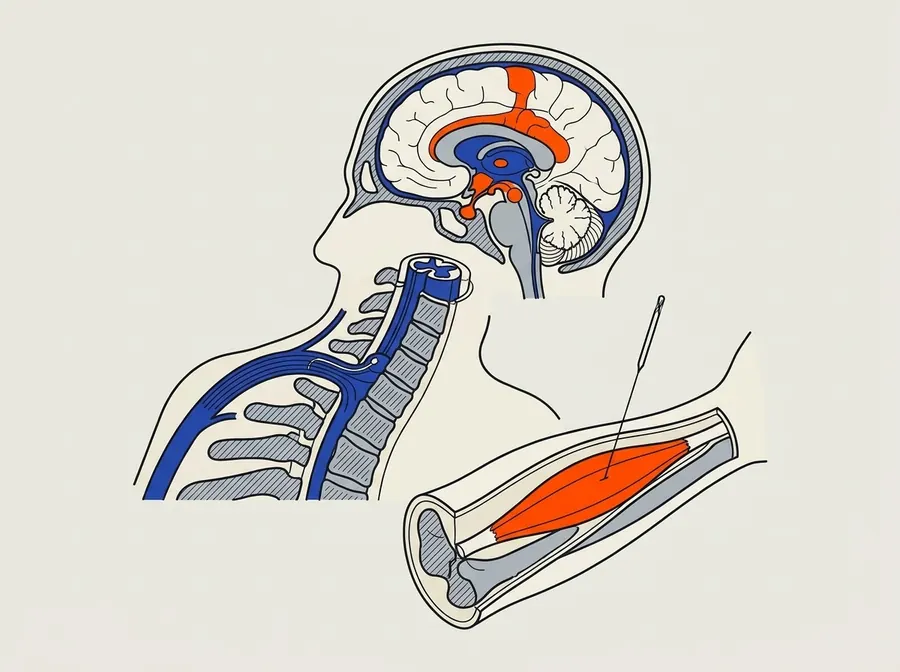
1. Local & myofascial coupling
Recruits Aβ/Aδ mechanoreceptors, releases local adenosine, and restores micro-perfusion in taut muscle bands.
2. Spinal dorsal horn gating
Segmental inhibitory interneurons dampen ascending nociceptive signaling and calm viscerosomatic reflexes.
3. Descending central control
Engages periaqueductal gray and brainstem relays, recruiting endogenous opioids and monoamines.
How Acupuncture Works in Constipation
Mechanisms in Chronic Constipation
Activation of Colonic Motility (25 Hz EA)
EA at higher frequency (25 Hz) at ST-25 (Tianshu — Front-Mu of the Large Intestine) activates high-amplitude propagating contractions (HAPCs) in the colon. Colonic manometry documents an increase in HAPCs after EA at ST-25 — the same type of contraction that bisacodyl induces pharmacologically, but without pain (cramping).
Somatovisceral Reflex to the Colon
ST-36 and BL-25 (back-Shu of the Large Intestine, L4–L5) activate the somatovisceral reflex to the descending and sigmoid colon. Stimulation of BL-25 mimics the mechanism of sacral neuromodulation for constipation — a growing approach in high-level gastroenterology.
Increase of Pro-Kinetic Neurotransmitters
ST-25 with 25 Hz EA increases serotonin (5-HT) in the colonic mucus — the main neurotransmitter of the myenteric plexus for motility. Studies with post-acupuncture colonic biopsies document an increase in enterochromaffin cells (5-HT producers) and elevation of fecal 5-HIAA.
Improvement of the Pelvic Floor (Outlet Obstruction)
For constipation due to pelvic floor dysfunction (paradoxical puborectalis contraction), BL-32+BL-33 (sacral foramina S2–S3) and SP-6 modulate the paradoxical puborectalis contraction — the same mechanism as anorectal biofeedback. Useful when anorectal manometry documents paradoxical puborectalis contraction.
Main Points (CONSTIPATE Protocol)
ST25 — Tianshu (Front-Mu of the Large Intestine)
ST25 is the alarm point of the large intestine — the most important point for constipation. In the CONSTIPATE trial, bilateral ST25 with 25 Hz EA was the central point of the protocol that showed +1.9 bowel movements/week. EA at 25 Hz is more effective than 2 Hz for colonic motility.
ST36 — Vagal Stimulation and General Motility
ST36 complements ST25 through vagal activation that increases myenteric plexus activity in the large intestine. The combination of bilateral ST25+ST36 with 25 Hz EA was the exact protocol of the CONSTIPATE trial — the largest RCT of acupuncture for constipation ever conducted.
BL25 — Back-Shu of the Large Intestine
BL25 is the back-Shu point of the large intestine — the partner of ST25 in the Front-Back technique. It activates the sacral plexus and the hypogastric nerve that modulates the sigmoid colon. Bilateral EA at BL25 complements the effect of ST25 on rectosigmoid motility.
Scientific Evidence: The CONSTIPATE Trial
The CONSTIPATE trial (Liu et al., Lancet Gastroenterol Hepatol, 2020) is one of the largest and most rigorous RCTs of acupuncture ever conducted — and one of the most convincing pieces of evidence in the field of integrative medicine in gastroenterology.
Modern Approach
Opioid-Induced Constipation
Opioid-induced constipation (OIC) affects 40%–80% of patients on chronic opioids. In addition to the standard protocol (ST25+ST36), add LI4 and LI11 which have an opioid-independent effect on colonic motility.
Constipation in Older Adults and Parkinsonism
Severe constipation in parkinsonism (autonomic dysfunction + reduced dopamine) responds to the ST25+ST36+BL25 protocol. Acupuncture is especially valuable here because prokinetics (metoclopramide) are contraindicated in Parkinson's disease due to dopaminergic antagonism.
When to See a Medical Acupuncturist
Indications
Confirmed chronic functional constipation (>6 months); failure of or dependence on osmotic or stimulant laxatives; opioid-induced constipation; Parkinson's disease with constipation (prokinetics contraindicated); IBS-C with a slow-transit component.
Colonoscopy Before Treatment
New-onset constipation in adults over 45 or with rectal bleeding requires colonoscopy to exclude colorectal neoplasia. Change in bowel habit associated with weight loss is a red flag. Acupuncture for functional constipation is indicated after appropriate workup.
Frequently Asked Questions
Frequently Asked Questions
Colonic motility requires specific activation of smooth-muscle cells via serotonin (5-HT) release in the myenteric plexus. EA at 25 Hz activates myosin light-chain kinase in colonic smooth-muscle cells, inducing peristaltic contractions — the same mechanical effect as stimulant laxatives, but without cramping. Manual acupuncture produces an intermittent stimulus insufficient to activate this mechanism in a sustained way over 30 minutes.
Not abruptly. Withdrawal of an osmotic laxative should be gradual — reducing the dose as acupuncture produces a response. In general, after 4–6 weeks of EA (3x/week), bowel-movement frequency improves enough to halve the laxative dose. Complete withdrawal can occur in weeks 8–12 if the response is good. The gastroenterologist should monitor this transition.
The CONSTIPATE trial used 3–4 sessions per week for the first 8 weeks — an intensive protocol. In clinical practice, 2 sessions/week for 8 weeks is usually feasible and sufficient for most patients. After the intensive phase, 1 session/week for 4 weeks and then 1 maintenance session/month.
Yes. Tricyclic antidepressants (amitriptyline, nortriptyline) and some SSRIs cause constipation through anticholinergic and anti-serotonergic effects on the myenteric plexus. EA at ST-25+ST-36 at 25 Hz increases enteric serotonin, partially counterbalancing the effect of antidepressants. It is preferable to maintain the antidepressant and treat constipation with acupuncture rather than discontinue the psychiatric medication.