
- Moderate
See the numbers: What this page rests on
| Year | Study type | Verdict | Study |
|---|---|---|---|
| 2022 | Meta-analysis | Moderate | Acupuncture for emotional symptoms in patients with functional gastrointestinal disorders: A systematic review and meta-analysis |
| 2024 | Systematic Review | Moderate | Symptom effects and central mechanism of acupuncture in patients with functional gastrointestinal disorders: a systematic review based on fMRI studies |
Evidence behind this recommendation.
Selected studies from our library that inform the recommendations on this page. Evidence grade shown when available.
Symptom effects and central mechanism of acupuncture in patients with functional gastrointestinal disorders: a systematic review based on fMRI studies
“This study showed that acupuncture can significantly help people with functional digestive problems, improving symptoms such as abdominal pain, bloating, and bowel changes.”
Acupuncture for emotional symptoms in patients with functional gastrointestinal disorders: A systematic review and meta-analysis
“This meta-analysis suggests that acupuncture may reduce emotional symptoms (anxiety/depression) associated with functional gastrointestinal disorders, with benefit comparable to conventional interventions in subgroups; the evidence is still heterogeneous and limited.”
What Functional Abdominal Pain Syndrome Is
Functional abdominal pain syndrome (FAPS) is defined by the Rome IV criteria as chronic abdominal pain — present for at least 6 months — that has no identifiable structural or biochemical substrate and whose relationship with defecation or alteration of bowel transit is inconsistent or absent. This last feature differentiates FAPS from irritable bowel syndrome (IBS), where pain has a systematic relationship with bowel habits.
FAPS affects 0.5%–2% of the adult population, with significant predominance in women (F:M of 3:1). It is highly comorbid with anxiety disorders (present in 40%–60% of cases) and depression (25%–40%). The socioeconomic impact is substantial: multiple medical visits, repeated tests without diagnosis, and significant work absenteeism.
Pathophysiology: Central Visceral Hyperalgesia
Conventional Treatments
Treatment of FAPS is challenging due to the absence of a treatable organic substrate. The approach is multimodal, combining neuromodulator pharmacotherapy with psychological interventions.
Therapeutic Approaches in FAPS
| Intervention | Mechanism | Limitations |
|---|---|---|
| Amitriptyline (low dose) | Neuromodulation; visceral antinociceptive | Dry mouth, constipation, sedation; gold standard |
| Duloxetine (SNRI) | 5-HT and NA reuptake inhibition; descending analgesia | Initial nausea; high cost |
| Gabapentin / Pregabalin | Reduction of central sensitization (Ca++ channel) | Drowsiness; weight gain; dependence |
| CBT (Cognitive Behavioral Therapy) | Restructuring of pain catastrophizing | Effective but with limited access in Brazil |
| Gut-directed clinical hypnosis | Cortical modulation of visceral perception | High efficacy; few trained professionals |
| Antispasmodics | Associated cramping and intestinal spasm | Limited effect on centralized pain |
Three neurobiological levels of medical acupuncture: from muscle to central modulation
Mechanical stimulation of myelinated peripheral afferents engages local tissue perfusion, spinal dorsal horn gating, and descending brainstem analgesia across sessions.
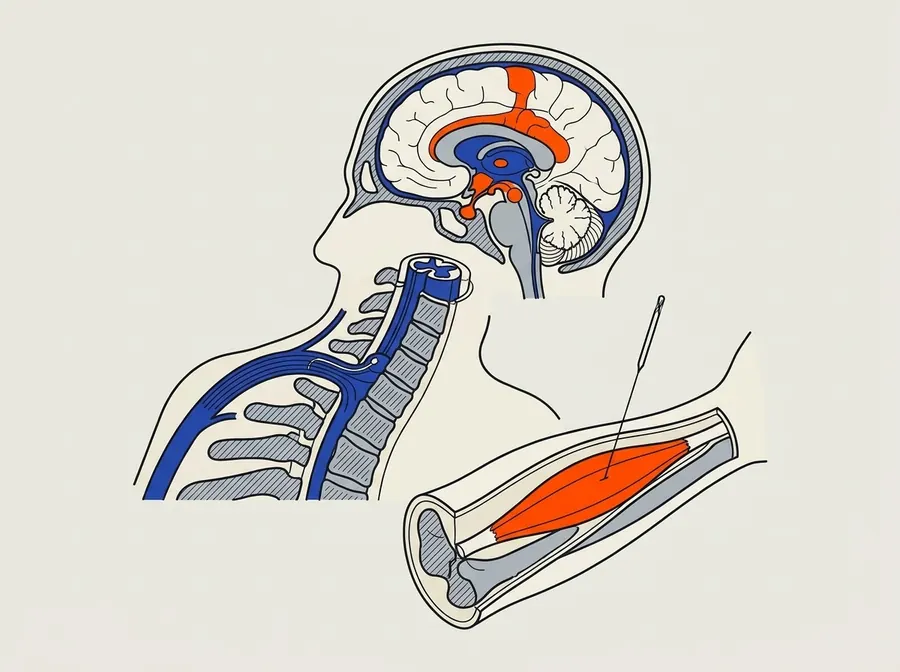
1. Local & myofascial coupling
Recruits Aβ/Aδ mechanoreceptors, releases local adenosine, and restores micro-perfusion in taut muscle bands.
2. Spinal dorsal horn gating
Segmental inhibitory interneurons dampen ascending nociceptive signaling and calm viscerosomatic reflexes.
3. Descending central control
Engages periaqueductal gray and brainstem relays, recruiting endogenous opioids and monoamines.
How Acupuncture Works in Functional Abdominal Pain
Acupuncture acts on FAPS through mechanisms that converge directly with its pathophysiology: reduction of visceral hyperalgesia, cortical modulation of pain processing, and normalization of enteric serotonergic signaling.
Mechanism of Action in Functional Abdominal Pain
LR-3 (Taichong) — Descending Analgesia
Stimulation of the superficial peroneal nerve → activation of PAG (periaqueductal gray matter) → release of endorphins and enkephalins → descending inhibition of sensitized dorsal horn neurons.
ST-36 + PC-6 — Normalization of the HPA Axis
Reduction of serum cortisol and hypothalamic CRH → attenuation of the stress-pain component. Normalized ACTH at 6 weeks of treatment; reduction of visceral amplification mediated by the stress axis.
SP-4 (Gongsun) — Enteric Serotonin
Modulation of 5-HT3 and 5-HT4 receptors in the Meissner plexus → normalization of visceral afferent sensitivity and intestinal motility; reduction of excessive postprandial tone.
Cortical Normalization (fMRI)
Reduction of hyperactivity of the anterior insula and anterior cingulate córtex documented by functional neuroimaging before and after treatment — an objective mechanism of central analgesia.
Increased Barostatic Threshold
28% increase in the pain threshold for colonic distension (barostat) after 10 sessions — objective evidence of reversal of visceral hyperalgesia, independent of placebo effect.
Scientific Evidence
Neurogastroenterol Motil 2019 — RCT (n=118)
Aliment Pharmacol Ther 2020 — Refractory RCT (n=94)
Modern Approach: Integrative Medical Acupuncture
Clinical Protocol in FAPS
| Component | Specification | Rationale |
|---|---|---|
| Main points | ST-36 + PC-6 + SP-4 + LR-3 | Descending analgesia + enteric normalization |
| Auxiliary points | CV-12 + SP-6 + GB-34 | According to location and associated symptoms |
| Frequency | 2 sessions/week for 5 weeks | Then 1 session/week for 5 more weeks |
| Electroacupuncture | 2 Hz at LR-3 and SP-4 | Stimulates release of endogenous endorphins |
| Integrative approach | Combine with CBT or hypnosis | Synergistic effect documented in IBS |
| Assessment | VAS + SF-36 every 4 weeks | Protocol adjustment by objective outcome |
When to See a Medical Acupuncturist
Ideal Candidates
- FAPS with complete negative workup (endoscopy, colonoscopy, CT)
- Failure or intolerance to antidepressants
- Excessive use of analgesics or opioids
- Comorbidity with anxiety or insomnia
- Children with recurrent functional abdominal pain
Red Flags — Investigate First
- Nighttime pain that wakes from sleep
- Blood in stools or weight loss
- Fever associated with pain
- Onset after age 50 without prior workup
- Family history of IBD or colorectal cancer
Frequently Asked Questions
Frequently Asked Questions
FAPS has a real neurobiologic basis — visceral hyperalgesia documentable by barostat and neuroimaging alterations (fMRI). It is not "made up" or "exaggeration." Comorbidity with anxiety and depression is both consequence and cause of chronic pain, in a bidirectional cycle. Effective treatment addresses both dimensions.
In mild to moderate cases, it can be an effective alternative for patients who refuse or do not tolerate antidepressants. In severe cases with significant associated depression, the combined approach (acupuncture + pharmacotherapy) tends to be superior to any isolated intervention.
RCTs demonstrate significant improvement after 8 to 10 weeks of treatment (10–15 sessions). In patients with a long-standing history of chronic pain, a longer cycle may be necessary. Assessment with VAS every 4 weeks guides protocol adjustment.
Yes, with prior pediatric workup to rule out organic causes. Adapted techniques are usually well tolerated, and there are needle-free alternatives (laser, auriculotherapy with seeds, tuina). Preliminary studies suggest reduction in school days lost and emergency visits in selected series, but pediatric evidence is limited. Treatment should be performed by a medical acupuncturist with experience in pediatrics and in coordination with the attending pediatrician.
Yes, in many cases. The mechanism of action involves central neurologic recalibration — it is not a purely pharmacologic effect that ceases with discontinuation. Follow-up studies show maintenance of 50%–60% of the improvement for up to 6 months after the treatment cycle.