
- Strong
- Moderate
See the numbers: What this page rests on
| Year | Study type | Verdict | Study |
|---|---|---|---|
| 2024 | Meta-analysis | Strong | Acupuncture for functional dyspepsia: Bayesian meta-analysis |
| 2026 | Meta-analysis | Moderate | Efficacy and safety of acupuncture for functional dyspepsia: an updated meta-analysis of randomized controlled trials |
Evidence behind this recommendation.
Selected studies from our library that inform the recommendations on this page. Evidence grade shown when available.
Acupuncture for functional dyspepsia: Bayesian meta-analysis
“This Bayesian meta-analysis represents one of the most comprehensive studies ever conducted on acupuncture for functional dyspepsia, analyzing 34 randomized clinical trials with 2,950 participants. Functional dyspepsia is a gastrointestinal disorder...”
Efficacy and safety of acupuncture for functional dyspepsia: an updated meta-analysis of randomized controlled trials
“This updated meta-analysis represents the most comprehensive evaluation available on the efficacy of acupuncture for functional dyspepsia, including 23 randomized clinical trials with 2,454 participants. Functional dyspepsia is a common syndrome...”
Functional Dyspepsia: Gastric Symptoms Without Structural Cause
Functional dyspepsia (FD) is defined by the Rome IV criteria as the presence of one or more of the following symptoms: bothersome postprandial fullness, early satiety, epigastric pain, and epigastric burning — lasting at least 6 months and without identifiable structural lesion on endoscopy. It affects 10%–30% of the world population, and is responsible for one of the largest causes of outpatient consultations in gastroenterology. The origin is multifactorial: gastric motility disorder (slow emptying), visceral hypersensitivity to distension, low-grade duodenal inflammation (duodenal eosinophilia), and dysregulation of the brain-gut axis.
Conventional Treatments: Limited Efficacy
Treatments for Functional Dyspepsia
| Treatment | Efficacy | Limitations |
|---|---|---|
| PPI (omeprazole, pantoprazole) | Modest; better in EPS subtype with burning | Limited efficacy in PDS; hypomagnesemia and B12 deficiency with prolonged use; acid suppression does not resolve slow emptying |
| Prokinetics (domperidone, bromopride) | Improve gastric emptying; efficacy in PDS | Domperidone: QT prolongation (rare but serious arrhythmia); bromopride: extrapyramidal effects; cost and availability |
| Amitriptyline 10–25 mg/day | Effective in FD with visceral hypersensitivity; NNT=4 | Drowsiness, dry mouth, constipation; not recommended as first line |
| H. pylori eradication (if positive) | Reduction of FD risk in 10% of cases; modest but lasting effect | Only when H. pylori positive; does not improve most patients with FD |
| Psychotherapy / CBT | Effective on the central component; improves quality of life | Limited access; does not modify gastric motility |
| Acupuncture | GCSI −3.8 pts; gastric emptying improved in 68% in specific studies; effect comparable to domperidone in RCTs | Access; requires regular sessions; more modest effect in pure EPS subtype; does not replace medication when indicated |
Three neurobiological levels of medical acupuncture: from muscle to central modulation
Mechanical stimulation of myelinated peripheral afferents engages local tissue perfusion, spinal dorsal horn gating, and descending brainstem analgesia across sessions.
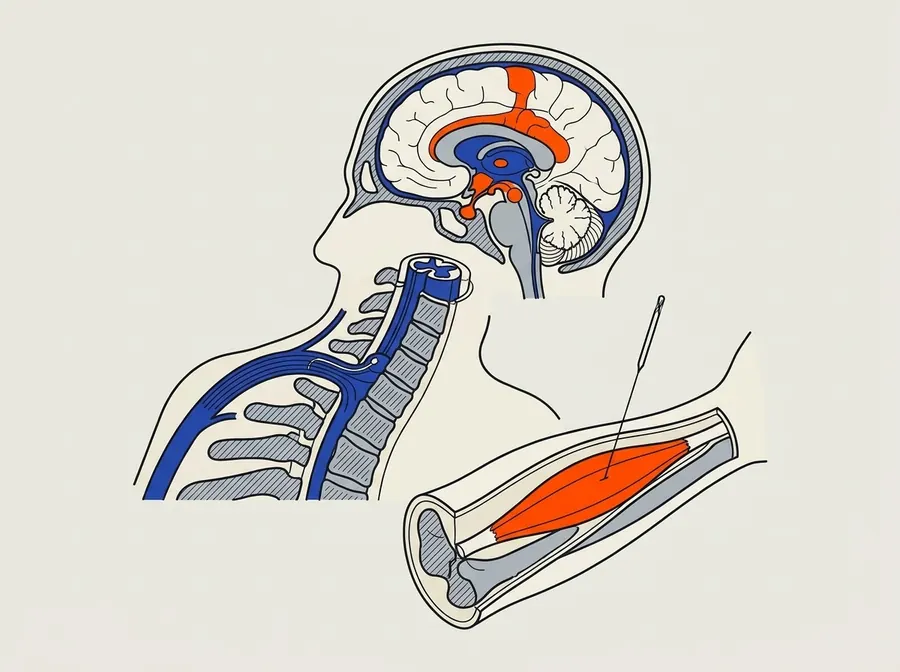
1. Local & myofascial coupling
Recruits Aβ/Aδ mechanoreceptors, releases local adenosine, and restores micro-perfusion in taut muscle bands.
2. Spinal dorsal horn gating
Segmental inhibitory interneurons dampen ascending nociceptive signaling and calm viscerosomatic reflexes.
3. Descending central control
Engages periaqueductal gray and brainstem relays, recruiting endogenous opioids and monoamines.
How Acupuncture Works in Functional Dyspepsia
Mechanisms in Functional Dyspepsia
Improvement of Gastric Emptying (Motility)
ST-36 (Zu San Li) is the most-studied point for GI motility. EA at 2 Hz at ST-36 activates the afferent and efferent vagus nerve, increasing myoelectric activity of the gastric antrum and accelerating gastric emptying. Gamma scintigraphy objectively documents improvement in t½ of emptying after acupuncture.
Modulation of Visceral Hypersensitivity
PC-6 and CV-12 modulate gastric hypersensitivity to distension — visceral hypersensitivity is the central mechanism of PDS. These points activate descending serotonergic inhibitory pathways that raise the threshold of sensitivity to antral distension.
Vagovagal Somatovisceral Reflex
Stimulation of ST-36 and PC-6 (limbs) activates the somatovisceral reflex via the vagus nerve — modulating gastric SNS activity. Increased vagal tone accelerates emptying (parasympathetic stimulates gastric motility) and reduces hypersensitivity (through the anti-inflammatory vagal effect via the cholinergic anti-inflammatory pathway).
Modulation of the Brain-Gut Axis
GV-20 and PC-6 regulate the brain-gut axis via cortisol reduction and central serotonin modulation — relevant when there is overlap of FD with anxiety or depression, extremely common (40%–60% of patients with FD have psychiatric comorbidity).
Main Points
ST36 — Gastric Motility and Antinauseant
The most-studied point in gastroenterology. EA at 2 Hz at ST36 increases gastric slow-wave activity (documented by EGG — gastric electromyography) and accelerates emptying. Especially improves PDS fullness and early satiety.
PC6 — Antinauseant and Antiemetic (Pericardium)
PC6 has Cochrane evidence for nausea and vomiting. In dyspepsia, it reduces postprandial nausea and gastric hypersensitivity. It stimulates the vagal trunk, modulating activity of the nucleus tractus solitarius (NTS) — the integration center of the nausea reflex.
CV12 — Front-Mu of the Stomach
CV12 is the alarm point of the Stomach — convergence of gastric energies. Direct modulation of gastric activity via the abdominal somatovisceral reflex. Combined with ST36, it forms the classic protocol for dyspepsia and delayed gastric emptying.
LR3 — Stagnation of Liver Qi (TCM)
In Chinese medicine, dyspepsia from 'invasion of the Liver over the Stomach' (stress → tension → epigastralgia) is treated with LR3. Neurobiologically: LR3 modulates the HPA axis and reduces cortisol — a mechanism especially relevant when dyspepsia worsens with stress.
Scientific Evidence
Modern Approach: Acupuncture in the Brain-Gut Axis
When to See a Medical Acupuncturist
Indications
FD confirmed by endoscopy (no structural lesion); failure or intolerance to PPI and prokinetics; PDS with documented slow gastric emptying; FD + IBS + anxiety (multiple functional syndrome); FD refractory to amitriptyline.
Frequently Asked Questions
Frequently Asked Questions
Acupuncture does not replace omeprazole. In EPS (epigastric pain syndrome) with burning, the PPI (omeprazole, pantoprazole) has a direct analgesic role through acid suppression — acupuncture does not suppress acid. For PDS (fullness, early satiety), where the PPI has limited efficacy, acupuncture can be a useful complement. Any decision to maintain, reduce, or discontinue the PPI must be made exclusively by the gastroenterologist.
Yes. H. pylori eradication is recommended in all patients with dyspepsia and positive H. pylori — independent of ulcer. In 10% of FD cases with H. pylori, eradication resolves symptoms. After completing the eradication regimen and confirming success (breath test), if symptoms persist, acupuncture can be initiated for residual FD.
Yes — this is one of the profiles that responds best to acupuncture. FD exacerbated by stress reflects the influence of the brain-gut axis: elevated cortisol inhibits gastric motility and increases visceral hypersensitivity. Acupuncture (GV-20, PC-6, LR-3) reduces cortisol, normalizes vagal tone, and improves both mechanisms simultaneously. Improvement in the anxious component frequently precedes improvement in gastric symptoms.
Diabetic gastroparesis has an autonomic neuropathy component that reduces gastric peristalsis. Acupuncture at ST-36+CV-12 improves gastric emptying documented by gamma scintigraphy — with a mechanism similar to that of functional gastroparesis. For severe gastroparesis with intractable vomiting, specialized gastroenterology is necessary. For mild-moderate degrees, acupuncture is a valid complementary option to strict glycemic control.