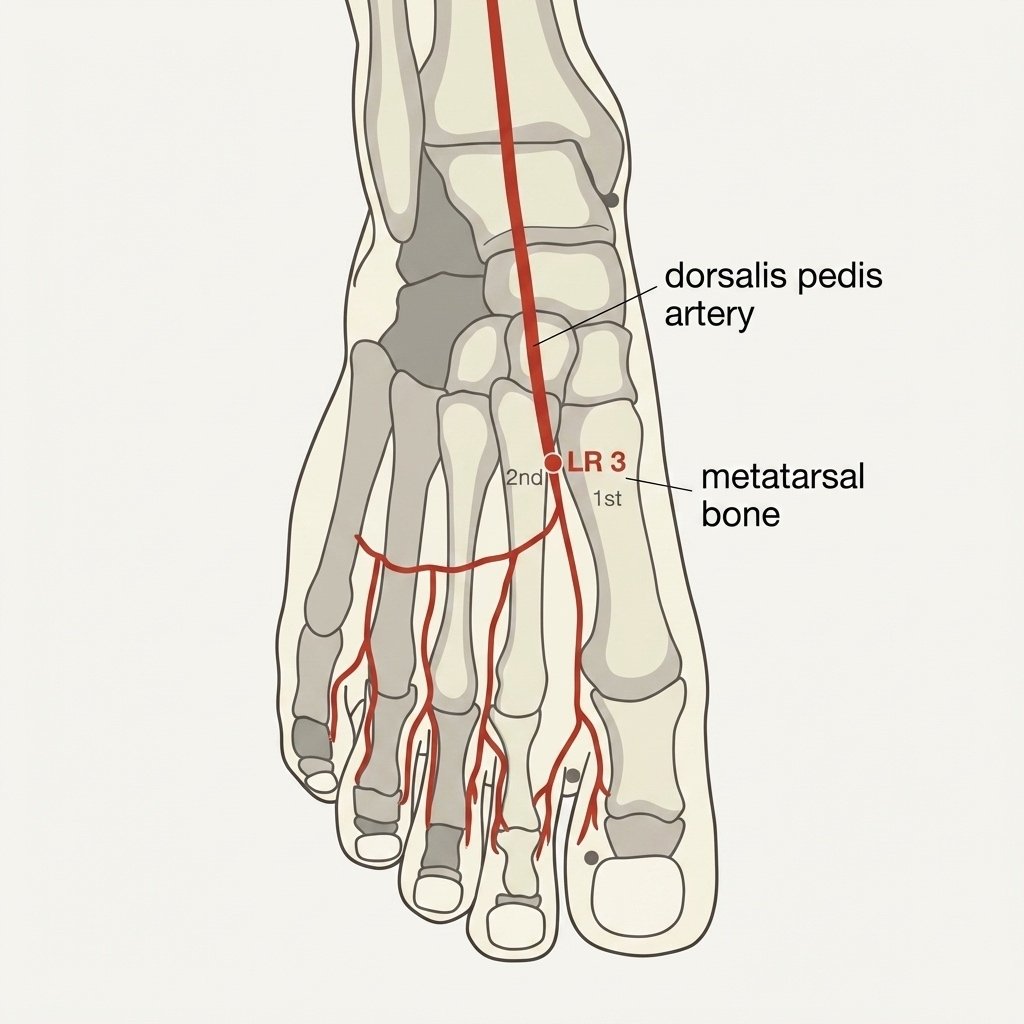
Avoid puncturing the dorsal artery of the foot. Caution in pregnancy.
📍 Location (classical)
On the dorsum of the foot, 1.5 to 2 cun above the interdigital web, in the pronounced groove distal to the junction of the bases of the first and second metatarsal bones.
🧭 How to find it (practical)
Seated with the foot supported and in slight dorsiflexion, locate the point on the dorsum of the foot, in the groove proximal to the junction of the bases of the first and second metatarsal bones, approximately 1.5 to 2 cun proximal to the interdigital fold, palpating the depression between the two metatarsals (WHO 2008, §LR-3).
🔬 Anatomy
Motor point of the first dorsal interosseous muscle, located between the 1st and 2nd metatarsals and the lateral border of the tendon of the extensor hallucis longus. Dorsal metatarsal nerve from the deep fibular nerve, dorsal venous plexus of the foot, and first dorsal metatarsal artery.
💉 Needling
Vertically or slightly oblique 0.5–1.0 cun, or toward Yongquan KI-1 by 0.5–1.5 cun.
📜 Etymology
Tai (太), great, supreme; Chong (衝), surge, thoroughfare, rushing. The Qi of the Liver channel surges forth strongly at this point — the name records the image of a current that breaks out vigorously. Tai Chong is also one of the classical names of the Chong Mai (Penetrating Vessel), with which the point shares a functional relationship through its action of regulating the Blood (Deadman, A Manual of Acupuncture, 2007, p. 470; Ling Shu, chapter 1).