Skip to content
Skip to content

SI-18 Quanliao (顴髎) — Cheekbone Crevice

SI-18
Quanliao
顴髎
Cheekbone Crevice · Cheek Bone Crevice
SI-18 Quanliao — Cheekbone Crevice
Encontro ID-TAPonto local da faceEncontro ID-TACautionCabeça
Depth
00.5–0.8 cun3.0
Transverse insertion
Precautions
Avoid facial vessels to prevent hematoma. According to some texts, this point is contraindicated for moxibustion.
Location (classical)
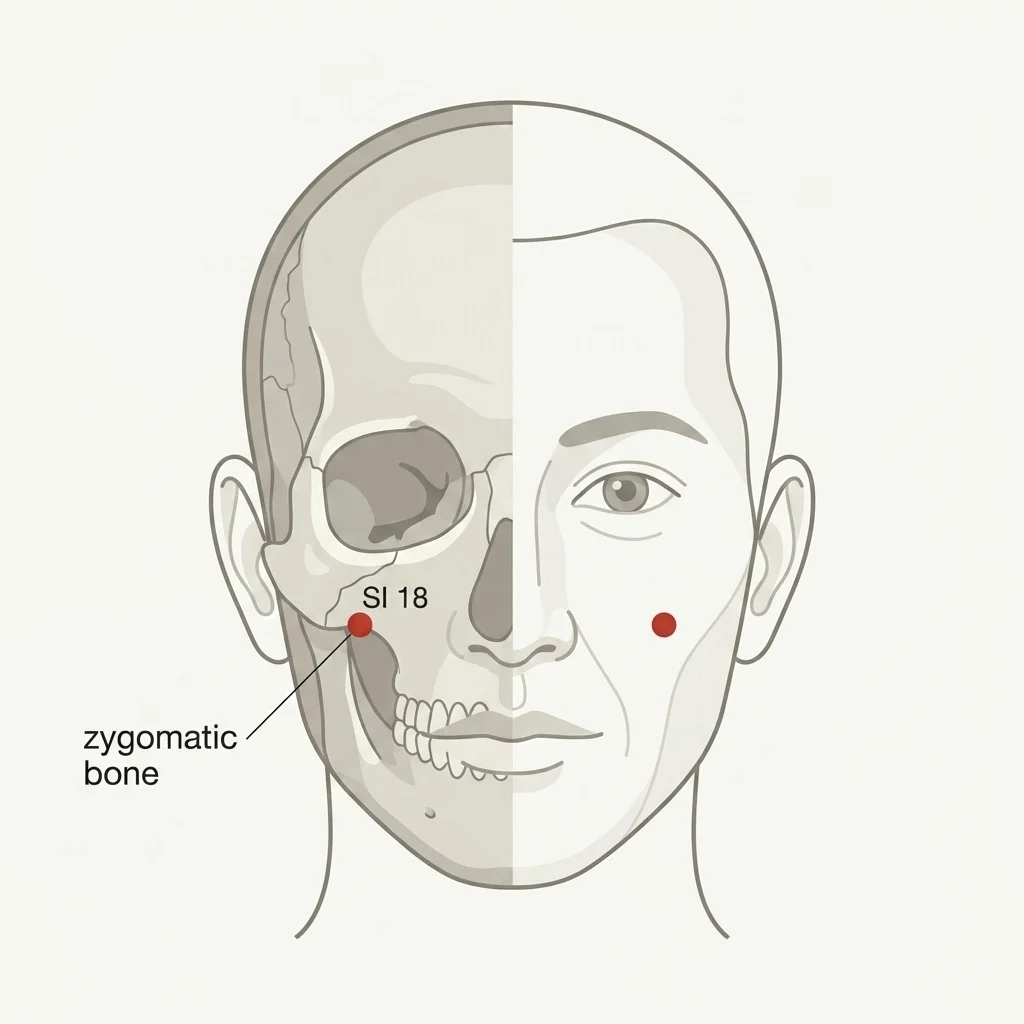
On the face, directly below the outer canthus of the eye, in the depression on the inferior border of the zygomatic bone.
How to find it (practical)
Seated, with the head erect, locate the point at the intersection of the horizontal line of the inferior margin of the zygomatic bone with the vertical line of the lateral commissure of the eyelid, approximately at the same level as Ying Xiang (LI-20).
Anatomy
Zygomaticus major muscle. Innervated by branches of the facial nerve and the infraorbital nerve (trigeminal).
Needling
Transverse insertion connecting to points such as Dicang ST-4, Xiaguan ST-7, Yingxiang LI-20, Jiache ST-6; or perpendicular insertion 0.5 to 0.8 cun.
Etymology
Quan (顴), zygoma; Liao (髎), foramen. The point lies in the inferior depression of the zygomatic bone.
CLASSICAL SOURCEJia Yi Jing

Clinical Relations

Adjacent Points on the Meridian

SI 18 in research

How many Library studies cite this point, since when, and with which designs and verdicts.

Studies
4Library studies cite SI 18
By year
20182025
Verdict
  • Moderate4
Study designs
  • RCT3
  • Other designs1
Classical source
Jia Yi Jing
Depth
0.5–0.8 cunTransverse

Each study counts once, under the most specific design it states. The verdict is the Library’s word for the strength of each study’s evidence.

See the numbers: SI 18 in research
YearStudies
20181
20201
20211
20251

Often appears with

Points the Library studies cite together with SI 18. It shows research practice, not a prescription.

  1. ST 64 studies in common
  2. LI 43 studies in common
  3. ST 43 studies in common
  4. ST 73 studies in common
  5. ST 82 studies in common
  6. GB 32 studies in common
  7. GB 142 studies in common
  8. LI 201 study in common

Each filled mark stands for 5 studies; an open mark, for 1 to 4.

Related Articles

6

Translation and clinical dataProf. Dr. Hong Jin Pai — Meridians: Theory and Clinical Practice, 4th edition. CEIMEC · São Paulo.

CodingWHO Standard Acupuncture Point Locations (2008) for classical and extra points.