Skip to content
Skip to content

ST-42 Chongyang (沖陽) — Surging Yang

ST-42
Chongyang
沖陽
Surging Yang · Rushing Yang
ST-42 Chongyang — Surging Yang
Ponto Yuan-FonteCautionMembro Inferior
Depth
00.3–0.5 cun3.0
Perpendicular insertion
Precautions
Avoid puncturing the dorsalis pedis artery.
Location (classical)
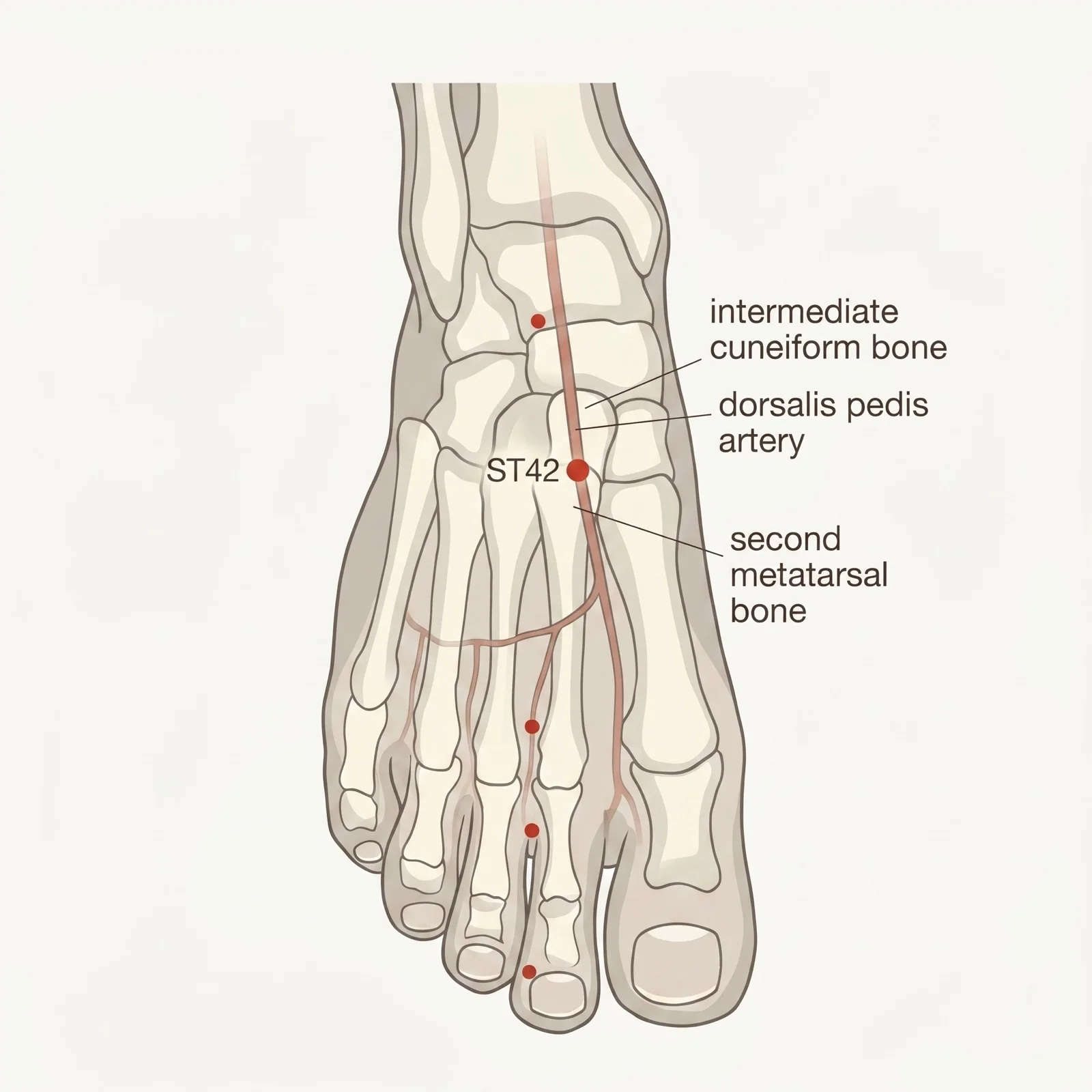
On the dorsum of the foot, at the joint between the base of the second metatarsal and the intermediate cuneiform, over the projection of the dorsal artery of the foot.
How to find it (practical)
Identify the base of the second metatarsal and its articulation with the intermediate cuneiform; confirm the projection of the dorsalis pedis artery.
Anatomy
Extensor digitorum brevis muscle. Innervated by the deep fibular nerve. Dorsalis pedis artery.
Needling
Perpendicular insertion 0.3–0.5 cun.
Etymology
Chong (冲), surging; Yang (阳), the Yang of Yin-Yang. The point lies where the dorsalis pedis artery is most prominent.
CLASSICAL SOURCELing Shu

Clinical Relations

Point Pairs
Yuan-LuoSP-4 Gongsun
Adjacent Points on the Meridian

ST 42 in research

How many Library studies cite this point, since when, and with which designs and verdicts.

Studies
3Library studies cite ST 42
By year
20122020
Verdict
  • Strong1
  • Moderate1
  • Limited1
Study designs
  • Systematic Review2
  • RCT1
Classical source
Ling Shu
Depth
0.3–0.5 cunPerpendicular

Each study counts once, under the most specific design it states. The verdict is the Library’s word for the strength of each study’s evidence.

See the numbers: ST 42 in research
YearStudies
20121
20141
20201

Often appears with

Points the Library studies cite together with ST 42. It shows research practice, not a prescription.

  1. ST 363 studies in common
  2. ST 403 studies in common
  3. CV 123 studies in common
  4. ST 322 studies in common
  5. ST 342 studies in common
  6. PC 62 studies in common
  7. LI 41 study in common
  8. ST 331 study in common

Each filled mark stands for 5 studies; an open mark, for 1 to 4.

Related Articles

6

Translation and clinical dataProf. Dr. Hong Jin Pai — Meridians: Theory and Clinical Practice, 4th edition. CEIMEC · São Paulo.

CodingWHO Standard Acupuncture Point Locations (2008) for classical and extra points.