Overview: When Pain Is Throughout the Body
Generalized chronic pain — pain in multiple regions of the body for more than 3 months — represents one of modern medicine's great challenges. Unlike regional pain caused by local tissue injury, generalized pain primarily reflects a dysfunction of the central nervous system: pain processing is amplified, inhibitory mechanisms are compromised, and the brain interprets normal stimuli as painful.
Fibromyalgia is the prototype of generalized chronic pain, affecting 2-4% of the global population — predominantly women (F:M ratio of 7:1). But fibromyalgia is not the only condition that produces generalized pain: rheumatoid arthritis, hypothyroidism, polymyalgia rheumatica, and joint hypermobility syndrome also produce pain in multiple regions and must be investigated.
This article explores the neurobiologic mechanisms of generalized chronic pain, updated diagnostic criteria for fibromyalgia, frequent comorbidities, and the multimodal approach — including the specific role of medical acupuncture.
Central Dysfunction, Not Peripheral Lesion
Generalized pain reflects central amplification of pain processing — the nervous system, not the tissue, is altered. This completely changes the therapeutic approach.
Fibromyalgia: Clinical Diagnosis
Fibromyalgia is diagnosed by ACR 2016 criteria — without specific laboratory tests. It is a diagnosis of inclusion by criteria, not exclusion.
Multimodal Approach Is Essential
Pain education + exercise + psychology + pharmacology + medical acupuncture: no single intervention matches the results of the combination.
Central Mechanisms: The Neurobiology of Generalized Pain
Generalized chronic pain is not simply "imaginary pain" or the result of psychological fragility. It is a condition with documented neurobiologic alterations that can be visualized on functional neuroimaging and measured by quantitative sensory testing.
The central mechanism is central sensitization: neurons of the dorsal horn of the spinal cord and of the brain become hyperexcitable — they respond with disproportionate intensity to normal stimuli (allodynia) and amplify pain from nociceptive stimuli (hyperalgesia). Two electrophysiologic phenomena are fundamental: wind-up (progressive increase of neuronal response with repetitive stimuli) and long-term potentiation (LTP) of nociceptive synapses.
Mechanisms of Generalized Chronic Pain
| Mechanism | Site | Phenomenon | Clinical Consequence |
|---|---|---|---|
| Wind-up | Spinal dorsal horn | Temporal summation — repetitive stimuli amplify response | Progressive hyperalgesia over time |
| Nociceptive LTP | Spinal synapses | Persistent strengthening of nociceptive connections | Chronic pain even without peripheral stimulus |
| Descending inhibitory déficit | Inhibitory pathways from the brain | Reduced serotonin, norepinephrine, endogenous opioids | Reduced ability to modulate pain |
| Cortical sensitization | Somatosensory córtex, insula | Cortical reorganization with expanded pain representation | Wide referred pain, allodynia |
| Autonomic dysfunction | SNS/PNS | Hyperactivated HPA axis, reduced heart rate variability | Fatigue, sleep disturbance, cognitive symptoms |
Three neurobiological levels of medical acupuncture: from muscle to central modulation
Mechanical stimulation of myelinated peripheral afferents engages local tissue perfusion, spinal dorsal horn gating, and descending brainstem analgesia across sessions.
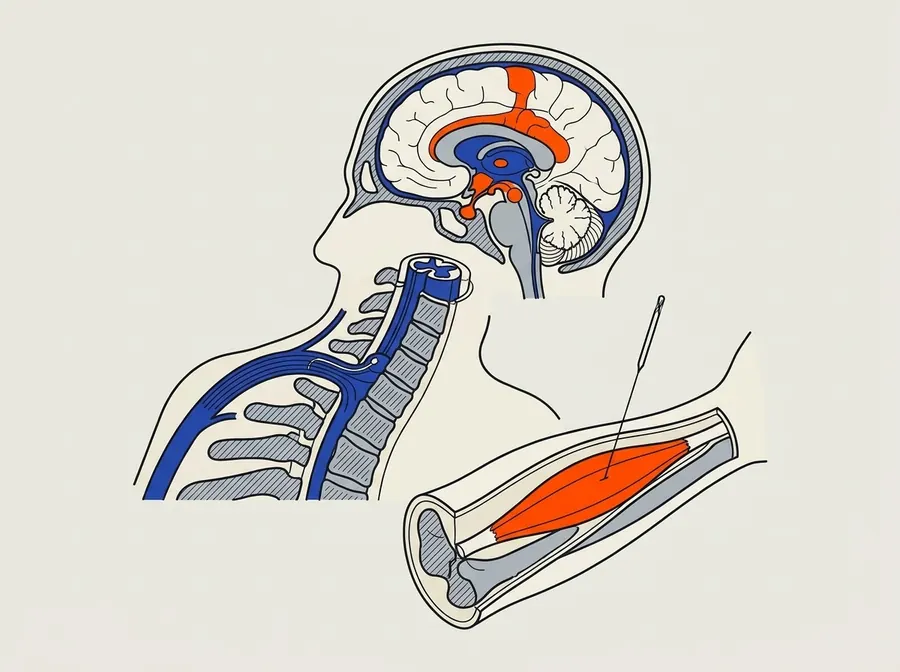
1. Local & myofascial coupling
Recruits Aβ/Aδ mechanoreceptors, releases local adenosine, and restores micro-perfusion in taut muscle bands.
2. Spinal dorsal horn gating
Segmental inhibitory interneurons dampen ascending nociceptive signaling and calm viscerosomatic reflexes.
3. Descending central control
Engages periaqueductal gray and brainstem relays, recruiting endogenous opioids and monoamines.
Fibromyalgia: Diagnosis and Clinical Presentation
The 2016 American College of Rheumatology diagnostic criteria (revised) eliminated the tender points of the older criterion and adopt two índices: the Widespread Pain Index (WPI) — count of painful áreas in the last 7 days (0-19) — and the Symptom Severity Scale (SSS) — severity of fatigue, unrefreshing sleep, and cognitive symptoms (0-12), plus other somatic symptoms.
Diagnosis requires: WPI ≥ 7 AND SSS ≥ 5, OR WPI 4-6 AND SSS ≥ 9; symptoms present for at least 3 months; and absence of another condition that explains all symptoms (although fibromyalgia can coexist with other diseases). Typical presentation includes generalized pain, intense fatigue, unrefreshing sleep, cognitive difficulty (fibro-fog), headache, irritable bowel syndrome, and restless legs syndrome.
Fibromyalgia Diagnostic Criteria (ACR 2016)
- Widespread Pain Index (WPI) ≥ 7 AND Symptom Severity Scale (SSS) ≥ 5
- OR WPI between 4-6 AND SSS ≥ 9
- Symptoms present for at least 3 months at a similar level
- Diagnosis is independent of other coexisting conditions
- Pain in at least 4 of 5 regions (excluding jaw, chest, and abdomen for WPI)
Central Sensitization: The Unifying Mechanism
Central sensitization is the neurobiologic mechanism that unifies fibromyalgia and other generalized chronic pain syndromes. Unlike peripheral sensitization (amplification at the peripheral nerve fiber after local inflammation), central sensitization involves functional changes in the CNS that perpetuate pain independently of continued peripheral stimulus.
The role of descending pain inhibition is central in this process. Normally, the brain sends inhibitory signals to the spinal cord (serotonergic, noradrenergic, and endogenous opioid pathways) that reduce nociceptive transmission. In fibromyalgia, this system is compromised — descending inhibition is insufficient, resulting in amplification of the painful signals that reach consciousness.
Clinical Signs of Central Sensitization
Allodynia: normally innocuous stimuli (light touch, cold) cause pain
Hyperalgesia: painful stimuli cause disproportionate pain
Pain that "spreads" to regions not initially affected
Pain worsens with stress, sleep deprivation, and mental effort
Multiple hypersensitivities: noise, light, odors, chemicals
Temporal summation: repetitive stimuli produce escalating pain
Comorbidities: The Universe of Fibromyalgia
Fibromyalgia rarely presents alone. Comorbidities are an integral part of the condition and share the same mechanisms of central sensitization and autonomic dysfunction. Understanding and treating comorbidities is essential for therapeutic success.
Irritable bowel syndrome (IBS) coexists in 50-80% of patients with fibromyalgia — both are conditions of visceral hypersensitivity. Chronic headache (migraine and tension-type) affects 50-60% of fibromyalgia patients. Chronic fatigue syndrome and fibromyalgia overlap in 30-70% of cases, with debate about whether they are distinct conditions or spectra of the same process.
Fibromyalgia Comorbidities: Frequency and Common Mechanism
| Comorbidity | Prevalence in FM | Common Mechanism | Therapeutic Implication |
|---|---|---|---|
| Irritable bowel syndrome | 50-80% | Central visceral hypersensitivity | PC-6, ST-36 modulate gut-brain axis |
| Chronic headache | 50-60% | Trigeminovascular sensitization | GB-20, GV-16 share the protocol |
| Anxiety and depression | 40-70% | Hyperactivated HPA axis, reduced serotonin | Acupuncture regulates HPA axis and serotonin |
| Chronic fatigue syndrome | 30-70% | Mitochondrial dysfunction, neuroinflammation | Adapted tonification protocol |
| Restless legs syndrome | 30-50% | Central dopaminergic dysfunction | SP-6, KI-3 — improve sleep quality |
| Interstitial cystitis | 20-30% | Central bladder hypersensitivity | Renal and bladder points in the protocol |
Clinical Evaluation and Differential Diagnosis
Evaluation of generalized chronic pain requires comprehensive history-taking: pain map (location, character, intensity), assessment of sleep, fatigue, mood, cognition, and visceral functions. Physical examination includes generalized sensitivity testing, pressure points, and a neurologic exam to exclude neuropathies.
Laboratory tests are necessary to exclude treatable causes of generalized pain: complete blood count, ESR, CRP, TSH, free T4, rheumatoid factor, anti-CCP, ANA, vitamin D, ferritin, and CK. Fibromyalgia has no laboratory marker — diagnosis is clinical, by ACR 2016 criteria.
Differential Diagnosis
Fibromyalgia
Read more- WPI ≥ 7 AND SSS ≥ 5 (ACR 2016 criteria)
- Fatigue, unrefreshing sleep, fibro-fog
- Normal laboratory tests
- F:M 7:1, peak 30-50 years
Multimodal protocol: BL-23, GV-4, SP-6, ST-36, GB-20 — modulates central sensitization and HPA axis
Rheumatoid Arthritis
Read more- Symmetric arthritis of small joints
- Morning stiffness > 1 hour
- Positive RF and anti-CCP
- Radiographic erosions
Adjunct to DMARD treatment — reduces pain and morning stiffness
Hypothyroidism
- Fatigue, weight gain
- Diffuse muscle and joint pain
- Elevated TSH, low T4
- Dry skin, brittle hair
Polymyalgia Rheumatica
- Pain and stiffness in shoulder and pelvic girdles
- Age over 50
- Markedly elevated ESR and CRP
- Dramatic response to corticosteroids
Joint Hypermobility Syndrome
- Beighton score ≥ 5
- Generalized joint pain
- Joint instability, frequent sprains
- Autonomic symptoms: palpitations, dizziness
Periarticular muscle strengthening and central hypersensitivity modulation
Fibromyalgia vs. Rheumatologic Disease
Distinguishing fibromyalgia from inflammatory rheumatologic diseases (rheumatoid arthritis, lupus, ankylosing spondylitis) is clinically important but can be difficult, since fibromyalgia can coexist with any of them. Findings that favor a rheumatologic disease: arthritis with objectively demonstrable joint swelling, prolonged morning stiffness (> 1 hour), elevated inflammatory markers (ESR, CRP), positive autoantibodies, and radiologic abnormalities.
Findings that favor fibromyalgia: generalized multisystem pain without arthritis, disproportionate fatigue, unrefreshing sleep, fibro-fog, multiple hypersensitivities, and normal laboratory tests. When the two conditions coexist, treating only the rheumatologic inflammation often fails to resolve the pain — fibromyalgia's central sensitization component requires a specific approach.
Favors a rheumatologic disease
- Arthritis with objectively demonstrable joint swelling
- Prolonged morning stiffness (> 1 hour)
- Elevated inflammatory markers (ESR, CRP)
- Positive autoantibodies
- Radiologic abnormalities
Favors fibromyalgia
- Generalized multisystem pain without arthritis
- Disproportionate fatigue
- Unrefreshing sleep and fibro-fog
- Multiple hypersensitivities
- Normal laboratory tests
The Role of Neuroimaging
Functional neuroimaging (fMRI, PET-CT) supports a neurobiologic substrate for fibromyalgia, although the findings are group-level. Studies show consistent alterations in pain processing: hyperactivity of the anterior insula and anterior cingulate córtex (affective pain processing regions), reduced connectivity in descending inhibitory pathways, and default-mode network connectivity changes that correlate with symptom severity.
In clinical practice, neuroimaging is not routinely requested to diagnose fibromyalgia — diagnosis is clinical, by ACR 2016 criteria. But knowledge of these alterations helps the physician explain to the patient the real basis of their condition, reducing stigma and improving treatment adherence.
Diagnosis by Pain Patterns
Pain patterns in fibromyalgia have features that guide diagnosis. Pain is typically diffuse and migratory — unlike localized regional pain. Unexpected factors such as emotional stress, sleep deprivation, weather changes, and light physical exertion trigger or amplify the pain. Allodynia — pain to normally innocuous stimuli such as light pressure or cold — is frequent.
The medical acupuncturist uses the patient's pain map — which regions hurt, when they worsen, what relieves them — not only for diagnosis, but also to select the most relevant acupuncture points and monitor treatment response over the sessions.
Multimodal Therapeutic Approach
Treatment of generalized chronic pain and fibromyalgia generally requires a multimodal approach — single interventions usually produce inferior results compared with combined strategies. International guidelines (EULAR 2017, ACR) recommend pain education, aerobic exercise (strong recommendation), psychological approach, and pharmacotherapy as pillars of treatment; acupuncture is cited in EULAR 2017 as an option with weak recommendation, and may be considered in the individualized therapeutic plan.
Multimodal Protocol for Fibromyalgia and Generalized Chronic Pain
Precise Diagnosis and Pain Neuroscience Education
Apply ACR 2016 criteria, exclude differential diagnoses, and explain the neurobiologic mechanisms of pain to the patient (PNE). Validate the patient's experience.
Acupuncture, Exercise, and Psychology
Medical acupuncture (10-15 initial sessions). Progressive aerobic exercise (walking, swimming, water aerobics). Cognitive-behavioral therapy when available.
Medications when Necessary
Duloxetine or milnacipran (SNRIs) for pain and fatigue; pregabalin for neuropathic pain and sleep; low-dose amitriptyline for sleep and pain. The physician individualizes the regimen.
Maintenance Sessions and Lifestyle
Monthly maintenance acupuncture. Regular exercise as medicine. Sleep hygiene. Stress management. Support for comorbidities.
Myth vs. Fact
Fibromyalgia is a psychosomatic disease — the pain stems from imagination or emotional fragility.
Fibromyalgia has objective neurobiologic bases documented by functional neuroimaging, quantitative sensory testing, and neuroinflammation biomarkers. The pain is real and as intense as that of any organic condition. Psychosocial factors amplify pain through real neurologic mechanisms (HPA axis activation, cortical pain modulation), but this does not mean the condition is invented — it means mind and body interact to generate and amplify pain in ways medicine is only now beginning to fully understand.
Do
- Do progressive aerobic exercise, such as walking, swimming, or water aerobics
- Learn the neurobiologic mechanisms of your own pain through pain neuroscience education
- Take care of sleep hygiene
Avoid
- Increase exercise intensity too quickly, which causes post-exertional worsening
- Treat stress management as optional, since it is a fundamental part of the therapeutic mechanism
- Use strong opioids and benzodiazepines long-term, which are contraindicated in fibromyalgia
- Treatment of generalized chronic pain and fibromyalgia generally requires a multimodal approach.
- Single interventions usually produce inferior results compared with combined strategies.
- Acupuncture is cited in EULAR 2017 as an option with weak recommendation, and may be considered in the individualized therapeutic plan.
Medical Acupuncture in Generalized Chronic Pain
Medical acupuncture has mechanisms of action particularly relevant to generalized chronic pain and fibromyalgia. Unlike interventions that treat only local pain, acupuncture acts on the central circuits altered in central sensitization.
The central mechanisms of acupuncture in generalized pain include: descending serotonergic inhibition (experimental studies suggest that acupuncture may modulate descending serotonergic transmission, but this has not yet been conclusively shown in fibromyalgia), modulation of the prefrontal córtex (fMRI studies show that acupuncture activates the prefrontal córtex — a region that mediates cognitive control of pain and that is hypofunctional in fibromyalgia), and modulation of the HPA axis (acupuncture may influence the cortisol response to stress, reducing the HPA axis hyperactivation that perpetuates central sensitization).
Acupuncture Points in the Fibromyalgia Protocol
| Point | Location | Main Indication | Mechanism |
|---|---|---|---|
| GV-20 (Baihui) | Apex of the skull | Cognition, anxiety, central pain | May modulate the prefrontal cortex; effect on fibro-fog uncertain |
| GV-4 (Mingmen) | Spinous process of L2 | Fatigue, low back pain, kidney yang | Tonifies yang; HPA axis; vital energy |
| BL-23 (Shenshu) | Paravertebral L2 | Low back pain, renal fatigue | Shu of the kidney; deep tonification |
| SP-6 (Sanyinjiao) | 3 cun above the medial malleolus | Sleep, generalized pain, anxiety | Confluence of the three yin; sedative, analgesic |
| ST-36 (Zusanli) | 3 cun below the inferior border of the patella, 1 cun lateral to the anterior crest of the tíbia (in the tibialis anterior) | Fatigue, immunity, diffuse pain | Systemic analgesia; immunomodulation; tonification |
| GB-20 (Fengchi) | Base of the occipital, between SCM and trapezius | Headache, cervicalgia, anxiety | Inhibits trigeminal caudal nucleus; reduces sensitization |
When to Seek Medical Help
Generalized pain persisting for more than 3 months, especially when associated with significant fatigue, unrefreshing sleep, and cognitive difficulty, deserves specialized medical evaluation. A precise diagnosis guides correct treatment and avoids years of unproductive investigations.
Frequently Asked Questions about Generalized Chronic Pain and Fibromyalgia
Fibromyalgia is generalized chronic pain caused by central nervous system dysfunction — pain processing is amplified (central sensitization). It differs from common pain in being: generalized (not localized), associated with intense fatigue and unrefreshing sleep, present for more than 3 months, and without local tissue injury to explain it. Laboratory tests are normal. Diagnosis is clinical, by ACR 2016 criteria.
Fibromyalgia has no cure in the sense of complete, definitive resolution in every case, but it is highly manageable. With appropriate multimodal treatment — exercise, pain education, psychology, medical acupuncture, and pharmacotherapy when necessary — many patients achieve improvement in pain, function, and quality of life. Some enter complete remission. The key is to address central sensitization, not just treat symptoms.
Stress activates the hypothalamic-pituitary-adrenal (HPA) axis and the sympathetic nervous system, releasing cortisol and catecholamines that, in chronic excess, amplify central sensitization, reduce descending pain inhibition, and increase neuroinflammation. Patients with fibromyalgia have abnormal regulation of the HPA axis — they respond to stress with more intense and more prolonged activation. For this reason, stress management is not "optional" in the treatment of fibromyalgia — it is a fundamental part of the therapeutic mechanism.
Yes, aerobic exercise is the intervention with the greatest evidence in fibromyalgia, with meta-analyses demonstrating reduction of pain and fatigue and improvement of quality of life. Walking, water aerobics, and swimming are the most indicated for beginners. Exercise increases endogenous opioids, improves descending pain inhibition, and reduces neuroinflammation. The caveat is slow progression — increasing intensity too quickly causes worsening ("post-exertional") that may discourage. The physician guides appropriate progression.
Fibro-fog is the popular term for the cognitive difficulties of fibromyalgia: short-term memory problems, difficulty concentrating, slowness in processing information, and word-finding difficulty. It is a real symptom with neurobiologic basis — neuropsychology studies document objective deficits of working memory and processing in patients with fibromyalgia. It is not "weakness" or intentional inattention. There is not yet solid clinical evidence that acupuncture reduces fibro-fog.
It may help, with evidence that is still limited. The Cochrane review (Deare 2013) suggests pain improvement compared with no treatment or standard care, but with no clear difference from sham acupuncture. Acupuncture is proposed to act on descending pain inhibition, the prefrontal cortex, and the HPA axis, but these mechanisms have not yet been conclusively shown in fibromyalgia. EULAR (2017) includes acupuncture as a therapeutic option with weak-to-moderate evidence, growing with new studies.
The main agents specifically approved for fibromyalgia in the United States are duloxetine and milnacipran (serotonin-norepinephrine reuptake inhibitors — SNRIs) and pregabalin (for neuropathic pain and sleep). In Brazil, physicians use these and other off-label options such as low-dose amitriptyline (for sleep and pain), cyclobenzaprine (spasm and sleep), and tramadol (moderate pain). Strong opioids and benzodiazepines are contraindicated long-term in fibromyalgia.
Yes, and it is common. Rheumatoid arthritis patients have an increased risk of developing fibromyalgia — RA's chronic peripheral inflammation can sensitize the central nervous system over time. When they coexist, treating only RA inflammation with DMARDs often fails to resolve all the pain — fibromyalgia's central sensitization component requires an additional, specific approach. The rheumatologist and the medical acupuncturist work complementarily in these cases.
Yes, significantly and bidirectionally. Unrefreshing sleep is both a symptom and an aggravating factor of fibromyalgia. During deep sleep (NREM stage 3), the glymphatic system clears inflammatory metabolites from the brain, neurons recover, and central sensitization is modulated. Experimental sleep deprivation in healthy volunteers produces allodynia and hyperalgesia within days — the same mechanisms as fibromyalgia. Treating sleep (with acupuncture, sleep hygiene, and medication when necessary) is an essential part of treatment.
Suspect fibromyalgia when: pain is generalized (multiple regions) for more than 3 months; associated with intense fatigue, unrefreshing sleep, and cognitive difficulty; multiple hypersensitivities (light, noise, odors, cold, and light pressure cause discomfort); laboratory tests (CBC, inflammatory markers, autoantibodies, TSH) are normal; pain worsens with stress, not with light physical activity. Suspect another disease when there is arthritis with objective swelling, elevated inflammatory markers, weight loss, fever, muscle weakness, or neurologic symptoms.
Related Reading
Deepen your knowledge with related articles