Skip to content
Skip to content

PC-7 Daling (大陵) — Great Mound

PC-7
Daling
大陵
Great Mound
PC-7 Daling — Great Mound
Ponto Shu-Riacho (Terra)Ponto Yuan-FontePonto de SedaçãoCautionMembro Superior
Depth
00.5–0.8 cun3.0
Oblique insertion
Precautions
High risk of injury to the median nerve with aggressive manipulation. Caution: the median nerve lies directly beneath this point. Puncture often produces an intense electrical sensation; once triggered, any further manipulation is inappropriate and may injure the nerve.
Location (classical)
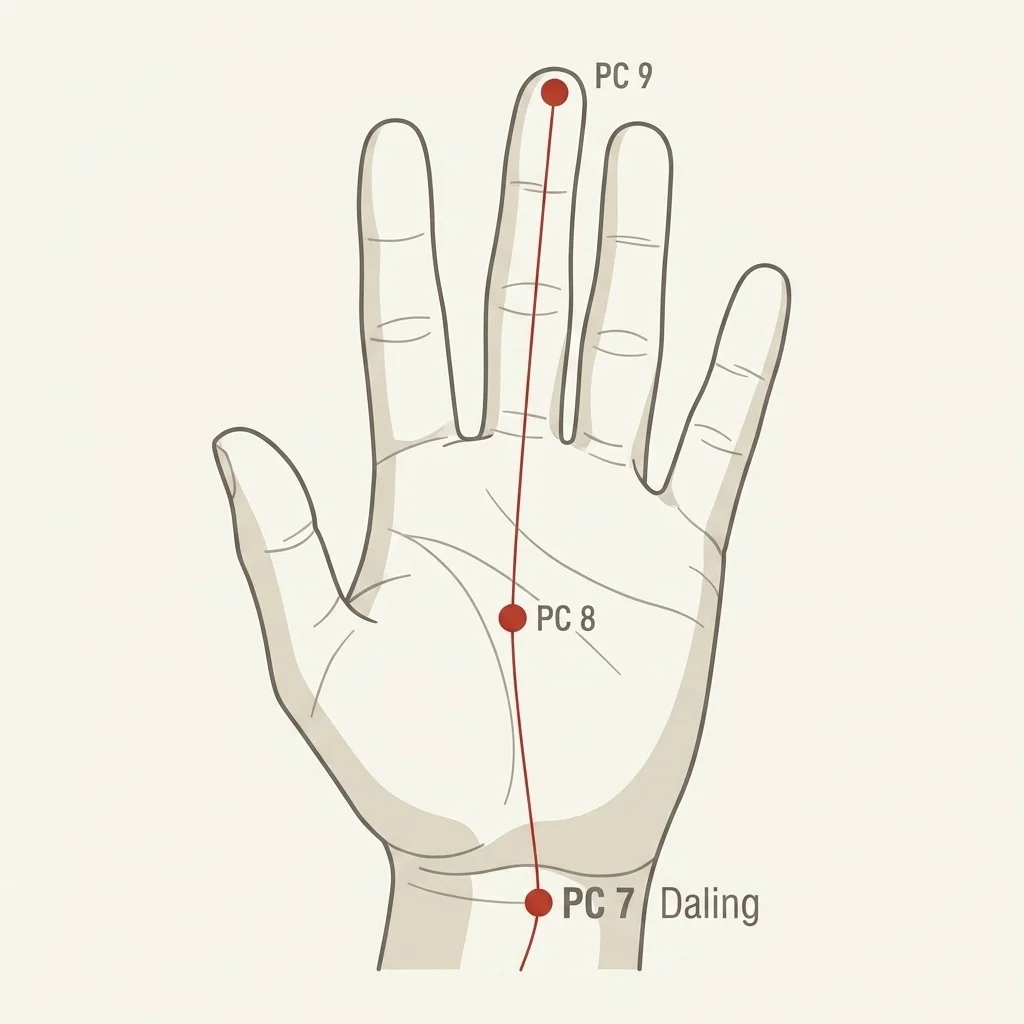
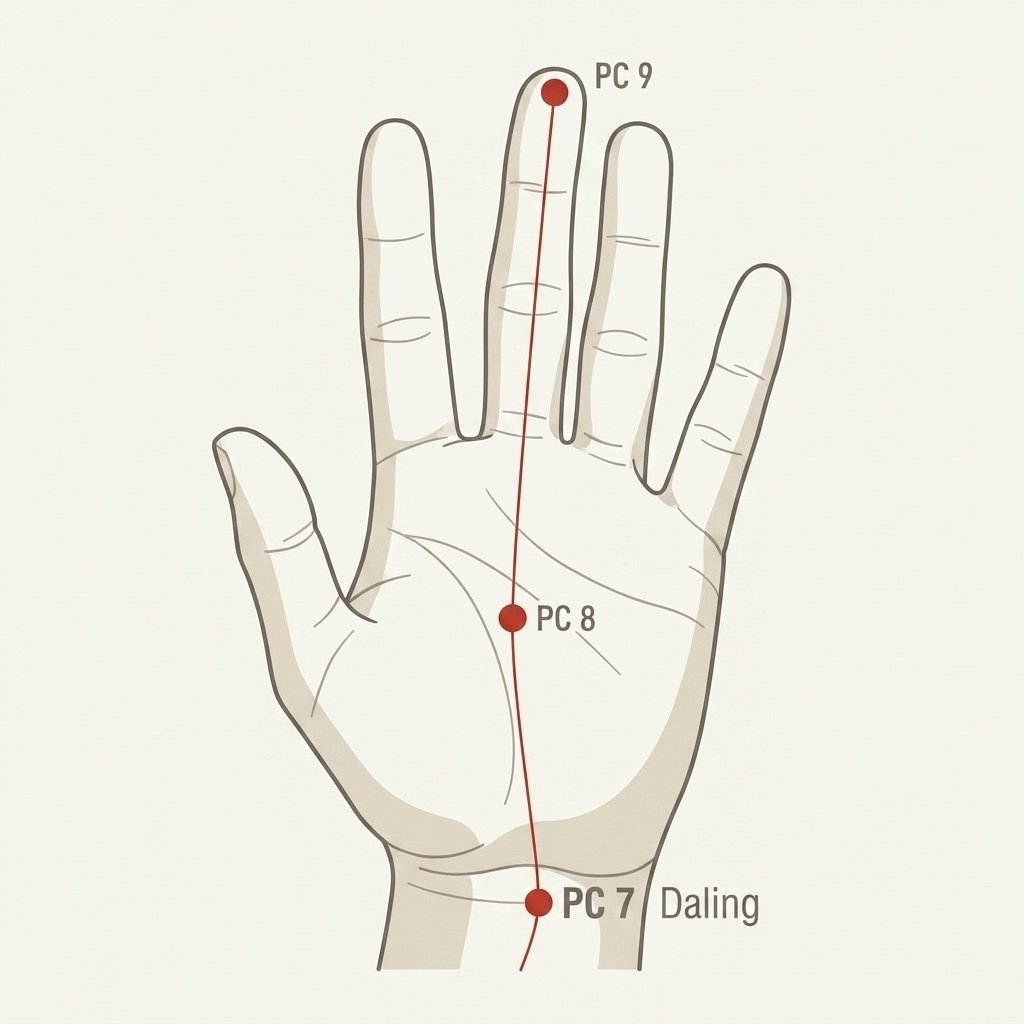
At the wrist joint, in the depression at the center of the transverse wrist crease, between the tendons of the palmaris longus and flexor carpi radialis muscles.
How to find it (practical)
With the arm extended and the palmar surface facing up, locate the point in the middle of the wrist crease, between the tendon of the palmaris longus and the ulnar side of the flexor carpi tendon.
Anatomy
Skin, subcutaneous tissue, medial and lateral cutaneous nerves of the forearm, palmar branch of the median nerve, median antebrachial vein, palmar carpal branches of the radial and ulnar arteries, palmar carpal ligament, pronator quadratus muscle, tendon of the flexor digitorum profundus, and median nerve.
Needling
Oblique insertion, 0.5 to 0.8 cun.
Etymology
Da (大), great; Ling (陵), mound. The lunate bone is prominent, like a mound. The point lies in the depression proximal to the prominence of the wrist.
CLASSICAL SOURCELing Shu

Clinical Relations

Point Pairs
Yuan-LuoTE-5 Waiguan
Adjacent Points on the Meridian

PC 7 in research

How many Library studies cite this point, since when, and with which designs and verdicts.

Studies
18Library studies cite PC 7
By year
20072024
Verdict
  • Strong3
  • Moderate13
  • Limited2
Study designs
  • Meta-analysis2
  • Systematic Review4
  • RCT6
  • Other designs6
Classical source
Ling Shu
Depth
0.5–0.8 cunOblique

Each study counts once, under the most specific design it states. The verdict is the Library’s word for the strength of each study’s evidence.

See the numbers: PC 7 in research
YearStudies
20071
20114
20121
20131
20141
20151
20175
20181
20191
20231
20241

Often appears with

Points the Library studies cite together with PC 7. It shows research practice, not a prescription.

  1. PC 612 studies in common
  2. LI 46 studies in common
  3. LI 114 studies in common
  4. PC 84 studies in common
  5. ST 363 studies in common
  6. SP 63 studies in common
  7. HT 73 studies in common
  8. LU 92 studies in common

Each filled mark stands for 5 studies; an open mark, for 1 to 4.

Related Articles

6

Translation and clinical dataProf. Dr. Hong Jin Pai — Meridians: Theory and Clinical Practice, 4th edition. CEIMEC · São Paulo.

CodingWHO Standard Acupuncture Point Locations (2008) for classical and extra points.