LU-9 Taiyuan (太淵) — Supreme Abyss
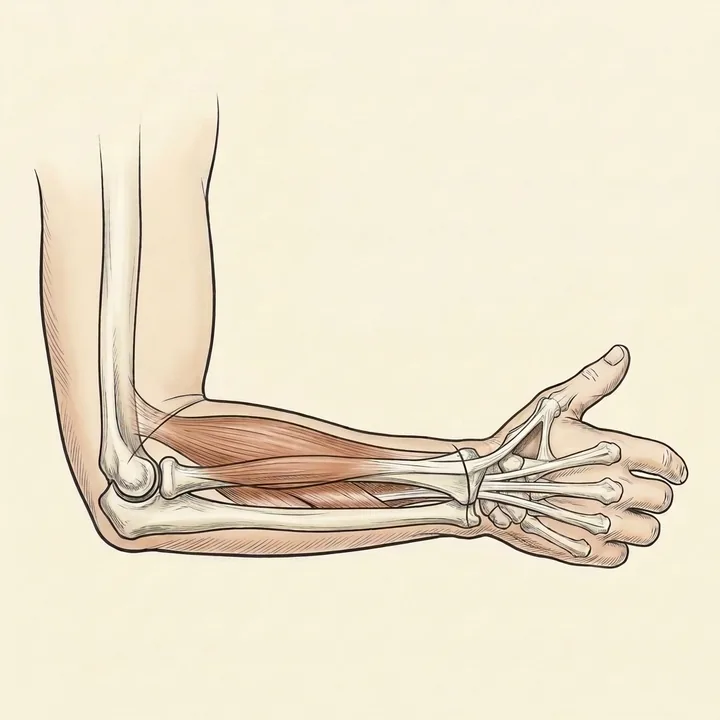
At the wrist joint space, in the depression between the radial artery and the tendon of the abductor pollicis longus, at the level of the wrist crease.
With the palm facing up, locate the point on the transverse wrist crease where the pulsation is felt.
Tendon of the flexor carpi radialis muscle, abductor pollicis longus muscle. Innervated by the lateral cutaneous nerve of the forearm and the radial nerve.
Perpendicular (vertical) insertion 0.2–0.3 cun, or 2 to 3 mm.
Medical application & myofascial correlation
Clinical synthesis
1. The Lung Meridian, Hand Tai Yin, is paired with the Hand Yang Ming and communicates with the Ren Mai. The points of the Large Intestine Meridian are commonly used to treat the sense organs. According to the therapeutic property of the five Shu points, this point is commonly used to treat the sense organs. 2. The heart governs blood circulation, and this is the Influential Point of the Vessels; it is therefore used to treat precordial pain. 3. The Tendinomuscular Meridian of the Hand Tai Yin "runs downward, gathers in the chest, and reaches the hypochondriac region," so it is indicated in the treatment of intercostal neuralgia.
Clinical practice indications
- 01Chronic obstructive pulmonary disease (COPD)
- 02Pulmonary emphysema
- 03Chronic bronchitis
- 04Cardiac arrhythmias
- 05Raynaud phenomenon
- 06Carpal tunnel syndrome
- 07Tenosynovitis of the radial styloid
- 08Respiratory tract disorders
- 09Bronchial asthma
- 10Circulatory disorders
- 11Occlusive peripheral arterial disease
- 12Raynaud disease
- 13Wrist disorders
Presenting symptoms & complaints
Classical tradition, channel actions & source
Classical therapeutic actions
- Tonifies the Lung and transforms Phlegm
- Promotes the descending function of the Lung
- Regulates and harmonizes the hundred vessels
- Activates the channel and relieves pain
- Tonifies and replenishes Lung Qi and Lung Yin
- Descends Lung Qi
- Promotes the circulation of Qi and Blood
- Opens the channel to relieve pain
Traditional indications (TCM)
Functional classification
Character etymology
Tai (太), great; Yuan (淵), deep well. Tai means abundance. At this point, the Qi of the meridian is abundant.
Layered tissue anatomy & needle biomechanics at LU 9
Cross-sectional technical schematic of perpendicular insertion (90°) (0.2–0.3 cun): superficial connective collagen coupling, intramuscular myofascial transduction, and deep neurovascular protection.
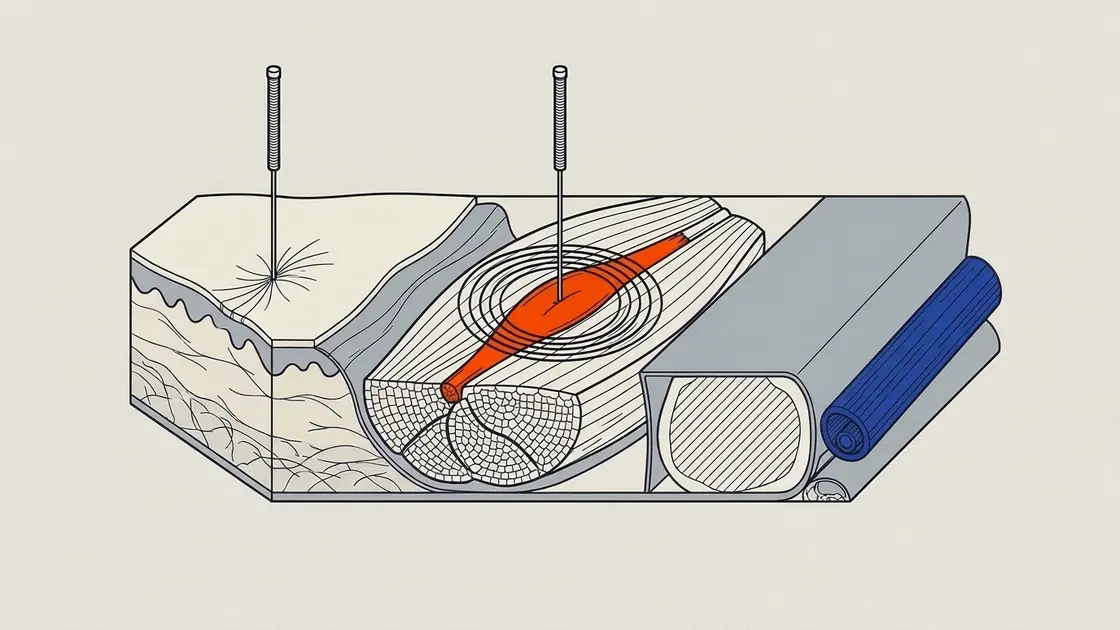
Dermal & fascial collagen coupling
A solid non-cutting filiform needle (0.25 mm rounded tip) enters via perpendicular insertion (90°), gently tenting loose areolar collagen fibers without slicing dermal vessels.
Myofascial spindle & Aδ / C transduction
Within the 0.2–0.3 cun target window at LU 9, mechanical coupling recruits intramuscular mechanoreceptors, increasing local micro-perfusion and releasing taut bands.
Strict anatomical safety floor
The deep fascial septum, bone cortex, and underlying neurovascular bundle or cavity define the strict anatomical boundary observed during physician needling at LU 9.
Clinical relations & channel protocols
Functional pairs & channel couplings
Immediate neighbors on the meridian

LU 9 in research
How many Library studies cite this point, since when, and with which designs and verdicts.
- Studies
- 5Library studies cite LU 9
- By year
- 20072019
- Verdict
- Strong2
- Moderate3
- Study designs
- RCT5
- Classical source
- Ling Shu
- Depth
- 0.2–0.3 cunPerpendicular
Each study counts once, under the most specific design it states. The verdict is the Library’s word for the strength of each study’s evidence.
See the numbers: LU 9 in research
| Year | Studies |
|---|---|
| 2007 | 1 |
| 2012 | 1 |
| 2015 | 1 |
| 2017 | 1 |
| 2019 | 1 |
Often appears with
Points the Library studies cite together with LU 9. It shows research practice, not a prescription.
- PC 64 studies in common
- LI 113 studies in common
- HT 73 studies in common
- ST 362 studies in common
- HT 22 studies in common
- HT 82 studies in common
- BL 132 studies in common
- PC 42 studies in common
Each filled mark stands for 5 studies; an open mark, for 1 to 4.
Related clinical reading
6Understand bronchial asthma — a chronic inflammatory airway disease that affects more than 300 million people worldwide, its mechanisms, diagnosis, and evidence-based treatments.
Understand childhood asthma — the pathophysiology of bronchial inflammation, age-stratified diagnosis, stepwise treatment, and how pediatric acupuncture can support complementary control.
Understand chronic bronchitis — a persistent inflammation of the lower airways associated with mucus hypersecretion, its pathophysiologic mechanisms, diagnosis, and evidence-based treatments.
Understand Raynaud disease — a vasomotor disorder that causes episodes of digital vasospasm in response to cold or stress, its pathophysiologic mechanisms, differential diagnosis, and evidence-based treatments.
Understand chronic obstructive pulmonary disease — the third leading cause of death worldwide, its mechanisms of pulmonary destruction, spirometric diagnosis, and evidence-based treatments.
Understand benign palpitations — the conscious perception of heartbeats that affects up to 16% of the population, their electrophysiologic mechanisms, how to distinguish them from dangerous arrhythmias, and evidence-based treatments.