Overview: Why Do Head and Neck Hurt Together?
Headache is one of the most common medical complaints worldwide, affecting about 50% of adults in any given year. What many do not realize is that many headaches — especially those with cervical tension — have a relevant component in neck structures, not only in the skull itself.
The trigeminocervical convergence explains this relationship: sensory neurons of the upper cervical region (C1-C3) converge with those of the trigeminal nerve in the trigeminal caudal nucleus, creating a "shared pain map." For this reason, tension in the upper trapezius can cause temporal pain, trigger points in the sternocleidomastoid can mimic sinusitis, and cervical osteoarthritis can provoke daily occipital headaches.
This article maps the most common origins of head and neck pain — from muscular trigger points to articular, neural, and vascular changes — and explains how the medical acupuncturist systematically approaches each one.
Trigeminocervical Convergence
C1-C3 cervical nerves and the trigeminal share neurons in the brainstem — this is why cervical pain "rises" to the head.
Multiple Simultaneous Origins
Muscular trigger points, cervical joint dysfunction, and a vascular component commonly coexist in the same patient.
Differential Diagnosis Is Essential
Not every headache is tension-type: identifying the correct origin determines effective treatment and rules out serious conditions.
Muscular Origins: Trigger Points That Cause Headache
Myofascial trigger points (TrP) are áreas of muscle hyperirritability — palpable nodules in taut bands — capable of producing referred pain at a distance. In the upper cervicothoracic region, different muscles refer pain to specific patterns in the head, creating clinical presentations that mimic other types of headache.
Recognizing these patterns is essential: a patient with "frontal migraine" who does not respond to triptans may actually have trigger points in the sternocleidomastoid that refer frontal and supraorbital pain — a condition that responds well to dry needling.
Muscles, Trigger Points, and Pain Patterns in the Head
| Muscle | TrP Location | Referred Pain Pattern | Typical Presentation |
|---|---|---|---|
| Upper trapezius | Upper border, between neck and shoulder | Temporal, retroauricular, occipital | Unilateral helmet-like pain, worsens with stress |
| Sternocleidomastoid (SCM) | Sternal and clavicular portion | Frontal, periocular, sinus, auricular | Mimics sinusitis or frontal migraine |
| Suboccipitals | Skull base, suboccipital triangle | Deep occipital, "inside the head" | Occipitonuchal pain on awakening |
| Splenius capitis | Middle third of the neck | Vertex, posterior temporal | Pain in the crown of the head when turning |
| Temporalis | Temporal fan | Supraorbital, temporal, upper teeth | Facial pain + dental sensitivity |
| Medial pterygoid | Pterygomandibular region | Mandibular, deep auricular | Deep pain in the ear + TMJ |
Upper Trapezius and Temporal Pain
The upper trapezius is the muscle most often involved in muscular headache. Its classic trigger point — on the anterior margin of the upper border of the muscle, halfway between the neck and the acromion — refers pain along the lateral neck, behind the ear, to the temporal region, and sometimes to the angle of the mandible. The result is a unilateral "helmet-like" pain that many patients describe as migraine, but without the typical autonomic phenomena.
The most common trigger is forward head posture, amplified by hours at the computer, driving, or on a phone. This posture progressively increases the mechanical load on the upper trapezius, which then works in constant shortening.
SCM and the Simulation of Sinusitis
The sternocleidomastoid (SCM) produces one of the most misleading referred-pain patterns in medicine. Trigger points in its sternal portion refer pain above the eye, on the cheek, and on the chin — exactly reproducing frontal or maxillary sinusitis. They can also cause ipsilateral lacrimation, conjunctival redness, and even nystagmus, mimicking cluster headache. The clavicular portion of the SCM refers deep pain to the ear and mastoid, mimicking otitis média.
Patients with years of "chronic sinusitis" refractory to otolaryngologic treatment deserve careful SCM evaluation. Palpating trigger points and reproducing the familiar pain confirms the diagnosis, and dry needling by the medical acupuncturist can relieve cases that persisted for years.
Articular and Structural Origins
Beyond the muscles, articular and bony structures of the upper cervical spine are common sources of headache. The cervical facet joints (the C2-C3 facets are the most relevant for headache), the atlantoaxial joint (C1-C2), and the temporomandibular joint (TMJ) contribute significantly to head and neck pain.
Cervicogenic Headache from C2-C3 Facet
Cervicogenic headache (CGH) is defined as a secondary headache whose origin is in cervical structures, most frequently the C2-C3 and C1-C2 facet joints. It accounts for 15-20% of chronic headaches. Pain typically begins in the neck or occiput and radiates to the forehead, eye, or ipsilateral ear, worsening with cervical movements and sustained postures.
Diagnostic criteria include: unilateral pain without side shift, triggered by neck movement or pressure on cervical points, reduced cervical range of motion, and abolition of pain with anesthetic block of the corresponding facets. Distinguishing this from migraine is clinically important because treatments differ.
Temporomandibular Disorder (TMD) and Temporal Headache
Temporomandibular disorder is an underestimated cause of temporal and retroauricular headache. The hypertonic masseter and temporalis muscles, frequently associated with bruxism and dental clenching, generate referred pain in the temporal region that mimics tension-type headache. In addition, the inflamed temporomandibular joint itself can refer pain diffusely throughout the face.
TMD, headache, and cervical pain are frequently linked: an estimated 50-70% of patients with chronic TMD also have headache. Integrated treatment — occlusal splint by the dentist, acupuncture of the masticatory muscles by the physician — often produces better results than treating each component alone.

Neural and Vascular Origins
Neural and vascular causes of headache range from benign primary conditions — such as migraine and tension-type headache — to medical emergencies. Understanding the pathophysiology guides both diagnosis and treatment.
Migraine: Vascular and Neuronal Mechanism
Migraine involves activation of the trigeminovascular system: trigeminal neurons innervate the meningeal blood vessels and, when activated, release vasoactive neuropeptides (CGRP, substance P) that cause vasodilation and neurogenic inflammation. The hyperexcitable córtex of the migraineur is the substrate that makes some individuals susceptible to this cycle.
Unilateral pulsatile pain, aggravated by physical exertion and accompanied by nausea and photophobia, lasts 4-72 hours. About 30% of patients have aura — transient focal neurologic symptoms preceding the pain. The frequent association with cervical tension is relevant: trapezius and SCM trigger points can trigger migraine attacks in susceptible patients.
Tension-Type Headache: The Most Common Type
Episodic tension-type headache is the most prevalent type, affecting up to 80% of people at some point in life. The pain is bilateral, pressing or tightening ("helmet-like"), of mild to moderate intensity, without worsening with routine physical activity. It does not present intense nausea or marked photophobia/phonophobia — which clinically distinguishes it from migraine.
Current understanding points to central and peripheral sensitization with dysfunction of the descending pain modulatory system. Cervicothoracic and pericranial muscle hypertonia, once thought to be the cause, is now seen as part of a feedback cycle: muscle tension → peripheral sensitization → central facilitation → more muscle tension.
Migraine
- Unilateral pulsatile pain.
- Aggravated by physical exertion.
- Accompanied by nausea and photophobia.
- Lasts 4-72 hours.
- About 30% of patients have aura, transient focal neurologic symptoms preceding the pain.
Tension-type headache
- Bilateral pain, pressing or tightening ("helmet-like").
- Mild to moderate intensity.
- No worsening with routine physical activity.
- No intense nausea.
- No marked photophobia or phonophobia.
Red Flags: When Headache Is an Emergency
The vast majority of headaches are benign, but some patterns require urgent investigation to rule out potentially lethal causes. Every physician — and every informed patient — should know the headache "red flags."
Headache Red Flags — Urgent Investigation
Thunderclap headache
Maximum intensity in less than 1 minute — suspect subarachnoid hemorrhage until proven otherwise.
Fever + neck stiffness
Suggestive of bacterial or viral meningitis — medical emergency.
New focal neurologic déficit
Weakness, aphasia, diplopia — suspect ischemic or hemorrhagic stroke.
Papilledema on examination
Indicates intracranial hypertension — tumor, venous sinus thrombosis, pseudotumor cerebri.
Progression over weeks
Progressively worsening headache over weeks — rule out neoplasm, chronic subdural hematoma.
Headache after head trauma
Even mild trauma — rule out epidural or subdural hematoma.
First severe headache after age 50
Suspect temporal (giant-cell) arteritis — cause of blindness if untreated.
Vertebral artery dissection (VAD)
Sudden occipital/cervical headache + Horner syndrome (ptosis, miosis) + vertebrobasilar symptoms (vertigo, ataxia, diplopia, dysarthria) — cervical manipulation and needling CONTRAINDICATED until investigation with CT angiography or MR angiography.
Clinical Evaluation and Differential Diagnosis
Headache diagnosis is primarily clinical, based on detailed history and physical examination. The ICHD-3 classification (International Classification of Headache Disorders) offers precise criteria for each type of primary and secondary headache.
Differential Diagnosis
Tension-Type Headache
Read more- Bilateral
- Pressure/tightness
- No intense nausea
- No worsening with activity
Migraine
Read more- Unilateral
- Pulsatile
- Nausea/vomiting
- Photo/phonophobia
- 4-72h
Cervicogenic Headache
Read more- Begins in the neck
- Precipitated by cervical movement
- Unilateral without side shift
GB-20, GV-16, BL-10 and local cervical points, as a therapeutic option
Cluster Headache
Read more- Periocular/temporal
- Ipsilateral autonomic features
- Duration 15-180 min
- Predominates in men
Temporomandibular Disorder
Read more- Temporal/preauricular pain
- TMJ click
- Bruxism
- Pain with mouth opening
ST-6, ST-7, GB-8, and temporal points for the masticatory musculature
Cervicogenic Headache
Cervicogenic headache is frequently underdiagnosed because it is mistaken for migraine or tension-type headache. The diagnosis requires showing that the headache originates in a cervical structure: it begins in the neck or occiput, is triggered or worsened by specific neck movements or pressure on the corresponding cervical points, and is unilateral without ever shifting sides. Cervical range of motion is typically reduced, especially ipsilateral rotation.
Diagnostic block of the C2-C3 facets with local anesthetic confirms the origin when the pain is abolished. Treatment includes acupuncture, physician-directed cervical mobilization (after excluding vertebral artery dissection — see red flags), and, in refractory cases, facet radiofrequency. Acupuncture at GB-20, GV-16, and BL-10 has a solid neurophysiologic basis: it stimulates descending pain inhibition in the trigeminal caudal nucleus, the same nucleus that processes cervicogenic pain.
Migraine
Migraine diagnosis is based on ICHD-3 criteria: at least 5 headache attacks lasting 4-72 hours, with at least 2 features (unilateral, pulsatile, moderate-to-severe, worsens with activity) and at least 1 accompanying symptom (nausea/vomiting or photo AND phonophobia). Migraine with aura adds reversible focal neurologic symptoms preceding the pain.
Identifying and managing triggers — stress, sleep deprivation, fasting, hormones, specific foods — is central to prevention. Cervical trigger points are physical triggers that are often overlooked. The medical acupuncturist can act in prevention; systematic reviews (Cochrane, Linde et al. 2016) suggest efficacy comparable to pharmacologic prophylaxis, with a more favorable adverse-event profile, although effect size varies across studies.
Temporomandibular Disorder
TMD encompasses disorders of the masticatory muscles, temporomandibular joints, and associated structures. Pain is typically preauricular, worsens in the morning (nocturnal bruxism) or at the end of the day (daytime clenching), and may radiate to the temporal region, ear, neck, and shoulder. Clicks or joint locking, difficulty fully opening the mouth, and tenderness on palpation of the masseter and temporalis complete the picture.
Integrated treatment is the most effective: the dentist provides an occlusal splint for joint protection and redistribution of occlusal forces; the medical acupuncturist treats muscle hypertonia by needling trigger points in the masseter, temporalis, and pterygoids, and uses systemic points for stress reduction and pain modulation. Comparative studies show that combining these approaches outperforms any single one in long-term outcomes.
Therapeutic Approach by Origin
Effective headache treatment depends on precise identification of the origin. A "one-treatment-fits-all-headaches" approach is inefficient and often frustrates both patient and physician. Diagnostic mapping allows the intervention to be individualized.
Protocol for Approaching Chronic Headaches
Investigation and Classification
Detailed history (duration, location, quality, precipitating factors, accompanying symptoms), 4-week headache diary, complete neurologic and musculoskeletal physical examination.
Treatment of Muscular Components
Dry needling of cervicothoracic and pericranial trigger points, postural correction guided by the physician, initial systemic acupuncture.
Approach to the Central Component
Acupuncture for central modulation (GB-20, LI-4, GV-20), stress and sleep management, review of triggers, preventive pharmacotherapy if indicated by the physician.
Maintenance and Prevention
Monthly maintenance sessions, cervical strengthening exercises, sleep hygiene, management of identified triggers.
Myth vs. Fact
Chronic headache is inevitable for anyone with genetic migraine.
Even patients genetically predisposed to migraine can reduce attack frequency and intensity. Treating modifiable factors — muscular trigger points, stress, sleep, posture — can, in some patients, bring chronic migraine (≥15 days/month) back to an episodic pattern (<15 days/month).
Do
- Identify the origin of the headache precisely in order to individualize the intervention.
- Keep a headache diary for 4 weeks during the investigation.
- Treat the modifiable factors: muscular trigger points, stress, sleep, and posture.
Avoid
- Cervical manipulation and needling when vertebral artery dissection is suspected, until investigation with CT angiography or MR angiography.
- Taking an analgesic and waiting it out in the face of a thunderclap headache.
- Prolonged self-medication, especially with analgesics and triptans, which can lead to medication-overuse headache.
- Effective headache treatment depends on precise identification of the origin.
- A "one-treatment-fits-all-headaches" approach is inefficient.
- Diagnostic mapping allows the intervention to be individualized.
Acupuncture in the Treatment of Headache and Cervicalgia
Acupuncture is one of the interventions with the best scientific evidence for primary headaches. The Cochrane Collaboration, in a systematic review of 22 studies (with more than 4,000 patients), concluded that acupuncture may be comparable to pharmacologic prophylaxis for migraine prevention, with a more favorable adverse-event profile.
In the head and neck, the mechanisms include: inhibition of the trigeminovascular system (CGRP), descending pain modulation in the trigeminal caudal nucleus, reduction of cortical hyperexcitability (a relevant mechanism in migraine), and resolution of muscular trigger points with normalization of cervicothoracic myofascial tension.
Acupuncture Points for Headache and Cervicalgia
| Point | Location | Main Indication | Mechanism |
|---|---|---|---|
| GB-20 (Fengchi) | Below the occipital, between SCM and trapezius | Cervicogenic headache, migraine | Inhibits trigeminal caudal nucleus, relaxes suboccipitals |
| GB-21 (Jianjing) | Top of shoulder, midway between neck and acromion | Trapezius tension, tension-type headache | Dissipates trigger points of the upper trapezius |
| LI-4 (Hegu) | Dorsum of the hand, between the 1st and 2nd metacarpals | Frontal, dental, facial headache | Systemic analgesia, central modulation |
| GV-16 (Fengfu) | Posterior midline of the neck, 1 cun above the hairline | Cervicalgia, suboccipital pain | Área of cervicotrigeminal convergence |
| BL-10 (Tianzhu) | Paravertebral on the nape, 1.3 cun lateral to GV-15 | Occipital headache, nuchal stiffness | Relaxes deep cervical extensors |
| ST-6 (Jiache) | Masseter, at the apex of the muscle | TMD, temporal headache | Needling of the hypertonic masseter |
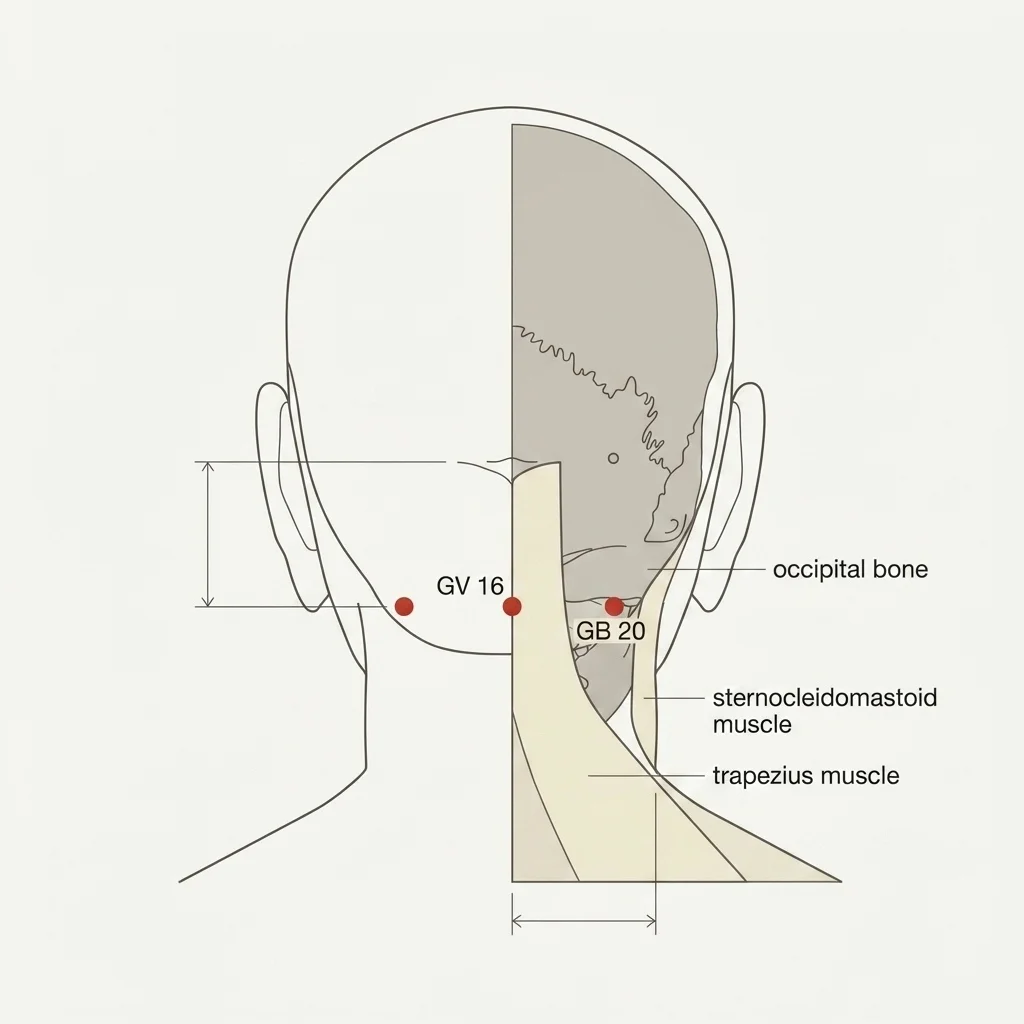
Below the occipital, between SCM and trapezius.
When to Seek Medical Help
Every new headache, headache that changes in pattern, or headache with any red flag deserves medical evaluation. Prolonged self-medication — especially with analgesics and triptans — can lead to medication-overuse headache (MOH), creating a vicious cycle of progressive worsening.
Frequently Asked Questions about Head and Neck Pain
The connection is anatomic and neurophysiologic. The sensory neurons of C1-C3 converge with those of the trigeminal nerve in the caudal nucleus, creating a "shared map" of pain. For this reason, tension in the trapezius can generate temporal pain, and trigger points in the sternocleidomastoid can mimic sinusitis or frontal migraine. About 20% of chronic headaches have a significant cervicogenic component.
Migraine: unilateral, pulsatile, 4-72 hours, with nausea and photo/phonophobia. Tension-type: bilateral, pressure/tightness, no intense nausea, does not worsen with activity. Cervicogenic: starts in the neck or occiput, worsens with neck movement, always unilateral on the same side. Accurate diagnosis requires medical evaluation — many patients have a mix of types.
Yes, frequently. Trigger points in the upper trapezius refer temporal and retroauricular pain; in the sternocleidomastoid they refer frontal and periocular pain (mimicking sinusitis); in the suboccipitals they refer pressure "inside the head." Studies suggest that dry needling of these trigger points can relieve headaches in some patients, although the quality of the evidence is limited.
It is a secondary headache originating in cervical structures (C2-C3 facet joints, suboccipital muscles, ligaments). Pain starts in the occiput or neck, radiates to the forehead or ipsilateral eye, and worsens with neck movement. Treatment includes acupuncture (GB-20, GV-16, BL-10), physician-directed cervical mobilization (after ruling out vertebral artery dissection — see red flags), and facet block in refractory cases.
The Cochrane review (Linde et al. 2016, 22 studies, ~4,985 patients) concluded that acupuncture may be comparable to pharmacologic prophylaxis for migraine in reducing attack frequency, with a more favorable adverse-event profile. Whether to substitute, maintain, or combine preventive medication is an individualized decision made by the physician. Proposed mechanisms involve modulation of the trigeminovascular system and cortical excitability.
For chronic headaches (≥15 days/month), the typical protocol is 10-15 initial sessions (1-2 per week), followed by monthly maintenance sessions. Most patients see progressive improvement from the 4th-6th session onward. Benefits tend to last — studies show sustained effects for 6-12 months after the initial cycle.
MOH occurs when analgesics, triptans, or combinations are used too frequently (more than 10-15 days per month). The brain adapts by downregulating its own analgesic systems, and stopping the medication causes rebound headache. The result is a near-daily, treatment-resistant headache. Management requires guided withdrawal of the overused medications and introduction of prophylaxis — where acupuncture plays an important role because it does not cause dependence.
Morning headache has several origins: nocturnal bruxism (masseter and temporalis trigger points active during sleep), sleep apnea (nocturnal hypoxia), arterial hypertension (occipital morning headache), suboccipital trigger points (activated by head position on the pillow), depression (morning headache is a classic symptom), and rebound headache (in patients who use analgesics at night). Medical evaluation is essential to identify the cause.
Yes — 50-70% of patients with chronic TMD also have headache. Hypertonic masseter and temporalis muscles refer temporal pain; the inflamed TMJ itself can cause diffuse facial pain. Ideal treatment is multidisciplinary: dentist (occlusal splint, occlusal adjustment) plus medical acupuncturist (muscular trigger points, ST-6, ST-7, GB-8). The combination outperforms any single approach.
Seek the emergency department for: sudden headache of maximum intensity ("worst of life" — possible subarachnoid hemorrhage), headache with fever and neck stiffness (meningitis), headache with new focal neurologic déficit (stroke), headache progressively worse over weeks (tumor, hematoma), and headache after head trauma. Consult an urgent physician for: new headache after age 50, headache that wakes you from sleep regularly, headache with double vision or visual loss.
Related Reading
Deepen your knowledge with related articles