Skip to content
Skip to content

BL-10 Tianzhu (天柱) — Celestial Pillar

BL-10
Tianzhu
天柱
Celestial Pillar
BL-10 Tianzhu — Celestial Pillar
Ponto Janela do CéuPonto importante para eliminar VentoPonto local do occipital e coluna cervicalCautionCabeça
Depth
00.4–0.6 cun3.0
Oblique insertion
Precautions
Deep or upward perpendicular insertion may enter the foramen magnum. Caution: do not needle in a superior direction.
Location (classical)
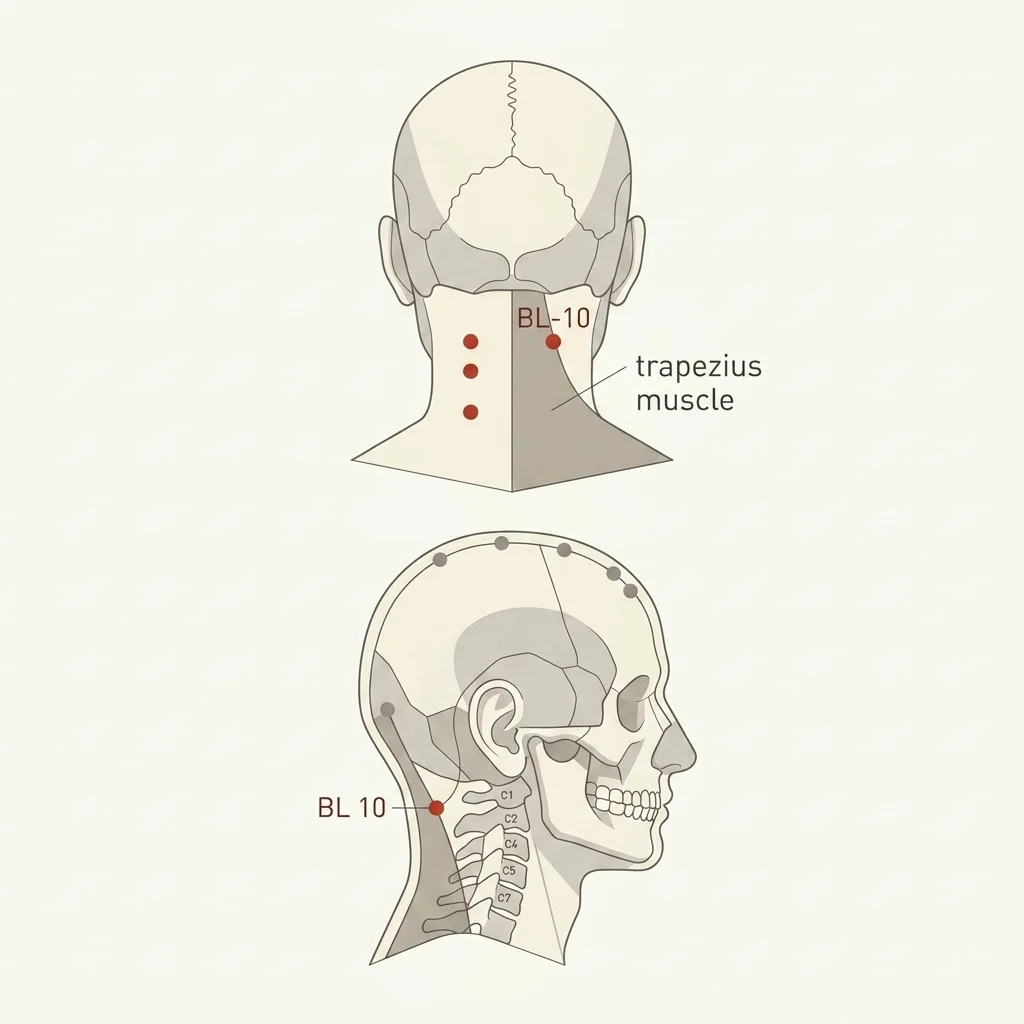
On the posterior region of the neck, at the level of the superior border of the spinous process of C2, in the depression lateral to the trapezius muscle.
How to find it (practical)
With the head in a neutral position, identify the level of the superior border of the spinous process of C2 and the lateral border of the trapezius. BL-10 lies in the depression lateral to the muscle at this level.
Anatomy
Trapezius and splenius capitis muscles. Innervated by the greater occipital nerve. Occipital artery and vein.
Needling
Perpendicular or slightly oblique insertion toward the spine, 0.4–0.6 cun.
Etymology
Tian (天), heaven; Zhu (注), pillar. In ancient times, the vertex was considered heaven and the cervical spine, Zhu Gu, the pillar of bone. The point lies lateral to the cervical spine.
CLASSICAL SOURCELing Shu

Clinical Relations

Adjacent Points on the Meridian

BL 10 in research

How many Library studies cite this point, since when, and with which designs and verdicts.

Studies
7Library studies cite BL 10
By year
20152026
Verdict
  • Strong2
  • Moderate4
  • Weak1
Study designs
  • Meta-analysis2
  • Systematic Review1
  • RCT2
  • Observational1
  • Other designs1
Classical source
Ling Shu
Depth
0.4–0.6 cunOblique

Each study counts once, under the most specific design it states. The verdict is the Library’s word for the strength of each study’s evidence.

See the numbers: BL 10 in research
YearStudies
20151
20161
20201
20231
20251
20262

Often appears with

Points the Library studies cite together with BL 10. It shows research practice, not a prescription.

  1. SI 144 studies in common
  2. GB 204 studies in common
  3. GB 214 studies in common
  4. LI 162 studies in common
  5. GB 122 studies in common
  6. LR 32 studies in common
  7. ST 21 study in common
  8. ST 361 study in common

Each filled mark stands for 5 studies; an open mark, for 1 to 4.

Related Articles

6

Translation and clinical dataProf. Dr. Hong Jin Pai — Meridians: Theory and Clinical Practice, 4th edition. CEIMEC · São Paulo.

CodingWHO Standard Acupuncture Point Locations (2008) for classical and extra points.