What Bell's Palsy Is
Bell's palsy is the most common cause of acute unilateral peripheral facial paralysis — accounting for 60–75% of all cases. It is characterized by sudden-onset weakness or paresis of all muscles on one side of the face, with no identifiable structural cause (idiopathic), but strongly associated with reactivation of herpes simplex virus type 1 (HSV-1) in the geniculate ganglion of the facial nerve.
Although 70–80% of patients recover spontaneously within 3–6 months, 20–30% develop incomplete recovery with functional and aesthetic sequelae: residual facial asymmetry, synkinesis (associated involuntary movements), and hemifacial contracture. Early initiation of treatment — pharmacological and with acupuncture — is the main determinant of a favorable outcome.
Limitations of Conventional Treatment Alone
The standard treatment for Bell's palsy includes oral corticosteroid (prednisolone) initiated within the first 72 hours, with dosing and duration defined by the attending physician. Concomitant use of antivirals (acyclovir/valacyclovir) has less robust evidence and a more restricted indication. This protocol improves the recovery rate — but a portion of patients still develop sequelae, a scenario in which acupuncture has been investigated as a complement.
Corticosteroid Alone vs. Corticosteroid + Acupuncture
| Corticosteroid + Antiviral | Corticosteroid + Antiviral + Acupuncture |
|---|---|
| Variable rate of complete recovery (literature) | Groups with acupuncture + corticosteroid showed higher rates in heterogeneous meta-analyses |
| Recovery time variable according to severity | Possible reduction in time with early EA in subanalyses |
| Predominantly anti-inflammatory effect | Preclinical studies suggest modulation of NGF/BDNF — clinical relevance under investigation |
| Synkinesis: limited therapeutic options | Reports of lower occurrence of synkinesis in guided protocols — preliminary evidence |
| Facial physical therapy typically initiated after the acute phase | Adjuvant acupuncture may be initiated early, under evaluation |
Craniofacial trigeminal divisions (V1, V2, V3) and facial sensory neuromodulation
The trigeminal ganglion maps facial sensation into three anatomical territories essential to distinguish paroxysmal neuralgia from TMJ, dental, or sinus pain.
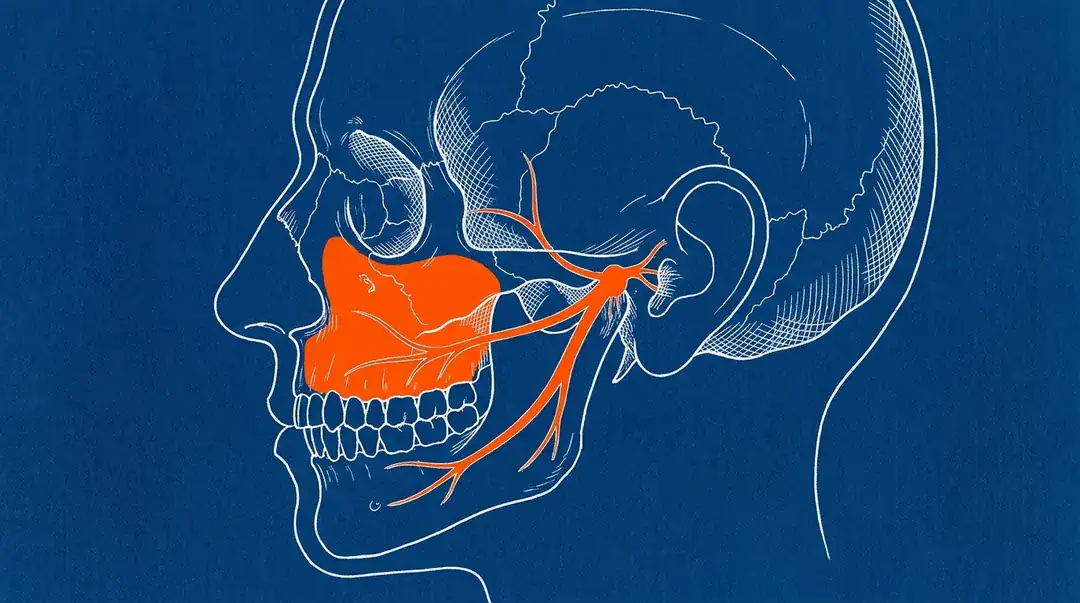
1. Maxillary territory (V2)
Supplies the cheek and upper dental arch, where light touch or breeze can trigger brief electric paroxysms.
2. Trigeminocervical convergence
Facial and upper cervical afferents meet in the spinal trigeminal nucleus, a key target for adjunctive modulation.
3. Mandibular branch (V3) & TMJ
Separates second-long neuropathic shocks along the jaw from continuous myofascial masseter and TMJ ache.
How Acupuncture Works in Bell's Palsy
The medical acupuncturist acts on two axes: reducing inflammation in the facial canal (where the facial nerve is compressed) and active stimulation of axonal regeneration of the facial nerve VII.
Mechanisms of Action in Bell's Palsy
Reduction of Edema in the Facial Canal
Needling of local points (ST-7, GB-2, SI-18) and point TE-17 (just at the stylomastoid foramen) reduces peripheral inflammation and the edema that compresses the facial nerve in the narrow bony canal
Stimulation of Axonal Regeneration
Electroacupuncture 2 Hz at facial points induces release of NGF (nerve growth factor) and BDNF, which promote growth of facial nerve axons toward the motor end plates of the paralyzed muscles
Maintenance of the Neuromuscular Junction
Electrical stimulation via electroacupuncture prevents disuse atrophy of paralyzed facial muscles and maintains the integrity of motor end plates while awaiting reinnervation
Prevention of Synkinesis
The 2 Hz stimulation pattern guides reinnervation toward the correct branches of the facial nerve, reducing aberrant reinnervation responsible for synkinesis (e.g., eye closure when smiling)
Anti-HSV Immune Modulation
Stimulation of ST-36 and LI-4 activates an immune response with NK cells and cytotoxic T cells that controls HSV-1 viral reactivation in the geniculate ganglion, limiting nerve injury
Main Facial Points
Scientific Evidence
Acupuncture for Bell's palsy is one of the most studied neurological indications, with an updated Cochrane review and multiple high-quality RCTs from China, Korea, and Europe.
Functional Recovery
- Higher recovery rate in acupuncture + corticosteroid groups in RCTs
- Possible reduction in mean recovery time
- House-Brackmann scale: improvement reported in RCTs
Possible Support for Nerve Regeneration
- Improvement in nerve conduction parameters in selected studies
- Increased NGF described in preclinical models
- EMG: early signs of reinnervation in some protocols
Prevention of Sequelae
- Reports of lower occurrence of synkinesis with EA — preliminary evidence
- Possible reduction of residual hemifacial contracture
- Paradoxical lacrimation ("crocodile tears") addressed by the protocol
Modern Approach: Phased Protocol
The protocol is adapted to the degree of paralysis (House-Brackmann scale) and to the time of evolution, with distinct approaches for the acute, subacute, and chronic sequelae phases.
Phased Protocol — Bell's Palsy
Acute phase (0–72 h): immediate start
Distal points only (LI-4, ST-36, GB-34): avoid excessive facial needling during the phase of maximum edema. Bilateral 2 Hz electroacupuncture at ST-36 for systemic NGF. Concurrent with corticosteroid.
Subacute phase (3rd–14th day): facial protocol
Introduction of ipsilateral facial points (ST-4, ST-6, ST-7, GB-14, BL-2, TE-17) with gentle stimulation; 2 Hz electroacupuncture pair TE-17–LI-4 ipsilateral. 5 sessions/week.
Recovery phase (2nd–8th week): intensification
2 Hz facial EA in all involved muscle groups; addition of GB-20, GV-14 for central neurological stimulation. 3 sessions/week.
Sequelae (after 3 months): rehabilitation
Specific protocol for synkinesis (inhibition points), hemifacial contracture (relaxation), and residual asymmetry (stimulation of deficient muscles). 1–2 sessions/week.
When to See a Medical Acupuncturist
Early initiation is fundamental: ideally within the first 72 h after onset of paralysis, simultaneous with the corticosteroid. But even late cases with sequelae respond to treatment.
Frequently Asked Questions
Frequently Asked Questions
As early as possible — ideally within the first 24–72 h. In the first 72 h, the protocol uses distal points (LI-4, ST-36) to stimulate systemic NGF without aggravating facial edema. From the 3rd–7th day, ipsilateral facial points are progressively introduced.
Yes, but with realistic expectations. Synkinesis and hemifacial contracture established for more than 2 years have a partial response. Functional and aesthetic improvement is achieved in 50–70% of chronic cases, rarely reaching complete symmetry. Early treatment is always superior to late treatment for prevention of sequelae.
Acute phase: 5 sessions/week in the first 2 weeks, then 3/week for 4–6 weeks. Total: 20–30 sessions for grade IV–VI cases. For grade II–III, 10–15 sessions are usually sufficient. Chronic sequelae require 20–40 sessions in a longer protocol.
Facial acupuncture uses very fine needles (0.20–0.25 mm gauge) and causes minimal discomfort. Post-session swelling is uncommon when performed by an experienced physician. Facial sessions typically last 20–30 minutes with the patient lying comfortably.
Yes, with an adapted protocol. Ramsay Hunt syndrome (zoster of the facial nerve with auricular vesicles) has a more guarded prognosis than idiopathic Bell's palsy — complete recovery in only 50–60% of cases. Acupuncture is initiated after control of acute zoster with antiviral, following a protocol similar to that of Bell's palsy but with additional treatment of facial nerve neuralgia.