EX-HN3 Yin Tang () — Yin Tang — Hall of Impression
At the glabella, midway between the medial ends of the eyebrows
Anatomical illustration acupuntura.com · verified against Focks (2008), WHO/WPRO (2008), and Pontos e Meridianos
Anatomical location
On the forehead, on the anterior midline, at the midpoint between the eyebrows. (Fig. 12.2)
Practical palpation guide
Sitting with the head erect, locate the point between the eyebrows, directly above the root of the nose.
Needling technique
0.3 to 0.5 cun · transverse
Medical application & myofascial correlation
Clinical practice indications
- 01Infantile convulsion
- 02Headache
- 03Congestion
- 04Conjunctival pain and edema
- 05Dizziness from postpartum hemorrhage
- 06Vertigo
- 07Rhinorrhea
- 08Epistaxis
- 09Insomnia
- 10Facial furuncle and trigeminal neuralgia
Presenting symptoms & complaints
Classical tradition, channel actions & source
Traditional indications (TCM)
Functional classification
Layered tissue anatomy & needle biomechanics at EX-HN3
Cross-sectional technical schematic of transverse insertion (~15°) (0.3–0.5 cun): superficial connective collagen coupling, intramuscular myofascial transduction, and deep neurovascular protection.
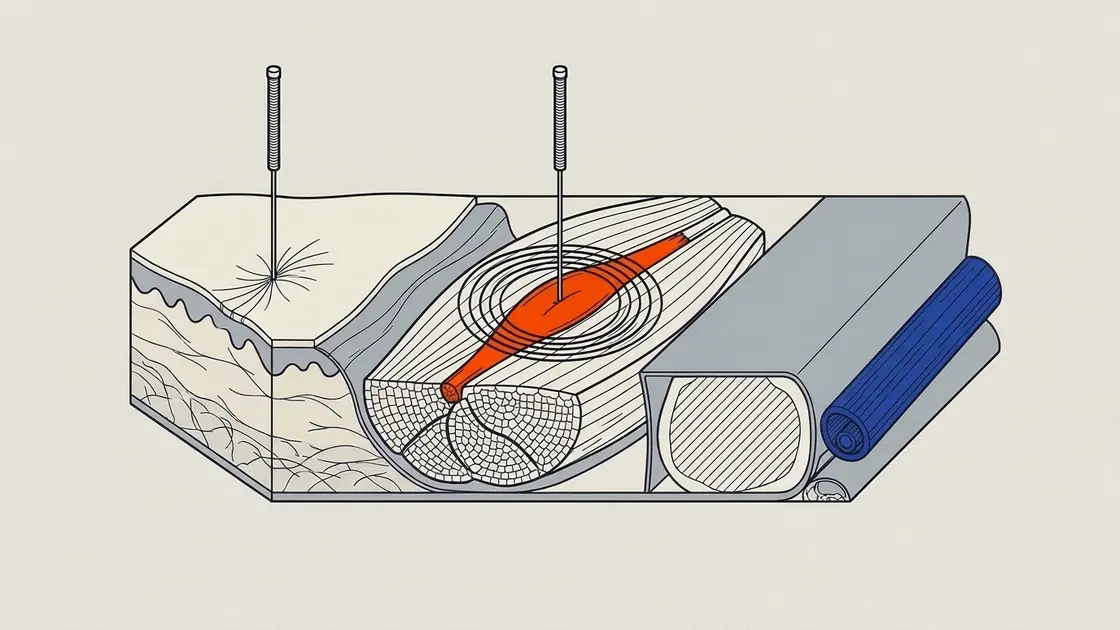
Dermal & fascial collagen coupling
A solid non-cutting filiform needle (0.25 mm rounded tip) enters via transverse insertion (~15°), gently tenting loose areolar collagen fibers without slicing dermal vessels.
Myofascial spindle & Aδ / C transduction
Within the 0.3–0.5 cun target window at EX-HN3, mechanical coupling recruits intramuscular mechanoreceptors, increasing local micro-perfusion and releasing taut bands.
Deep neurovascular clearance
Calibrated angle and depth keep the needle tip clear of periosteum and deep neurovascular trunks, pairing targeted stimulation with anatomical safety.
Clinical trial protocols using this point
- studies cite this point
- 45 studies cite this point
- RCTs
- 11 RCTs
- sham-controlled
- 29 sham-controlled
Top clinical conditions tested
Most frequent synergistic partner points
Clinical Protocols & Trials Using This Point
Clinical conditions in our trial library where EX-HN3 ranks among the core protocol points (5 mapped protocols).
EX-HN3 in research
How many Library studies cite this point, since when, and with which designs and verdicts.
- Studies
- 45Library studies cite EX-HN3
- By year
- 20042025
- Verdict
- Strong12
- Moderate28
- Limited4
- Weak1
- Study designs
- Meta-analysis13
- Systematic Review5
- RCT11
- Case Series1
- Narrative Review7
- Observational1
- Other designs7
- Classical source
- Zhen Jiu Da Cheng
- Depth
- 0.3–0.5 cunTransverse
Each study counts once, under the most specific design it states. The verdict is the Library’s word for the strength of each study’s evidence.
See the numbers: EX-HN3 in research
| Year | Studies |
|---|---|
| 2004 | 1 |
| 2008 | 1 |
| 2011 | 3 |
| 2012 | 2 |
| 2013 | 1 |
| 2014 | 1 |
| 2017 | 1 |
| 2018 | 4 |
| 2019 | 1 |
| 2020 | 3 |
| 2021 | 7 |
| 2022 | 5 |
| 2023 | 5 |
| 2024 | 7 |
| 2025 | 3 |
Often appears with
Points the Library studies cite together with EX-HN3. It shows research practice, not a prescription.
- SP 612 studies in common
- HT 712 studies in common
- PC 611 studies in common
- LR 310 studies in common
- GV 2010 studies in common
- LI 49 studies in common
- ST 369 studies in common
- KI 35 studies in common
Each filled mark stands for 5 studies; an open mark, for 1 to 4.